
¶ 101
Overview
Scope of the chapter. This chapter establishes the conceptual foundation for the treatise. It defines asset protection planning, distinguishes it from the unlawful conduct with which it is sometimes confused, explains why clients seek it, traces the doctrines from which it is built, examines how courts have responded to it, states what it can and cannot achieve, and sets out the conditions that a defensible plan must satisfy. Each later chapter applies the framework established here to a particular creditor, tool, jurisdiction or procedural setting.
Organization. The chapter proceeds in eight parts:
- the definition of asset protection planning and its four elements (¶ 110);
- the reasons clients seek protection (¶ 120);
- the legal pedigree of the doctrines on which planning relies (¶ 130);
- judicial attitudes, with a detailed examination of the two leading contempt decisions (¶ 140);
- the goals a plan can realistically achieve (¶ 150);
- the limits of protection (¶ 160);
- the three variables from which every plan is built (¶ 170); and
- the conditions of a defensible plan (¶ 180).
Terminology. The treatise uses the following terms in the senses given.
| Term | Meaning in this treatise |
|---|---|
| Client | The person whose assets are to be protected, whether or not that person is the settlor of a trust |
| Settlor | The person who creates and funds a trust; also called grantor, trustor or founder in some jurisdictions |
| Planner | Any professional who designs or implements a protective structure, including counsel, trustees and financial advisors |
| Creditor | A person who holds a claim against the client, as "claim" is defined in voidable-transactions law (see infra ch. 5) |
| Transfer | Any mode of disposing of or parting with an asset or an interest in an asset, as defined in voidable-transactions law. Unif. Voidable Transactions Act § 1(16) (Unif. L. Comm'n 2014) |
| Protective structure | A trust, entity, exemption or combination of them, established in whole or in part to limit creditors' access to assets |
| Self-settled trust | A trust of which the settlor is also a beneficiary |
| Offshore or foreign trust | A trust governed by the law of a jurisdiction outside the United States; for U.S. tax purposes the term has a separate statutory meaning (see infra ch. 42) |

¶ 110
Definition
Working definition. Asset protection planning is the arrangement of ownership, title, legal relationships and governing law, in advance of any claim, so that a person's wealth lies beyond the lawful reach of future creditors, while every disclosure, reporting and fiduciary obligation is met.
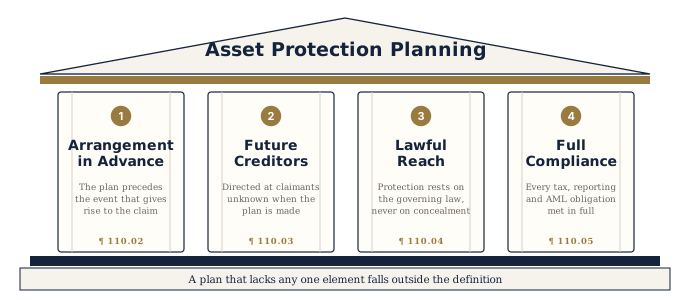
The definition is deliberately narrow. It excludes several activities that are sometimes described as asset protection, including the concealment of assets, transfers made after a claim has arisen, and structures that depend for their effect on non-reporting. Each of the four elements that follow serves to separate legitimate planning from one of those activities.
First element: arrangement in advance. The plan must precede the claim against which it is to operate. This element reflects the central rule of voidable-transactions law: a transfer made with intent to hinder, delay or defraud a creditor may be avoided by that creditor, and a transfer made without reasonably equivalent value while the debtor is insolvent may be avoided by creditors whose claims already exist (see infra chs. 6–7). A transfer made before any claim exists, by a solvent client, for legitimate purposes, is beyond the reach of those rules.
The word "claim" is construed broadly. A claim exists from the moment of the event that gives rise to it, whether or not the claimant has made a demand, filed suit or even become aware of the injury (see infra ¶ 510.01). The relevant question is therefore whether the plan preceded the event giving rise to the claim. The filing date of the lawsuit does not control.
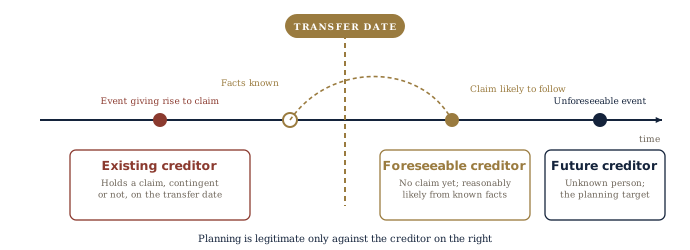
Second element: future creditors. The plan must be directed at claimants who are unknown when it is made. Existing creditors, and creditors whose claims are reasonably foreseeable from facts known on the transfer date, are protected by law. The planner must respect that protection, and a plan that does not respect it falls outside the definition.
Three categories of creditor must be distinguished, and the distinction recurs throughout the treatise.
| Category | Status on the transfer date | Treatment |
|---|---|---|
| Existing creditor | Holds a claim, including a contingent or unmatured claim | Protected against actual-intent and constructive transfers |
| Foreseeable creditor | Holds no claim but is reasonably likely to acquire one from facts then known | Protected against transfers aimed at that creditor; courts treat such transfers as made with intent to hinder that creditor |
| Future creditor | Unknown person whose claim will arise from events not foreseeable on the transfer date | Protected only against transfers made with actual intent to hinder future creditors generally; legitimate advance planning is the core of the discipline |
The line between a foreseeable creditor and a future creditor is the most contested in the field. Chapter 5 examines the authorities in detail (see infra ch. 5). For present purposes, the governing principle is that a client may plan against the general risks of life, profession and business, and may not plan against a particular risk that has already materialized or that the client is deliberately about to assume.
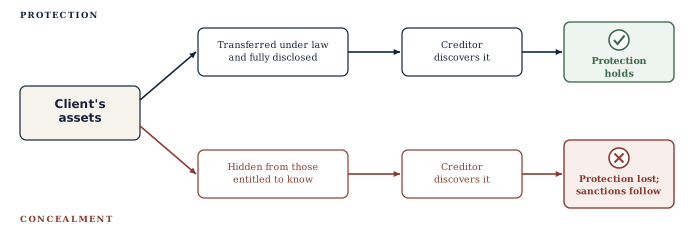
Third element: lawful reach. The objective of planning is to place assets where the law, properly applied, does not permit collection. Placing assets where a creditor cannot find them is concealment, and concealment is unlawful in every setting in which it matters: it is contempt when it defeats a court order, a crime when it defeats a bankruptcy trustee, and a badge of fraud when it is used to evade a creditor (see infra ¶ 110.06).
The distinction between protection and concealment is practical as well as legal. A concealed asset is protected only for as long as it remains undiscovered. Discovery, through litigation, bank reporting, exchange of tax information or the testimony of a former advisor, ends the protection and usually exposes the client to sanctions. A protected asset remains protected after discovery, because its protection rests on the governing law. The modern transparency regime (see infra chs. 43–45) has made concealment both more dangerous and less effective, and the treatise proceeds on the assumption that every asset will be discovered.
Fourth element: full compliance. Tax, information-reporting, beneficial-ownership and anti-money-laundering obligations must be met in full. A structure that depends on non-reporting adds penalty exposure to the creditor exposure it was meant to address, and the penalties often exceed the claims the structure was designed to resist.
The penalties for failure to report foreign trusts and accounts illustrate the point. A U.S. person who fails to report a transfer to a foreign trust is subject to an initial penalty equal to the greater of $10,000 or 35 percent of the gross reportable amount. 26 U.S.C. § 6677(a). The owner of a foreign grantor trust that fails to file its annual information return faces a penalty equal to the greater of $10,000 or 5 percent of the gross value of the trust assets treated as owned by that person. Id. § 6677(b). A willful failure to report a foreign financial account exposes the account holder to a civil penalty of up to the greater of $100,000, as adjusted for inflation, or 50 percent of the account balance, for each violation. 31 U.S.C. § 5321(a)(5)(C). The Supreme Court has held that the non-willful penalty applies once for each report and is not multiplied by the number of accounts. Bittner v. United States, 598 U.S. 85 (2023). The willful penalty is not so limited.
Related conduct distinguished. Asset protection planning must be distinguished from five forms of conduct with which it is sometimes conflated. The table summarizes the distinctions, and the paragraphs that follow explain them.
| Conduct | Defining feature | Legal consequence |
|---|---|---|
| Asset protection planning | Advance arrangement against future, unknown creditors, fully disclosed | Lawful |
| Voidable (fraudulent) transfer | Transfer made with intent to hinder, delay or defraud, or without reasonably equivalent value while insolvent | Avoidable at civil law; may support denial of a bankruptcy discharge; criminal under some state statutes (see infra ¶ 330.03) |
| Concealment | Hiding the existence or location of assets from a creditor, court or trustee | Contempt; in bankruptcy, a federal crime (18 U.S.C. § 152) |
| Tax evasion | Non-reporting or misreporting to avoid tax | Criminal (26 U.S.C. § 7201) |
| Money laundering | Transactions in the proceeds of specified unlawful activity | Criminal (18 U.S.C. §§ 1956–1957) |
| Sham arrangements | A structure whose formal terms do not reflect the parties' real arrangement | Disregarded by courts; the assets are treated as the client's own |
Voidable transfers. The voidable transfer is the closest relative of legitimate planning, and the difference between them is principally one of timing and intent. The same trust, funded with the same assets, may be a legitimate plan when funded at a time of financial stability and a voidable transfer when funded after a claim has arisen. The civil consequence is avoidance; in some states the conduct is also criminal (see infra ch. 7).
Concealment. Concealment differs in kind. It operates by defeating the creditor's knowledge of the asset. It is unlawful whenever the client is under a duty to disclose, as in discovery, in bankruptcy schedules and in response to a court order. In bankruptcy, the knowing and fraudulent concealment of property of the estate is a federal crime. 18 U.S.C. § 152(1).
Tax evasion and money laundering. These are crimes in their own right and are relevant to asset protection because some structures marketed as protective depend on non-reporting, and because a structure funded with criminal proceeds offers the planner no protection against prosecution for laundering. Source-of-wealth diligence (see infra ch. 45) addresses the second risk.
Sham arrangements. A structure whose formal terms do not reflect the real arrangement between the client and the nominal owner will be disregarded. A trust under which the trustee in practice follows every instruction of the settlor, or an entity whose assets the client treats as personal, may be held to be the client's alter ego, a nominee arrangement or a sham. The doctrines vary by jurisdiction and are examined in chapters 15, 18 and 30 (see infra chs. 15, 18, 30). The practical rule is that the form of the structure must be respected in operation as well as in the documents.

¶ 120
Why Clients Seek Protection
Overview. Clients come to asset protection for different reasons, and the reason shapes the plan. A surgeon worried about a verdict above policy limits needs a different structure from a founder with personal guarantees, a family exposed to an unstable home government or parents concerned about a child's marriage. The planner's first task is to identify which of the following concerns is dominant, because the dominant concern determines the dominant creditor class in the Threat Matrix (see infra ch. 2).
The litigation environment. Several features of the American civil justice system combine to create exposure that has few parallels elsewhere.
- Civil jury trial. The right to a jury in most civil actions for damages places the assessment of liability and damages with lay fact-finders, whose awards are difficult to predict.
- Contingency fees. Plaintiffs' counsel can finance litigation against defendants of means without cost to the plaintiff, and counsel's return depends on the size of the recovery.
- Broad discovery. Pretrial discovery permits extensive inquiry into a defendant's conduct, documents and, after judgment, assets.
- Joint and several liability. In states that retain it, a defendant found partly at fault may be required to pay the whole of a judgment if co-defendants cannot pay.
- Punitive damages. Awards intended to punish are frequently uninsurable as a matter of public policy or excluded by policy terms.
The combined effect is that a defendant with substantial assets may face a claim that exceeds insurance coverage without any personal wrongdoing. Asset protection responds to that exposure in the way insurance does: it limits the consequences of an event that has not yet occurred.
Professionals. Physicians, lawyers, accountants, architects, engineers and financial advisors face personal liability for professional negligence that cannot be eliminated by practicing through an entity. A professional corporation or limited liability company may shield one professional from the malpractice of another, but it does not shield the professional from liability for the professional's own acts (see infra ch. 15). Professional clients therefore typically present C2 as their dominant creditor class, with regulatory claims as a secondary concern (see infra ch. 51).
Business owners, executives and guarantors. Owners of operating businesses face exposure from three sources: personal guarantees of business debt, which make business creditors personal creditors (see infra ¶ 410.02); liability for the owner's own conduct in the business, including statutory liability imposed on responsible officers for unpaid payroll taxes and wages; and veil-piercing claims where the entity's separateness has not been respected. Executives and directors face claims by shareholders, regulators and, after insolvency, bankruptcy trustees. For these clients, C1 and C6 are frequently as important as C2.
Family risk. Divorce remains the most common cause of the division of accumulated family wealth. Planning against that risk takes two forms, which the law treats very differently.
- Protecting descendants. Parents and grandparents who make gifts or bequests through discretionary and spendthrift trusts can protect those assets from the future spouses of their descendants. Such planning is uncontroversial and is the oldest form of asset protection (see infra ¶ 130.02).
- Protecting one spouse from the other. Planning by a married person against that person's own spouse is closely scrutinized. Courts may treat transfers made during marriage, or in contemplation of divorce, as a dissipation of marital assets, and some domestic asset protection trust statutes make the trust ineffective against a spouse's property claims (see infra ch. 9).
The prenuptial or postnuptial agreement remains the primary tool for allocating property between spouses, and protective structures should be coordinated with it.
Regulatory and sovereign risk. For many international families the principal threat comes from a state. The home government may expropriate property, impose exchange controls, bring politically motivated prosecutions or fail to protect the family from criminal threats such as kidnapping and extortion. For these clients, protection is a matter of moving assets and governance beyond the reach of an unreliable legal system, and the dominant creditor class is a foreign sovereign (see infra ¶ 450.08).
For U.S. clients the federal government is a creditor with tools no private creditor holds: the federal tax lien, administrative levy, criminal restitution and forfeiture (see infra ch. 10). As the Threat Matrix shows, protection against the federal government rests principally on compliance (see infra ¶ 210.06).
Succession and continuity. Protection also serves the next generation. A discretionary trust protects its beneficiaries from their own creditors, their own divorces and their own imprudent decisions. It can also provide professional management for beneficiaries who are young, disabled or unsuited to managing wealth. A structure that provides for succession to the management of a family business protects the business from disruption on the death or incapacity of its founder. These purposes are legitimate in their own right. They also strengthen the protective character of the plan, because a structure with substantial independent purposes is more credible to a court than one whose only purpose is to defeat creditors (see infra ¶ 150.04).
Peace of mind. Many clients describe their objective as security or peace of mind. That objective is legitimate, but it should not be allowed to obscure the specific risks the plan must address. The planner should translate a general wish for security into an identification of the client's dominant and secondary creditor classes before any structure is designed.

¶ 130
The Legal Pedigree
Overview. Asset protection is sometimes described as a recent invention of offshore financial centers. The description is inaccurate. The discipline is built from doctrines that the common law and American legislatures adopted long ago, for reasons of public policy that remain current: the freedom of donors to set the terms of their gifts, the protection of families from destitution, the encouragement of enterprise through limited liability and the security of retirement savings. What is recent is the extension of those doctrines to trusts of which the settlor is a beneficiary. This paragraph traces each line of development. Later chapters examine each in detail.
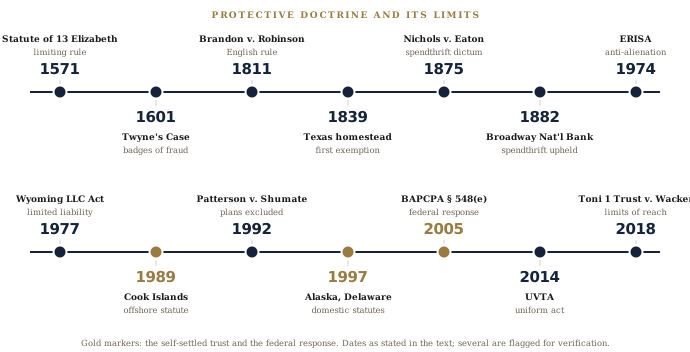
Spendthrift trusts. A spendthrift provision restrains both voluntary and involuntary alienation of a beneficiary's interest in a trust, so that the beneficiary cannot assign the interest and the beneficiary's creditors cannot reach it before distribution.
The English rule. English law has long refused to enforce a direct restraint on the alienation of an equitable life interest. Brandon v. Robinson (1811) 18 Ves. Jun. 429, 34 Eng. Rep. 379 (Ch.). English settlors achieved a similar result through the protective trust, under which the beneficiary's interest terminates on attempted alienation or bankruptcy and is replaced by a discretionary trust for the beneficiary and the beneficiary's family. The device was later codified. Trustee Act 1925, 15 & 16 Geo. 5 c. 19, § 33 (Eng.).
The American rule. American courts departed from the English position in the late nineteenth century. In Nichols v. Eaton, 91 U.S. 716 (1875), the Supreme Court upheld a testamentary trust under which a son's right to income ceased on his bankruptcy and the trustees acquired discretion to apply income for the benefit of his family. Writing for the Court, Justice Miller went further and reasoned that a donor may give the income of property to a beneficiary in a manner that places it beyond the reach of the beneficiary's creditors, because the creditors have no claim to property the debtor never owned. That reasoning was dictum, but it was widely adopted. The Supreme Judicial Court of Massachusetts relied on it in Broadway Nat'l Bank v. Adams, 133 Mass. 170 (1882), which upheld a direct spendthrift restraint against the beneficiary's creditor and became the leading state authority.
Criticism and acceptance. The American rule was criticized from the start. John Chipman Gray argued that spendthrift trusts allowed the wealthy to live in comfort while their creditors went unpaid. John Chipman Gray, Restraints on the Alienation of Property (2d ed. 1895). The criticism did not prevail. The Restatement (Second) of Trusts recognized the validity of spendthrift restraints, subject to exceptions for certain creditors. Restatement (Second) of Trusts §§ 152, 157 (Am. L. Inst. 1959). The Restatement (Third) of Trusts and the Uniform Trust Code continue that recognition. Restatement (Third) of Trusts §§ 58–59 (Am. L. Inst. 2003); Unif. Tr. Code §§ 502–503 (Unif. L. Comm'n 2000) (amended 2005). Today nearly every state enforces spendthrift provisions in trusts created by one person for the benefit of another (see infra ch. 17).
The policy. The policy justification has remained constant since Nichols. The donor owns the property and may set the terms on which it is given. A creditor of the beneficiary has no claim to the donor's property, and suffers no wrong when the donor declines to make it available. That justification has no application where the donor and the beneficiary are the same person, and that is why the self-settled trust developed separately (see infra ¶ 130.08).
Exemptions. Every state exempts certain property of an individual debtor from execution by creditors. The exemptions reflect a legislative judgment that a debtor and the debtor's family should not be reduced to destitution, and that some assets are better protected for the family's benefit than applied to debts.
Homestead. The homestead exemption is the oldest and most significant. The Republic of Texas is generally credited with the first homestead exemption, enacted in 1839. See Tex. S. Res. 827, 80th Leg., R.S. (2007); Tex. State Hist. Ass'n, Homestead Law, Handbook of Texas Online. The exemption spread rapidly through the states during the nineteenth century. Its amount varies enormously. Some states protect a homestead without limit on value, subject to limits on acreage, while others protect only a modest sum. Florida's constitutional homestead protection is the most frequently litigated. Fla. Const. art. X, § 4. The Florida Supreme Court has held that the protection applies even where the debtor acquired the homestead with nonexempt funds for the purpose of hindering creditors, subject only to the exceptions stated in the constitution. Havoco of Am., Ltd. v. Hill, 790 So. 2d 1018 (Fla. 2001).
Other exemptions. States also exempt wages in part, life insurance cash values and proceeds, annuities, retirement accounts, tools of a trade, vehicles and household goods, in widely varying amounts (see infra ch. 12).
Federal limits. Congress has limited the effect of state exemptions in bankruptcy. The Bankruptcy Abuse Prevention and Consumer Protection Act of 2005 capped the homestead exemption available to a debtor who acquired the homestead within the 1,215 days before the petition, 11 U.S.C. § 522(p), and reduced the exemption to the extent the homestead was acquired with nonexempt property converted with intent to hinder, delay or defraud creditors within ten years before the petition, id. § 522(o). The caps are adjusted for inflation. Id. § 104.
Limited liability. Limited liability is the most important asset protection device in commercial life, although it is rarely described in those terms. The general incorporation statutes of the nineteenth century allowed investors to commit capital to an enterprise without exposing their other assets to its debts. The limited partnership, introduced in the United States by New York in 1822, extended the same protection to passive partners. The limited liability company, first authorized by Wyoming in 1977, combined limited liability for all members with the tax treatment of a partnership, and is now the dominant form for closely held businesses and investment vehicles (see infra chs. 15–16, 26).
The charging order, which confines the creditor of a partner or member to the distributions made on the debtor's interest, originated in the English Partnership Act 1890, 53 & 54 Vict. c. 39, § 23 (Eng.), and entered American law through the Uniform Partnership Act of 1914, § 28. Its extension to limited liability companies, and the question whether it is the creditor's exclusive remedy, are among the most active areas of asset protection law (see infra ch. 16).
Tenancy by the entirety. Tenancy by the entirety is a form of co-ownership available only to married couples, in which each spouse holds the whole property and neither may alienate it unilaterally. In the states that retain the estate in its traditional form, a creditor of one spouse alone cannot reach entireties property. The Supreme Court of Hawaii explained the rule as protecting the marital unit and the expectations of creditors who could have required both spouses to sign. Sawada v. Endo, 561 P.2d 1291 (Haw. 1977). Roughly half the states recognize the estate, with significant variation in its incidents (see infra ch. 11). The protection does not extend to joint creditors of both spouses. It also does not defeat a federal tax lien against one spouse, which attaches to that spouse's interest in entireties property. United States v. Craft, 535 U.S. 274 (2002).
Retirement plans. Federal law protects most employer-sponsored retirement savings from creditors. The Employee Retirement Income Security Act of 1974 requires qualified pension plans to provide that benefits may not be assigned or alienated. 29 U.S.C. § 1056(d)(1); see also 26 U.S.C. § 401(a)(13). The Supreme Court held that this anti-alienation provision is a restriction enforceable under applicable nonbankruptcy law, so that a debtor's interest in an ERISA-qualified plan is excluded from the bankruptcy estate. Patterson v. Shumate, 504 U.S. 753 (1992). Individual retirement accounts were later held exemptible in bankruptcy, Rousey v. Jacoway, 544 U.S. 320 (2005), and Congress then protected retirement funds generally, subject to an inflation-adjusted cap for IRAs. 11 U.S.C. § 522(b)(3)(C), (n). Inherited IRAs, however, are not "retirement funds" and are not protected by the federal exemption. Clark v. Rameker, 573 U.S. 122 (2014) (see infra ch. 13).
The limiting rule. Alongside these protective doctrines runs a limiting rule of equal antiquity: a debtor may not transfer property to defeat existing creditors. The rule derives from the Fraudulent Conveyances Act 1571, 13 Eliz. c. 5 (Eng.), and Twyne's Case (1601) 3 Co. Rep. 80b, 76 Eng. Rep. 809 (Star Chamber). It survives in the Uniform Voidable Transactions Act and in the Bankruptcy Code (see infra chs. 6–8). Every protective doctrine described above operates subject to it. A gift to a spendthrift trust for a child, a contribution to a retirement plan or an investment in a homestead may each be avoided if made to defeat a creditor who already holds a claim, subject to the special rules some states apply to exempt property.
The self-settled trust. The doctrines described so far protect property given by one person for the benefit of another, property the law exempts for reasons of family welfare, and capital committed to an enterprise. None of them allowed a person to place the person's own wealth in a trust for the person's own benefit and beyond the reach of the person's own creditors. The common law consistently refused that result.
The traditional rule. Where a settlor creates a trust for the settlor's own benefit, the settlor's creditors may reach the maximum amount that the trustee could distribute to the settlor, notwithstanding a spendthrift provision. Restatement (Second) of Trusts § 156 (Am. L. Inst. 1959); Restatement (Third) of Trusts § 58(2) (Am. L. Inst. 2003); Unif. Tr. Code § 505(a)(2) (Unif. L. Comm'n 2000) (amended 2005). The rule follows from the policy described in ¶ 130.02: the justification for spendthrift protection, that the donor may set the terms of the donor's own gift, has no force when the donor makes the gift to the donor.
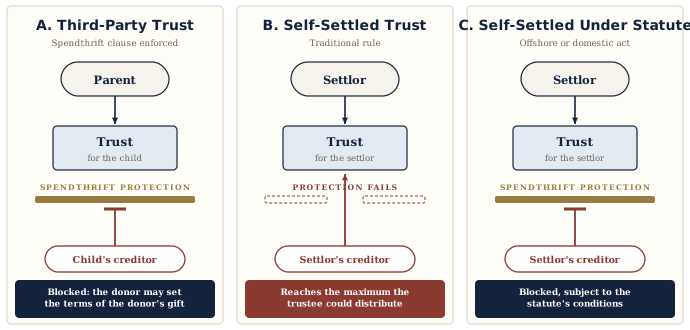
The offshore statutes. The first statutory departure from the rule came from offshore jurisdictions. The Cook Islands enacted its International Trusts Act in 1984 and, by amendment in 1989, added provisions designed to protect self-settled trusts against foreign creditors, including restrictions on the recognition of foreign judgments, short limitation periods and a heightened burden of proof for creditors. International Trusts Amendment Act 1989, No. 23 (Cook Is.), § 6 (inserting §§ 13A–13I). Other jurisdictions followed, including Belize in 1992 and Nevis in 1994. Trusts Act, No. 5 of 1992 (Belize), now Cap. 202; Nevis International Exempt Trust Ordinance, Cap. 7.03(N) (in force May 1, 1994). Those statutes are examined in chapters 22 through 24 (see infra chs. 22–24).
The domestic statutes. In 1997 Alaska and Delaware enacted the first domestic statutes permitting self-settled spendthrift trusts. Delaware's statute permits a settlor to retain specified interests and powers in a "qualified disposition" while protecting the trust from the settlor's creditors, subject to exceptions and a limitation period. Del. Code Ann. tit. 12, §§ 3570–3576. Nevada, South Dakota, Wyoming and other states followed, and a substantial number of states now permit such trusts in some form. Wyoming's qualified spendthrift trust statute is examined in chapter 26 and Delaware's statute in chapter 27 (see infra chs. 26–27).
The federal and judicial response. Congress responded in 2005 by adding section 548(e) to the Bankruptcy Code, which permits a bankruptcy trustee to avoid transfers to self-settled trusts made with actual intent to hinder, delay or defraud creditors within ten years before the petition. 11 U.S.C. § 548(e)(1). Courts have also limited the reach of domestic statutes over residents of other states. The Alaska Supreme Court held that Alaska could not, by statute, give its own courts exclusive jurisdiction over voidable-transfer claims against Alaska trusts so as to bind courts of other states. Toni 1 Tr. v. Wacker, 413 P.3d 1199 (Alaska 2018). The resulting questions of choice of law and full faith and credit are examined in chapters 18 and 35 (see infra chs. 18, 35).

¶ 140
Judicial Attitudes
Overview. Courts distinguish sharply between planning undertaken in advance of any claim and structures used to frustrate an existing creditor or court order. The first is generally respected, and the use of trusts, exemptions and entities for protective purposes is not in itself a ground for disregarding them. The second provokes a strong reaction, and courts have used the full range of their powers, including civil contempt and incarceration, against settlors who invoked protective structures after liability arose. The two leading decisions, FTC v. Affordable Media, LLC and In re Lawrence, are examined in detail below because they define the practical limits of offshore planning for U.S. clients.
Respect for advance planning. Courts routinely enforce spendthrift trusts, exemptions, entity separateness and retirement-plan protections against creditors, even where the debtor was aware of the protective effect when the arrangement was made. See, e.g., Broadway Nat'l Bank v. Adams, 133 Mass. 170 (1882) (spendthrift trust); Patterson v. Shumate, 504 U.S. 753 (1992) (ERISA plan); Havoco of Am., Ltd. v. Hill, 790 So. 2d 1018 (Fla. 2001) (homestead); Hanson v. First Nat'l Bank in Brookings, 848 F.2d 866, 868 (8th Cir. 1988) (conversion of nonexempt to exempt property on the eve of bankruptcy, "without more," does not defeat the exemption). But see Norwest Bank Neb., N.A. v. Tveten, 848 F.2d 871 (8th Cir. 1988) (discharge denied where extrinsic evidence showed intent to defraud in a conversion of about $700,000 into contracts exempt without dollar limit). The protective motive, standing alone, does not render a transfer voidable; the question is whether the transfer was made with intent to hinder, delay or defraud a creditor, which in turn depends on the creditor's status and the debtor's financial condition at the time (see infra ch. 7).
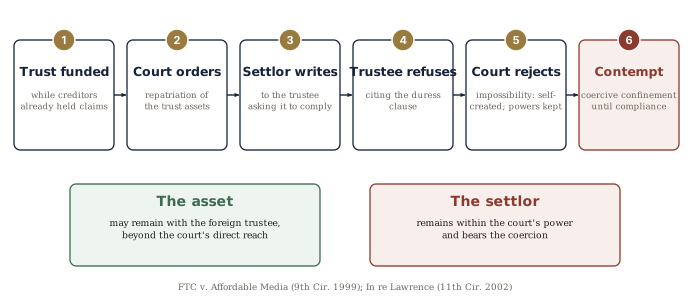
FTC v. Affordable Media, LLC. FTC v. Affordable Media, LLC, 179 F.3d 1228 (9th Cir. 1999), is the leading decision on the impossibility defense in the offshore-trust context.
Facts. Michael and Denyse Anderson operated a telemarketing business through Affordable Media, LLC, which sold investors "media units" in late-night television product promotions, promising returns of 50 percent within 60 to 90 days. The Federal Trade Commission alleged that the venture was a Ponzi scheme. In July 1995, some years before the FTC action, the Andersons had settled an irrevocable trust under Cook Islands law, naming themselves and a Cook Islands trust company, AsiaCiti Trust Limited, as co-trustees and themselves as protectors. 179 F.3d at 1232. Their involvement with the media-unit venture began after April 1997. Id. at 1231. The trust contained a duress provision under which a trustee resident where an event of duress occurred would cease to act, leaving control with the foreign trustee, which would decline to repatriate the assets. Id. at 1232; id. at 1239 n.9.
Proceedings. The district court entered a preliminary injunction requiring the Andersons to repatriate assets held for their benefit outside the United States. The Andersons wrote to the Cook Islands trustee instructing it to repatriate the trust assets. The trustee treated the order as an event of duress, removed the Andersons as co-trustees and declined to repatriate. The Andersons asserted that compliance was impossible. The district court held them in civil contempt and ordered them incarcerated.
Holding. The Ninth Circuit affirmed. Once the FTC showed by clear and convincing evidence that the Andersons had violated a specific and definite order, the burden shifted to the Andersons to demonstrate why they were unable to comply. The Andersons were required to show "categorically and in detail" why compliance was impossible. 179 F.3d at 1241. The court held that the Andersons had not carried that burden. It relied in particular on the Andersons' position as protectors, which carried affirmative powers to appoint new trustees and to certify conclusively whether an event of duress had occurred, and on their attempt to resign as protectors once the FTC disclosed that role. Id. at 1242–43 & n.13. The court also expressed doubt that a party could rely on an impossibility that was the intended result of the party's own planning, while leaving that question "for another day." Id. at 1239–40.
Lessons. The decision carries four lessons for planners.
- Timing. The trust was settled in 1995, before the venture began, but the court described the Andersons' "history of spiriting their commissions away to a Cook Islands trust." Id. at 1236. The transfers that mattered were made while investors' claims were accruing. The investors were existing creditors. A structure funded at T0 would have presented a materially different case.
- Retained powers. The Andersons' protector powers undermined their claim that they lacked control. A settlor who retains, directly or through a compliant agent, the power to remove trustees, change the governing law or direct distributions will find it difficult to establish impossibility (see infra ch. 30).
- Burden. The burden of proving impossibility rests on the contemnor and is demanding. Assertions that compliance is impossible, supported only by the trust instrument, will not satisfy it.
- Coercion. The court's power over the settlor's person was decisive. Whatever protection the trust gave the assets, the Andersons were taken into custody on June 17, 1998, and were released on December 22, 1998, with the district court finding that they remained in contempt. Id. at 1233 & n.3.
In re Lawrence. Lawrence v. Goldberg (In re Lawrence), 279 F.3d 1294 (11th Cir. 2002), is the leading decision on the duration of coercive incarceration and on the treatment of self-settled offshore trusts in bankruptcy.
Facts. Stephan Jay Lawrence, a Florida resident, was involved in an arbitration with Bear, Stearns & Co. In January 1991 Lawrence settled an offshore trust governed by the law of Mauritius, with an estimated value of $7 million. Two months later an arbitration award of $20.4 million was entered against him. 279 F.3d at 1296. A 1993 amendment made the settlor's powers unexercisable under duress and ended his life interest on bankruptcy, and in March 1995 the trustees declared Lawrence an "excluded person." Id.
Proceedings. Lawrence filed a voluntary bankruptcy petition in June 1997. As a discovery sanction, the bankruptcy court entered a default judgment that held the trust governed by Florida law, despite its choice of Mauritius law, and held the trust to be property of the estate. It then ordered Lawrence to turn over the trust assets. Lawrence asserted that compliance was impossible because he had been excluded as a beneficiary and the trustees had ignored his attempt to appoint the bankruptcy trustee as trustee. The bankruptcy court found that he controlled the trust through his retained powers to remove and appoint trustees and to add and exclude beneficiaries, held him in civil contempt on September 8, 1999, and ordered him incarcerated on October 5, 1999. Id. at 1297. The district court affirmed. In re Lawrence, 251 B.R. 630 (S.D. Fla. 2000).
Holding. The Eleventh Circuit affirmed. It held that Lawrence had not shown that compliance was impossible, giving weight to findings that he retained de facto control over the trust through his power to appoint trustees who could reinstate him as a beneficiary, and that his testimony to the contrary was not credible. 279 F.3d at 1299–1300. It also held that the 1993 duress amendment was void as to creditors under Florida law. Id. at 1299. The court further treated the claimed impossibility as self-created, and rejected the argument that the trust predated the litigation. Id. at 1300. A party who deliberately places assets beyond the court's reach cannot rely on that conduct to escape an order to restore them.
Duration. Lawrence was incarcerated in October 1999 and remained in custody when the Eleventh Circuit decided the appeal in January 2002. Id. at 1297. The court reminded the lower courts that a contemnor who will steadfastly refuse to comply must be released once confinement has lost its coercive effect, and instructed the bankruptcy court to reconsider the incarceration at reasonable intervals. Id. at 1300–01. The case illustrates the principle that civil contempt is coercive and may continue for as long as the court believes compliance is within the contemnor's power. The determination whether confinement has lost its coercive effect is left to the court that imposed it and is made on that court's assessment of the contemnor's credibility (see infra ch. 39).
Lessons. Lawrence confirms the lessons of Affordable Media and adds three more.
- Bankruptcy courts apply forum law. The bankruptcy court applied Florida law and treated the self-settled trust as property of the estate, notwithstanding the trust's choice of Mauritius law, although it did so in a default judgment entered as a discovery sanction. A U.S. court will generally not apply the foreign governing law of a self-settled trust where doing so would offend the forum's public policy (see infra ch. 35).
- Credibility is decisive. The impossibility defense turns on findings of fact about the settlor's continuing influence over the trust. A settlor whose communications with the trustee, history of distributions or testimony suggest continuing control will not be believed.
- The cost of resistance. A plan that depends on the settlor's willingness to endure prolonged confinement is not a plan most clients would accept if the consequences were explained in advance.
What the contempt cases decide. The contempt decisions are sometimes cited as showing that offshore trusts do not work. Their holdings are narrower. In each case the settlor funded the trust when existing creditors held claims, retained powers inconsistent with a claim of impossibility, and invoked the trust's protections only after a U.S. court had ordered repatriation. None of the decisions involved a trust funded at T0 by a solvent settlor who had relinquished control. The decisions establish that a U.S. court will not accept impossibility as a defense to contempt where the impossibility was created by the settlor after liability arose or is contradicted by retained powers. They do not establish that assets held by an independent foreign trustee under a properly timed trust can be recovered by a U.S. creditor.
Other recurring patterns. Beyond the contempt cases, reported decisions disregarding or avoiding protective structures share recurring features.
| Pattern | Typical judicial response |
|---|---|
| Transfer after the claim arose, while insolvent | Avoidance as a voidable transfer (see infra ch. 7) |
| Settlor retained practical control of a trust or entity | Alter ego, sham or nominee findings; assets treated as the debtor's (see infra chs. 15, 18) |
| Self-settled trust governed by the law of a permitting state, settlor resident elsewhere | Application of forum or residence-state law and the traditional self-settled trust rule (see infra chs. 18, 35) |
| Concealment or inaccurate disclosure | Denial of discharge, contempt, adverse inferences and, in serious cases, prosecution (see infra chs. 3, 8) |
| Formalities ignored in operation | Disregard of the structure (see infra ch. 54) |
Each of these patterns describes a failure of timing, control, disclosure or formality. Representative decisions include FTC v. Affordable Media, LLC, 179 F.3d 1228 (9th Cir. 1999), and In re Lawrence, 279 F.3d 1294 (11th Cir. 2002) (retained control); and In re Huber, 493 B.R. 798 (Bankr. W.D. Wash. 2013) (Alaska self-settled trust of a Washington resident; Washington law applied and transfers avoided). None of the decisions examined in this chapter involved a properly designed and properly operated structure established at T0.

¶ 150
Realistic Goals
Deterrence and settlement. In most cases the principal goal of asset protection is deterrence. Few claims against individuals are tried to judgment, and fewer still are collected through contested enforcement proceedings. Most are resolved by settlement, and the amount of the settlement reflects the claimant's assessment of what can be collected, at what cost and over what period. A well-built plan alters that assessment. It makes collection slower, more expensive and less certain. It also shifts the likely outcome toward a settlement within insurance limits or at a substantial discount.
Plaintiffs' counsel evaluate a case on two axes: liability and collectability. A strong liability case against a defendant whose assets are beyond practical reach has limited value to counsel working on a contingency fee. Counsel will frequently recommend settlement at or near the available insurance, and some claims will not be brought at all.
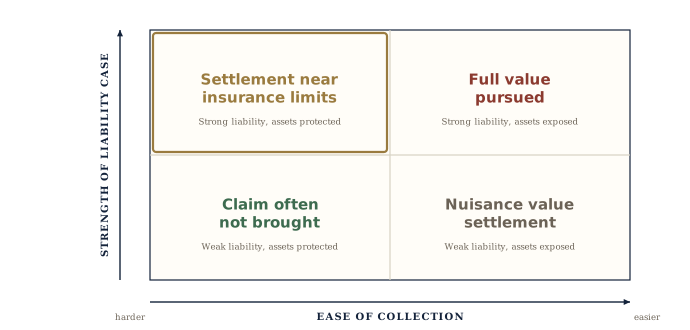
Preservation against judgment. Where a claim proceeds to judgment, the plan seeks to keep protected assets beyond the creditor's reach under the governing law. This is the most difficult goal. Its achievement depends on the timing of the transfers, the creditor class, the governing law, the forum's reach over the custodian and over the debtor (see infra ch. 2), and the quality of the planning file. It is also the goal most dependent on events after the plan is made, including the client's own conduct when the claim arises (see infra ch. 36).
Privacy and secrecy distinguished. Planning may lawfully reduce the public visibility of wealth. In most places the ownership of trust assets, entity interests and investment accounts does not appear in any public record, and a client is entitled to keep it that way. Privacy of this kind has protective value: a potential plaintiff who cannot readily identify a defendant's assets is less likely to sue.
Privacy must be distinguished from secrecy, which withholds information from persons entitled to it. Tax authorities, regulators, financial institutions and, in litigation, courts and opposing parties are entitled to complete and accurate information about the client's assets, including assets held in protective structures. The international exchange of financial-account information, the beneficial-ownership registers of many jurisdictions and the due-diligence obligations of banks and trustees have made secrecy impractical as well as unlawful (see infra chs. 44–45).
Integration with estate, tax and succession planning. Protection is most durable when it forms part of an estate, tax and succession plan with independent purposes. Integration serves the client in three ways.
- Credibility. A trust that also governs succession, consolidates investment management and provides for a disabled family member is more credible, in court and in fact, than a trust whose only purpose is to defeat creditors. The independent purposes are evidence that the transfer was made for reasons other than intent to hinder creditors (see infra ¶ 710.06).
- Efficiency. A single integrated structure is less costly to establish and maintain than separate protective and estate-planning structures. It also reduces the risk that one will undermine the other.
- Durability. An integrated plan is more likely to be maintained, because the client and the family rely on it for purposes they value independently of creditor protection.
Measuring success. The success of a plan is measured by outcomes that rarely appear in reported decisions: claims never brought, claims settled within coverage, and creditors who abandon collection efforts. The reported cases necessarily overrepresent failures, because successful plans seldom produce litigation that reaches an appellate court. Planners and clients should read the reported decisions with that bias in mind.
¶ 160
Limits of Asset Protection
Overview. Clients and planners alike tend to overestimate what a protective structure can achieve. The limits stated in this paragraph should be explained to every client in writing before any transfer is made. Written advice on the limits of protection is also the planner's principal defense if the plan later fails (see infra ¶ 320.04).
Existing and foreseeable creditors. No structure protects against a creditor whose claim exists or is reasonably foreseeable on the transfer date. A transfer that defeats such a creditor is avoidable, may support denial of a bankruptcy discharge and may be criminal (see infra chs. 7–8).
Control and protection. Protection and control trade off against each other. A client who retains the power to direct the trustee, to revoke the trust, to compel distributions or to control the entity holding the assets retains an interest that creditors and courts can reach, directly or through orders directed at the client personally. The more control the client retains, the weaker the protection. Chapter 2 and the jurisdiction chapters examine where the balance lies under each structure (see infra chs. 2, 22–27).
Insurance. A protective structure complements liability insurance. Insurance pays claims, funds the defense and provides a source of settlement that allows a plaintiff to accept less than full value. A structure that removes the client's assets from reach while the client carries inadequate insurance invites the argument that the client deliberately increased risk to future claimants, and leaves the client without a funded defense (see infra ch. 14).
Compliance. A structure that is not fully reported exposes the client to penalties that frequently exceed the claims the structure was designed to resist (see supra ¶ 110.05). The federal government's claims for those penalties are also among the hardest for any structure to resist (see infra ¶ 450.01).
The client's own conduct. A structure may protect assets while leaving the client exposed personally to contempt, to sanctions for discovery violations or to criminal prosecution. A client who conceals assets, testifies inaccurately or disregards court orders will forfeit much of the protection the structure would otherwise provide (see supra ¶ 140.05).
Changes in law. The law governing protective structures changes. Statutes are amended, courts revisit settled doctrine, and Congress has repeatedly legislated against particular planning techniques, as it did in 2005 with section 548(e) of the Bankruptcy Code. A plan should be reviewed regularly against current law (see infra ch. 54).
No guarantee. Every structure examined in this treatise has known failure modes, and each chapter identifies them. A planner who represents that a structure is certain to succeed misstates the law and assumes a liability the planner should not accept.
¶ 170
The Three Variables
Overview. Every protective plan is built from three variables: timing, title and forum. The treatise is organized around them, and the Threat Matrix in chapter 2 combines them with the identity of the creditor to produce a structured assessment (see infra ch. 2).
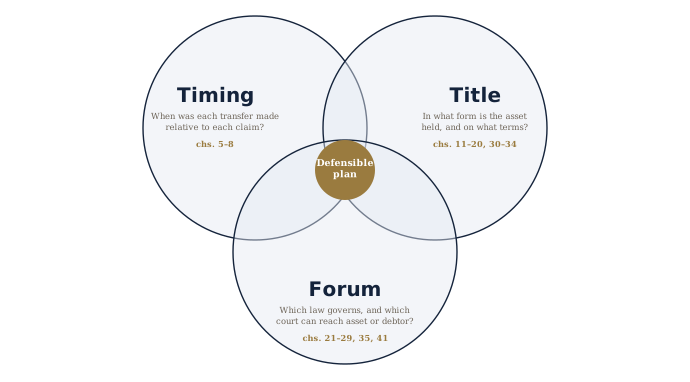
Timing. Timing is the relationship between the date of each transfer and the date of each claim. It is the variable the client controls most completely, because the client decides when to act, and the one that most often decides cases. A transfer made at T0 by a solvent client is defensible against nearly every creditor; the same transfer made after an incident may be avoidable. Timing is examined in chapters 5 through 8 (see infra chs. 5–8).
Title. Title is the legal form in which the asset is held and the terms on which the client may benefit from it. The possibilities range from outright ownership, through exempt forms of ownership such as a homestead or retirement plan, through interests in entities, to beneficial interests in trusts. Each form of title carries a different level of protection against each creditor class, and the protection generally decreases as the client's control and benefit increase. Title is examined in chapters 11 through 20 and 30 through 34 (see infra chs. 11–20, 30–34).
Forum. Forum is the combination of the law that governs the creditor's claim against the asset, the court that will decide that claim, and that court's power over the asset's custodian and over the debtor. Forum is the variable that most distinguishes domestic from offshore planning. It is also the reason the treatise treats banking and custody as structural questions (see infra ch. 34). Forum is examined in chapters 21 through 29, 35 and 41 (see infra chs. 21–29, 35, 41).
Interaction of the variables. The variables operate together. Good title cannot cure bad timing: an asset transferred to the strongest available structure after a claim has arisen remains exposed to avoidance. A favorable forum cannot cure retained control: a court with power over the debtor can coerce the debtor even where it lacks power over the asset. A plan must therefore be tested on all three variables at once, against each creditor class the client is likely to face.
¶ 180
Conditions of a Defensible Plan
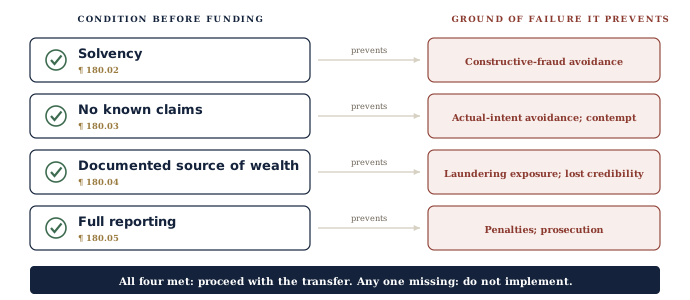
Overview. A protective plan is defensible when it can withstand challenge by a creditor, scrutiny by a court and review by the professionals who administer it. A prudent trustee should accept a protective structure only where four conditions are met. The conditions are stated here because they inform the analysis in every later chapter. They are implemented through the engagement protocol in chapter 3 (see infra ¶ 350.02).
First condition: solvency. The settlor must be solvent after the transfer, measured under the definitions of voidable-transactions law (see infra ¶ 730). Solvency should be confirmed by a sworn solvency affidavit and supported by a balance sheet that lists every asset at fair value, excludes exempt and encumbered assets, and lists every debt, including contingent liabilities such as guarantees and pending claims (see infra ch. 52; app. F). The balance sheet should show the client's position both before and after the transfer.
Second condition: no known claims. The settlor must disclose all pending, threatened and reasonably anticipated claims, and the transfer must impair none of them. Disclosure should be made in writing, signed by the client, and verified by independent searches of litigation, judgment and lien records in each state of the client's residence and business, together with a credit report (see infra ¶ 350.02). Where a claim exists, the transfer should be limited so that the client retains assets sufficient to satisfy it, or deferred until the claim is resolved.
Third condition: documented source of wealth. The origin of the assets must be evidenced to the standard set out in chapter 45 (see infra ch. 45). The requirement serves three purposes. It satisfies the trustee's own anti-money-laundering obligations. It protects the planner against the risk of assisting in the laundering of criminal proceeds (see infra ¶ 330.05). It also strengthens the plan, because a structure funded with assets of documented legitimate origin is more credible to a court than one whose funding cannot be traced.
Fourth condition: full reporting. The client's own tax preparer must confirm that every required U.S. and foreign filing will be made, including the information returns associated with foreign trusts, foreign entities and foreign accounts (see infra ch. 43). The trustee's own reporting obligations, such as reporting under FATCA, are separate from the client's returns and do not discharge them.
Consequence of failure. A plan that cannot meet these conditions should not be implemented, whatever its technical merit. Each condition corresponds to a principal ground on which protective structures have failed in reported decisions: insolvency to constructive-fraud avoidance, known claims to actual-intent avoidance and contempt, undocumented funding to laundering and credibility concerns, and non-reporting to penalties and prosecution. A plan that satisfies all four conditions has addressed the most common causes of failure before the first transfer is made.