

¶ 401
Overview
Scope of the chapter. Chapter 2 grouped creditors into six classes and used those classes as the first axis of the Threat Matrix (see supra ¶ 210). This chapter examines each class in the depth that design requires. For every class it asks four questions: how the claim comes into existence, what remedies the claimant holds before and after judgment, which statutory exceptions favor the claimant, and what treatment courts have given protective structures when the claimant was the challenger. The chapter closes with a method for building a creditor profile of a particular client, which is the factual input to the matrix (see infra ¶ 480).
Why the creditor comes first. A protective structure is designed against a threat. A plan that would hold against a trade creditor may fail against a divorcing spouse, and a plan that would defeat a tort plaintiff in state court may collapse when the Internal Revenue Service levies on the same asset. The planner who begins with the tool and looks for a client to fit it will build the wrong structure for a large share of clients. The planner who begins with the creditor will know which exceptions to avoid, which forum questions to answer and which assets to leave in the client's own name.
How a person becomes a creditor. Every claim in this chapter arises in one of five ways.
- By agreement. The claimant extends credit, sells on terms, leases property or accepts a guarantee. The claim exists from the date of the agreement, even where liability is contingent.
- By injury. The claimant suffers harm caused by the client or by someone for whom the client is answerable. The claim exists from the date of the harm, whether or not the claimant knows of it.
- By status. Marriage and parenthood create obligations that the law enforces whatever the parties agreed. The claim exists from the date of the marriage or birth, although its amount is fixed later.
- By statute. Taxes, regulatory penalties, restitution and forfeiture arise because a statute imposes them. The statute fixes the date of the claim, which may precede assessment or judgment by years.
- By collective proceeding. In bankruptcy a trustee succeeds to the rights of all creditors and acquires additional powers of its own. The trustee's claim to a transferred asset depends on the rights of the creditors whose position it inherits.
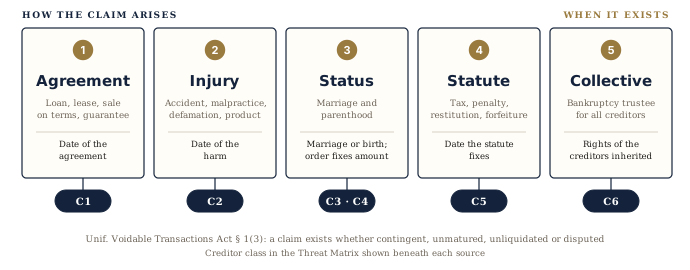
The mode of creation determines the timing analysis in chapter 5. It also determines the strength of the creditor's equities. Courts are slower to help a creditor who chose to deal with the client than one who had no choice.
The definition of a claim. The voidable-transactions statutes protect "creditors," and a creditor is a person who holds a "claim." The Uniform Voidable Transactions Act defines a claim as a right to payment, "whether or not the right is reduced to judgment, liquidated, unliquidated, fixed, contingent, matured, unmatured, disputed, undisputed, legal, equitable, secured, or unsecured." Unif. Voidable Transactions Act § 1(3) (Unif. L. Comm'n 2014). The Bankruptcy Code uses nearly identical language. 11 U.S.C. § 101(5). The breadth of the definition is the starting point for every chapter that follows. A client who has signed a guarantee, caused an accident, married or failed to file a return already has a creditor, even though no demand has been made and no amount has been fixed.
How to read the chapter. Paragraphs 410 through 460 treat the six classes in the order of the matrix: contract creditors (C1), tort creditors (C2), family claimants (C3 and C4), regulatory claimants and sovereign claimants (C5), and the bankruptcy trustee (C6). Paragraph 470 addresses creditors of the client's beneficiaries and entities, who are often overlooked in planning for the client personally. Paragraph 480 sets out the profiling method. Each section includes worked examples, and the principal decisions are discussed in the format used throughout the treatise: facts, proceedings, holding and lessons.