

¶ 301
Overview
Scope of the chapter. This chapter states the legal duties and exposures of the professionals who design, implement and administer protective structures. It addresses three sources of risk: professional discipline, civil liability to creditors and clients, and criminal liability. It then examines the separate position of the trustee and closes with a model engagement protocol designed to keep each professional within the lawful side of the line drawn in chapter 1 (see supra ¶ 130.07).
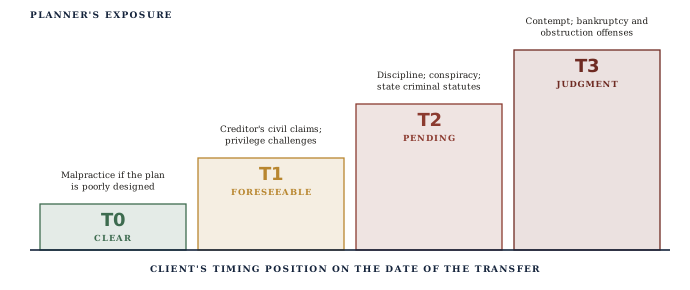
Risk follows timing. The planner's legal risk tracks the client's timing position under the Threat Matrix (see supra ¶ 220.01). The same advice can be routine estate planning at T0 and assistance in a voidable transfer at T2.
| Client's timing position | Typical planning activity | Planner's principal exposure |
|---|---|---|
| T0 Clear | Advance planning for unknown future creditors | Malpractice if the plan is poorly designed or explained |
| T1 Foreseeable | Transfers after an incident or as risk rises | Civil claims by the creditor; privilege challenges; discipline if the planner knew of the claim |
| T2 Pending | Transfers after a claim is asserted | Discipline under Rule 1.2(d); conspiracy and aiding-and-abetting claims; state criminal statutes |
| T3 Judgment | Transfers or concealment after judgment or order | Contempt; bankruptcy and obstruction offenses; loss of license |
Who is a planner. The treatise uses "planner" for every professional who designs or implements a protective structure. The term includes the client's lawyer, the trustee and its officers, the registered agent or administrator of an entity, the client's accountant and financial advisor, and any promoter who markets protective structures. The rules differ among these groups. Lawyers are governed by the rules of professional conduct; trustees by fiduciary law and financial regulation; accountants by their own professional standards; and every professional by the general civil and criminal law.
Sources of duty. The planner's obligations come from four bodies of law, which overlap but are enforced by different authorities.
| Source | Applies to | Enforced by | Principal consequence |
|---|---|---|---|
| Rules of professional conduct | Lawyers | Disciplinary authorities and courts | Discipline; disqualification; fee forfeiture |
| Fiduciary law | Trustees, protectors, directors of trust companies | Courts at the instance of beneficiaries | Damages; removal; surcharge |
| Financial regulation | Licensed trustees, banks, corporate service providers | Regulators | Licence conditions; fines; revocation |
| General civil and criminal law | Every planner | Creditors, clients, prosecutors | Damages; avoidance; criminal penalties |
Compliance with one body of law does not satisfy the others. A lawyer acting within the rules of professional conduct may still be sued by a creditor in a jurisdiction that recognizes conspiracy claims, and a trustee acting within its licence may still owe duties to beneficiaries that require it to defend the trust.