

¶ 201
Overview
Purpose of the Threat Matrix. The Threat Matrix is the analytical method used throughout this treatise to evaluate a protective tool or structure. It asks three questions of every tool: which creditor it must withstand, at what point in that creditor's claim the relevant transfer is made, and which court will decide whether the creditor can reach the asset. The answers are combined into a structured assessment that identifies the weakest point of a plan against the creditor most likely to appear.
Why a single ranking is inadequate. Earlier practice literature commonly ranked protective tools on a single scale, from the weakest (such as outright gifts) to the strongest (such as foreign trusts). A single ranking is useful as an introduction, but it conceals the variable that matters most in practice. The strength of a tool depends on the creditor. A homestead that defeats a tort plaintiff yields to a federal tax lien. A discretionary trust that defeats a bankruptcy trustee may yield to a child-support claimant. An offshore trust that places assets beyond the reach of a commercial lender may leave the settlor exposed to coercive contempt at the instance of a federal agency. A tool cannot be placed on one scale when its position on that scale changes with the identity of the creditor and the date of the transfer.
The three axes. The matrix therefore assesses each tool along three axes:
- the creditor, sorted into six classes that differ in their remedies, statutory exceptions and judicial treatment (¶ 210);
- the timing, expressed as one of four positions in the life of the creditor's claim on the date of the relevant transfer (¶ 220); and
- the forum, analyzed through three questions about the reach of the law, the reach of the court over the custodian of the asset, and the reach of the court over the debtor (¶ 230).
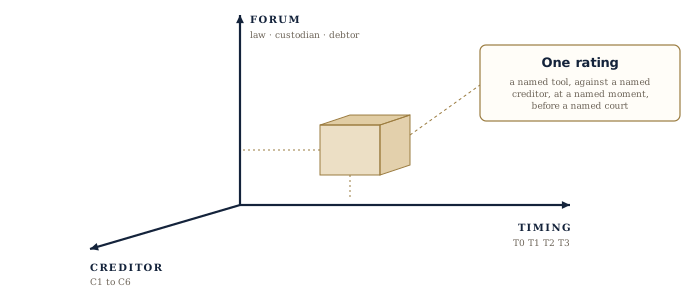
The resulting ratings appear in ¶ 240. Paragraph 250 adds the effect of the client's retained control and benefit, which modifies every rating. Paragraph 260 sets out the five-step method for applying the matrix, with three worked illustrations, and ¶ 270 states the limits of the method.
Sources of the ratings. The ratings in the matrix are drawn from three sources: the governing statutes and the decisions construing them, the reported outcomes of challenges to protective structures, and the practical experience of trustees and counsel in negotiating with creditors. The first two sources are cited in the chapters that develop each tool. The third is reflected in the distinction between Strong and Moderate: a tool rated Moderate may well prevail in court, but its defense will cost enough, and take long enough, that the typical outcome is a negotiated settlement (see infra ¶ 240.02).
How to read the chapter. Paragraphs 210 through 230 describe the three axes in the abstract. Paragraph 240 applies them to the common tools. Paragraphs 250 and 260 show how the analysis is adjusted for the client's retained control and how it is carried out for a particular client. A reader who needs a rating for a single tool may turn directly to ¶ 240.03 and then return to the earlier paragraphs to adjust the rating for the client's facts.