

¶ A01
Introduction and Use of the Form
Purpose. This appendix sets out a complete form of deed for a discretionary international trust under the International Trusts Act 1984 (No. 14) of the Cook Islands, as amended to 2013 (the Act). The trust is settled by a single individual, has one trustee that is a trustee company licensed under the Trustee Companies Act 2014, and has an independent protector. It is registered under section 15 of the Act before it receives substantial property. Each clause is preceded by a short note on what it does, and the commentary at ¶ A20 explains the rule of the Act on which each clause rests and the choices the form makes. The schedules at ¶ A30 contain the documents signed with the deed and the particulars for registration.
How the form is built. Each clause carries forward a model provision from the chapters, adjusted so that the clauses work together. The governing-law, execution and residence clauses adapt ¶¶ 690.02 to 690.04. The beneficial provisions adapt ¶¶ 880.02 to 880.07. The protector, duress and automatic change-of-law clauses adapt ¶ 990.02 and ¶ 2590.06. The variation, change-of-law and termination clauses adapt ¶ 1180.06. The clauses on additions, proceedings, foreign judgments and the conduct of litigation adapt ¶¶ 2150.06, 2190.09, 2290.06, 2390.05 and 2490.03. The tax-reporting and financial-crime clauses adapt ¶ 2790.03 and ¶ 2890.06, the regulatory-event clause adapts ¶ 460.10, and the clause on underlying companies adapts ¶ 2690.03. Where the form departs from a model provision, the commentary says why.
Conventions. Words in square brackets are choices or blanks to be completed: [name], [address], [date], [amount]. Alternatives are shown as [first choice] [second choice], and the drafter keeps one. Capitalised terms are defined in clause 1. References to sections are to the Act unless another statute is named. No official consolidation of the Act was available for this edition, and the section references are to the Act as enacted and amended by the Acts of 1985, 1989 (two Acts), 1991, 1995–96, 1999, 2004 and 2013 (see supra ch. 5). Before the form is used, each reference should be checked against the text then in force.
The assumed facts. The form assumes a settlor who is an individual domiciled and resident outside the Cook Islands, typically in the United States, who is solvent and has no claim pending or threatened against him or her. The beneficiaries are the settlor, the settlor's spouse and the settlor's descendants, none of whom is domiciled or ordinarily resident in the Cook Islands. The Act requires only that the beneficiaries be non-resident at all times; it imposes no residence condition on the settlor of an international trust, although a purpose trust under section 12(2) must be settled by a non-resident (International Trusts Act 1984, §§ 2, 12(2) (Cook Is.); see supra ¶ 570.01). The trustee is a single licensed trustee company. The protector is an independent trust company or professional resident outside the settlor's home country. The trust fund is held through custodians, and through underlying companies or Cook Islands LLCs, located outside the settlor's home country. Figure A.1 shows the parties and the powers the form gives each of them.
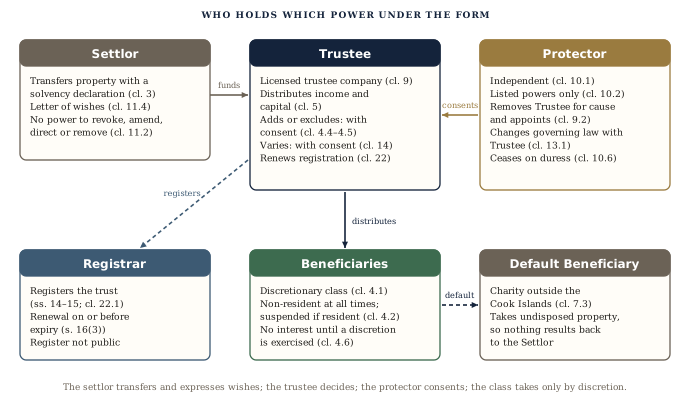
Order of signing and funding. The order in which the documents are signed, the trust is registered and property is transferred matters to the protection the Act gives. The registration cycle and the effect of each step are examined in chapter 5 (see supra ¶ 580), and the evidence of solvency in chapter 21 (see supra ¶ 2150). Table A-1 sets out the sequence the form assumes.
Table A-1. Sequence of settlement, registration and funding.
| Step | Document or act | Who acts | Authority |
|---|---|---|---|
| 1 | Due diligence on the settlor, protector and beneficiaries; title to and source of the property | Trustee | Trustee Companies (Due Diligence) Regulations 1996; Financial Transactions Reporting Act 2017; ch. 28 |
| 2 | Statement of assets and liabilities and affidavit of solvency (Schedule 5) | Settlor | ¶ 2150.06; § 13B |
| 3 | Deed executed, in counterparts if convenient | Settlor, Trustee, Protector | § 7; cl. 24 |
| 4 | Acceptances of office (Schedules 3 and 4) | Protector, Trustee | cls. 9, 10 |
| 5 | Nominal initial fund paid (Schedule 1) | Settlor | cl. 3 |
| 6 | Application to register, with the trustee company's certificate, within 45 days after the trustee is appointed | Trustee | §§ 14(1), 15(1); Table A-2 |
| 7 | Certificate of registration issued | Registrar | § 15(2)–(3) |
| 8 | Substantial property transferred by deed of addition, with a solvency declaration | Settlor, Trustee | cl. 3.3; ¶ 2290.06 |
| 9 | Letter of wishes delivered (Schedule 2) | Settlor | cl. 11.4 |
| 10 | Compliance calendar opened: renewal on or before expiry, records, tax reporting | Trustee | §§ 16(3), 27C; cls. 18, 22 |
Registration before funding. Registration is part of the definition of an international trust, and the Act's provisions apply to trusts registered under section 15 (International Trusts Act 1984, §§ 2, 5(1) (Cook Is.)). Where the trust is registered within the forty-five days allowed by section 14(1), the Act applies from the date of settlement (id. § 15(4)), so registration within time closes any gap for the nominal initial fund. The form nonetheless delays substantial funding until the certificate issues, for two reasons. The trustee company must certify the trust for registration and complete its due diligence on each later disposition, and a transfer made before the certificate issues depends on the registration being completed within time. Each transfer also starts its own limitation periods under sections 13B(3) and 13K(1), and the date of each transfer should be recorded and provable (see supra ¶¶ 2120, 2220).
What the form does not contain. The form gives the settlor no power to revoke the trust, to amend it, to direct the trustee or to remove and appoint trustees or protectors. Section 13C would permit the settlor to keep each of those powers without making the trust invalid, and section 11 would treat the trust as revocable only if the instrument gave an express power (International Trusts Act 1984, §§ 11, 13C (Cook Is.)). The form omits them because the Privy Council held in Webb v. Webb, [2020] UKPC 22 (appeal taken from Cook Is.), that a settlor's personal power to take the trust fund is in substance property of the settlor, and because a United States court treats retained control as evidence that the settlor can comply with an order to repatriate (see supra ¶¶ 680, 950 and ch. 25). The form does not make the settlor a trustee or protector. It has no enforcer, because an enforcer is needed only for a purpose trust under section 12 (see supra ch. 10). It is not a form of international relationship property trust under the 2021 Act (see supra ¶ 560.08).