

¶ 2801
Overview
The subject of the chapter. Every Cook Islands international trust, limited liability company and foundation is formed and administered through a licensed trustee company, and every licensed trustee company is a reporting institution under the Financial Transactions Reporting Act 2017. Financial Transactions Reporting Act 2017, § 5(a) (Cook Is.); Financial Supervisory Commission Act 2003, § 2 (Cook Is.) (definition of licensed financial institution, as substituted by Trustee Companies Act 2014, sched. 1). The 2017 Act decides what the trustee company must learn about a client before it registers a structure, what it must keep, what it must report to the Financial Intelligence Unit, and what it may tell the client about a report. This chapter examines those obligations as they bear on the planner, the settlor and the trustee company. The institutions that administer them, the Financial Supervisory Commission and the Financial Intelligence Unit, are described in chapter 4 (see supra ¶¶ 410–420, 480), and the exchange of tax information is treated in chapter 27.
The text of the 2017 Act. The Act received assent on June 23, 2017, and came into force on the following day. Financial Transactions Reporting Act 2017, § 2 (Cook Is.). It repealed the Financial Transactions Reporting Act 2004. Id. § 68. It was amended within the year by the Financial Transactions Reporting Amendment Act 2017 (No. 18), assented to on December 1, 2017, and the Financial Transactions Reporting Regulations 2017 were made under it in the same year. A further Financial Transactions Reporting Amendment Act 2024 is listed in the Pacific Islands Legal Information Institute's collection of Cook Islands sessional legislation. Its text could not be obtained for this edition (see infra ¶ 2810.06). The discussion in this chapter states the 2017 Act as amended in December 2017, and the reader should check every provision relied on against the 2024 amendments.
The structure of the regime. The Act imposes five groups of duties on a reporting institution. It must establish and maintain a compliance programme under a Money Laundering Reporting Officer; assess the risk of financial misconduct in its business and in each customer; conduct customer due diligence, including identification of the natural persons who ultimately own or control a customer; keep records for at least six years; and report cash transactions, certain funds transfers and suspicious activity to the Financial Intelligence Unit. Financial Transactions Reporting Act 2017, § 3(3) (Cook Is.). Breach of most of these duties is an offence. Id. § 63.
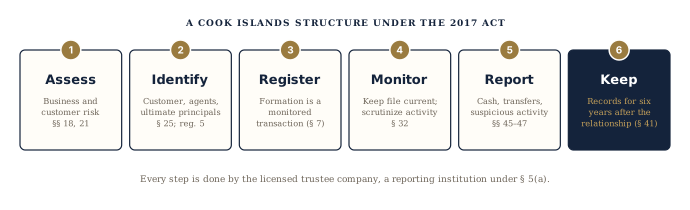
The term "ultimate principal." The Cook Islands statute does not use the expression "beneficial owner." It uses "ultimate principal": one or more natural persons who ultimately own or effectively control the customer or on whose behalf a transaction is conducted. Id. § 8. The Financial Intelligence Unit's guidelines treat the two expressions as the same. Fin. Intelligence Unit (Cook Is.), Practice Guidelines for the Financial Transactions Reporting Act 2017, § 5.1.2 (Aug. 2017) [hereinafter Practice Guidelines]. For a legal person the statute adopts a twenty-five percent threshold of shares or voting rights; for a trust it names the trustee and any natural person who exercises effective control. Financial Transactions Reporting Act 2017, § 8 (Cook Is.). The rules for trusts and foundations are supplemented by regulation 6 of the 2017 Regulations, which requires identification of the settlor, the trustees, any person with power to direct the trust, and the known beneficiaries (see infra ¶ 2850).
Where beneficial-ownership information sits. The Cook Islands keeps no public register of beneficial ownership. The International Registry records the entity, its registration details and its administering trustee company; it does not record who owns or benefits from the entity (see supra ¶ 470). The information about the natural persons behind a structure is held by the trustee company as part of its customer due diligence, and the Financial Supervisory Commission and the Financial Intelligence Unit can compel its production (see infra ¶ 2850.08). The Commission's Statement of Corporate Intent for 2026–27 records that it will begin a legal review of beneficial-ownership information capture at the Registry and lists "beneficial ownership reforms" in its legislative programme. Fin. Supervisory Comm'n (Cook Is.), Statement of Corporate Intent 2026–2027, at 12, 14.
Why it matters to the planner. The due-diligence file decides whether a structure can be formed at all. A trustee company that cannot complete customer due diligence must decline or end the relationship and consider a suspicious activity report. Financial Transactions Reporting Act 2017, § 26(1) (Cook Is.). The same file is what the trustee company produces when the Commission or the Financial Intelligence Unit asks for it, and what a foreign authority receives through the Unit or through a tax information exchange (see infra ch. 27). The planner who understands the statute can assemble the file before it is asked for, explain its purpose to a client who values privacy, and avoid structures the statute treats as higher risk without reason.
Plan of the chapter. Paragraph 2810 sets out the legislation. Paragraphs 2820 and 2830 cover who is a reporting institution and the compliance programme and risk assessment the Act requires. Paragraph 2840 covers customer due diligence, and ¶ 2850 the identification of ultimate principals of trusts, limited liability companies and foundations. Paragraph 2860 covers records, reporting and the prohibition on tipping off. Paragraph 2870 covers offences, the relation of the Act to the secrecy provisions of the International Trusts Act 1984 and legal professional privilege. Paragraph 2880 places the regime against the international standards and reviews, and ¶ 2890 gives an onboarding sequence, model provisions and a checklist.