

¶ 2701
Overview
Scope of the chapter. This chapter examines the channels through which information about a Cook Islands international trust, limited liability company or foundation can reach a foreign tax authority. There are three. The first is exchange on request under a tax information exchange agreement or the Convention on Mutual Administrative Assistance in Tax Matters, in which a foreign competent authority asks the Collector of the Revenue Management Division for information about a named taxpayer. The second is automatic exchange under the Common Reporting Standard, in which Cook Islands financial institutions report financial accounts held by foreign residents to the Collector every year and the Collector passes the reports to the partner jurisdictions. The third is the United States Foreign Account Tax Compliance Act (FATCA), under which a Cook Islands financial institution that wishes to avoid United States withholding reports its United States accounts to the Internal Revenue Service. The chapter also examines how each channel meets the secrecy provisions of the three structure statutes, which are the provisions on which the Cook Islands' reputation as a confidential jurisdiction was built.
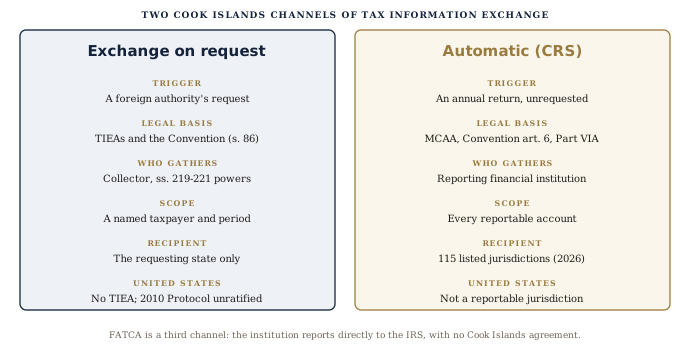
The statutory base. All of the Cook Islands' international tax obligations rest on the Income Tax Act 1997. Section 86 authorises the Minister to enter into agreements for the relief of double taxation, for the exchange of information and, since 2016, to give effect to the Multilateral Convention. Income Tax Act 1997, § 86(1) (Cook Is.), as substituted by Income Tax (Automatic Exchange of Financial Account Information and Other Matters) Amendment Act 2016, § 5 (Cook Is.). Part VIA, inserted by the same 2016 Act, implements the Common Reporting Standard and authorises the regulations that impose reporting duties on financial institutions. Id. § 6 (inserting §§ 96A–96B). The information-gathering powers in sections 219 to 221 extend to "giving effect to agreements described in section 86" and override the secrecy provisions of the International Trusts Act 1984, the Limited Liability Companies Act 2008 and the Foundations Act 2012. Income Tax Act 1997, §§ 219(1), 220(1), 221(1) (Cook Is.). There is no separate Tax Information Exchange Act. Each agreement takes effect in Cook Islands law through section 86 "despite anything to the contrary in this Act or any other enactment." Id. § 86(1).
The position in 2026. The Cook Islands joined the Global Forum on Transparency and Exchange of Information for Tax Purposes in 2009 and has been rated "Largely Compliant" with the standard on exchange of information on request in both of its full reviews, the second published on July 29, 2026. Global Forum on Transparency & Exch. of Info. for Tax Purposes, Cook Islands, Namibia and Tanzania Receive Positive Ratings on Transparency and Exchange of Information on Request for Tax Purposes (July 29, 2026). It signed the Multilateral Competent Authority Agreement on automatic exchange in October 2015, signed the Multilateral Convention on October 28, 2016, and has exchanged Common Reporting Standard information since September 2018. Revenue Mgmt. Div., Ministry of Fin. & Econ. Mgmt., Guidance Notes for the Common Reporting Standard (CRS): Cook Islands 2, 8 (n.d.) [hereinafter CRS Guidance Notes]. Its August 2026 lists name 115 jurisdictions as participating and reportable jurisdictions. Revenue Mgmt. Div., Automatic Exchange of Financial Account Information: Reporting Jurisdictions – Cook Islands (updated Aug. 2026). The United States is not among them, and the Cook Islands has not concluded a FATCA intergovernmental agreement with the United States. U.S. Dep't of the Treasury, Foreign Account Tax Compliance Act (table of FATCA agreements and understandings by jurisdiction) (visited Nov. 7, 2026).
Why it matters to the planner. A Cook Islands structure is built to resist the enforcement of foreign judgments (see supra chs. 21–23). It is not built to resist the tax authorities of the settlor's home country, and since 2018 it cannot do so. The planner's task is to design the structure so that its reporting position under each channel is known in advance, the settlor and beneficiaries are told what will be reported and to whom, and the trustee company has the documents it needs to classify the structure and report correctly. A client whose plan depends on the tax authorities of the home country not learning of the structure has no Cook Islands plan available. The tax consequences of the structure in the Cook Islands are examined in chapter 26, the anti-money laundering and beneficial ownership regime in chapter 28 and the United States tax and reporting rules for the settlor and beneficiaries in chapter 29 (see infra chs. 26, 28, 29).