

¶ A01
Overview
Purpose of the worksheets. This appendix contains seven worksheets for applying the Threat Matrix to a particular client. Chapter 2 states the method; the worksheets record its application (see supra ¶ 260.01). Each worksheet corresponds to a step in the five-step assessment, with two additions: a worksheet that records the client's purposes and assets before any tool is chosen, and a worksheet for the periodic reassessment that ¶ 270.02 requires. A completed set, filed with the planning memorandum, shows what the planner knew, what the planner concluded and why.
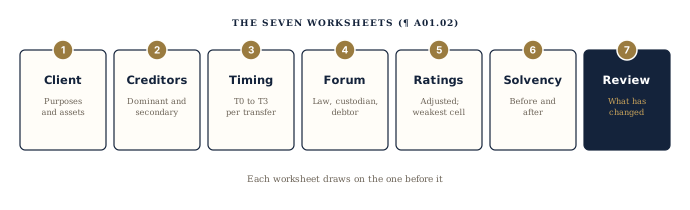
The seven worksheets. The worksheets are used in order, and each draws on the one before it.
| Worksheet | Records | Draws on | Text |
|---|---|---|---|
| 1. Client, purposes and assets | Identity, family, residence, purposes of the plan, asset inventory | Intake questionnaire (app. F, Form 4) | ¶ A10 |
| 2. Creditor profile | Dominant and secondary creditor classes, known claims, exposure by activity | Worksheet 1; searches | ¶ A20 |
| 3. Timing position | Position T0 to T3 for each class on each transfer date, with evidence | Worksheets 1 and 2 | ¶ A30 |
| 4. Forum and custodians | Governing law, location of every fiduciary and custodian, reach over the debtor | Proposed structure | ¶ A40 |
| 5. Tool ratings | Rating of each tool by class, adjusted for timing and retained control; the weakest cell | Worksheets 2 to 4; ch. 2 ¶ 240 | ¶ A50 |
| 6. Solvency snapshot | Assets, liabilities and contingent claims before and after each transfer | Schedule of assets and liabilities (app. F, Form 2) | ¶ A60 |
| 7. Reassessment | Changes since the last review and their effect on the ratings | Prior worksheets | ¶ A70 |
The worksheet as evidence. A completed worksheet belongs to the planning file and may be produced in discovery if the plan is later challenged. Whether it is protected depends on the privilege and work-product rules of the forum and on the crime-fraud exception (see supra ch. 37). The worksheets are therefore written for two readers: the planner, who needs a complete record, and a court, which may read it years later. Three rules follow from that.
- Record facts and assessments in neutral terms. A worksheet states that the client faces professional liability exposure typical of the specialty. It does not describe any person as a target or the plan as a means of defeating anyone.
- State the plan's purposes in full. Most plans serve succession, management, privacy, tax and family purposes alongside protection against future unknown claims (see supra ¶ 270.03). The worksheet records all of them.
- Never record a named or identifiable claimant as the reason for a transfer. Where a known claim exists, the worksheet records the claim, the reserve set aside for it and the solvency analysis showing that the claim can be paid (see infra ¶ A60.01).
Who completes the worksheets. The planner completes the worksheets from information the client supplies and from independent searches. The client signs the intake questionnaire and the solvency affidavit (see infra app. F, Forms 1 and 4). The client does not sign the worksheets, which are the planner's analysis. Where a trustee will accept the assets, the trustee will usually require its own due diligence and may ask for the client's consent to share Worksheets 1, 2 and 6 (see supra chs. 40, 45).
Conventions. The worksheets use the abbreviations and rating scale of chapter 2.
| Term | Meaning | Text |
|---|---|---|
| C1 | Contract creditor | ¶ 210.02 |
| C2 | Tort creditor | ¶ 210.03 |
| C3 | Spouse (property claim) | ¶ 210.04 |
| C4 | Support claimant | ¶ 210.05 |
| C5 | Sovereign creditor | ¶ 210.06 |
| C6 | Bankruptcy trustee | ¶ 210.07 |
| T0 | Clear: no claim reasonably likely | ¶ 220.02 |
| T1 | Foreseeable: claim reasonably likely but unasserted | ¶ 220.03 |
| T2 | Pending: claim asserted | ¶ 220.04 |
| T3 | Judgment, award or order | ¶ 220.05 |
| Strong / Moderate / Weak / None / Varies / Unaffected | Rating scale | ¶ 240.02 |
Reproduction. The worksheets may be reproduced and adapted for use in practice. Adapted versions should keep the neutral-terms rule of ¶ A01.03 and the date and reviewer fields on each sheet, because those fields carry most of the worksheet's evidentiary value.