

¶ 801
Overview
Scope of the chapter. Chapter 4 introduced the bankruptcy trustee as creditor class C6 and summarized the trustee's avoidance powers (see supra ¶ 460). This chapter examines bankruptcy from the creditor's side in depth. It explains why a protective structure that would hold against any single creditor may fail once its settlor is in bankruptcy, how creditors can put a debtor into bankruptcy involuntarily, what the trustee may learn and demand, how trusts and entities are treated as property of the estate, how the discharge is used as leverage, and the way the bankruptcy court's power over the debtor's person reaches assets abroad. It closes with the design principles for a plan that must survive the settlor's bankruptcy.
Why bankruptcy is the creditor's strongest weapon. Outside bankruptcy, each creditor acts alone. It must find assets, prove its own claim, bring its own avoidance action within its own limitation period and bear its own costs. Bankruptcy changes each of those conditions at once.
| Outside bankruptcy | In bankruptcy |
|---|---|
| Each creditor investigates for itself | Trustee investigates for all, with broad examination powers |
| Debtor answers discovery only in litigation | Debtor must schedule all assets and interests under penalty of perjury |
| Avoidance limited to the creditor's own claim | Trustee avoids the whole transfer for the estate (Moore v. Bay) |
| State look-back periods | State periods plus § 548 and § 548(e)'s ten years |
| Creditor's own resources | Estate pays the trustee's counsel from recoveries |
| Debtor may refuse to cooperate, at the cost of contempt in one case | Debtor's discharge depends on full cooperation |
| Remedies against the debtor's property | Remedies against the debtor's property and leverage over the debtor's future |
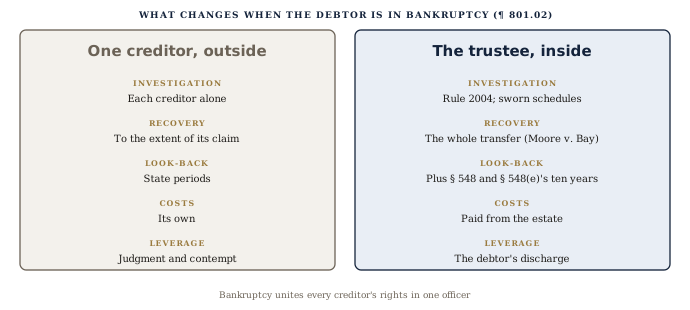
The last row is the most important. A debtor in bankruptcy seeks a discharge, and the discharge can be denied for concealment, false statements or failure to cooperate (see infra ¶ 860). A debtor who refuses to bring offshore assets home may keep the assets and lose the discharge, remaining liable for every debt for life. For a debtor with ongoing income, that outcome is often worse than losing the assets.
Who uses bankruptcy against a protected debtor. Bankruptcy is used against protected debtors in two ways. A debtor overwhelmed by claims may file voluntarily, seeking a discharge and the automatic stay, and in doing so place every structure under the trustee's scrutiny. Or a frustrated creditor may file an involuntary petition, precisely to obtain the trustee's powers. The planner must design for both.
How to read the chapter. Paragraph 810 describes the debtor's duties and the trustee's position. Paragraph 820 addresses involuntary petitions. Paragraph 830 examines the trustee's investigative powers. Paragraph 840 treats trusts and entities as property of the estate. Paragraph 850 assembles the avoidance powers into a single attack. Paragraph 860 addresses the discharge, and ¶ 870 the court's power over the debtor's person. Paragraph 880 covers cross-border insolvency, and ¶ 890 the planning response.