

¶ 4101
Overview
Scope of the chapter. This chapter addresses what a creditor holding a United States judgment, arbitral award or insolvency order can do with it abroad, and what effect foreign judgments have in the United States. It covers the common-law action on a foreign judgment, the defenses of fraud, penalty, revenue, multiple damages and public policy, the statutory registration regimes and treaties, the special position of the asset protection jurisdictions, arbitral awards under the New York Convention, cross-border insolvency under the UNCITRAL Model Law, chapter 15 and the common law, and the recognition of foreign judgments in the United States.
Why recognition matters to planning. A protective structure abroad is tested at the point of enforcement. The creditor's judgment is of little value against assets held in a jurisdiction whose courts will not recognize it, and the creditor's alternatives (a fresh action in the local court, insolvency proceedings, or pressure on the debtor personally through contempt) each carry costs and limitations. The routes available to a United States creditor are these: an action at common law on the judgment; registration under a statute where the United States is a designated country; enforcement under a treaty to which both states are party; enforcement of an arbitral award under the New York Convention; recognition of a United States insolvency proceeding and assistance to its representative; and a fresh action on the original claim. Which routes exist, and which defenses the debtor may raise, varies by jurisdiction and by the kind of judgment. Chapter 35 introduced the subject (see supra ¶ 3560). This chapter develops it in the detail needed to evaluate a structure.
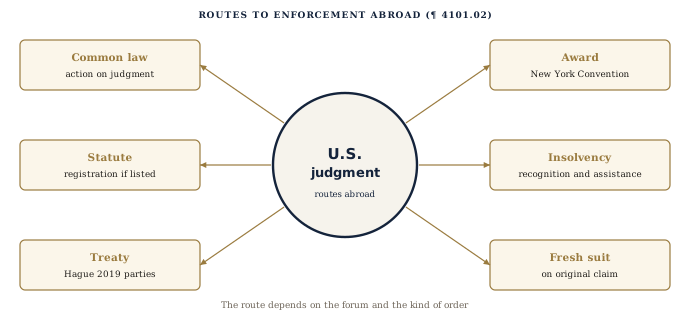
The central conclusions. No treaty provides for the enforcement of United States money judgments in the principal trust jurisdictions. The United States has signed but not ratified the Hague Judgments Convention of 2019 and the Hague Choice of Court Convention of 2005. See infra ¶ 4130.04. The United States is not a designated country under the English, Bermudian, Cayman or Belize registration statutes reviewed. A United States judgment creditor must therefore rely on the common-law action, which requires that the debtor was present in or submitted to the United States court, and which is subject to defenses. The asset protection jurisdictions add statutory bars that apply to judgments against trusts, trustees and trust property, whatever their basis. Arbitral awards travel further, because the New York Convention has 172 parties, but Nevis is not among them. Insolvency orders depend on the local cross-border insolvency regime, and offshore courts will not use common-law assistance to give a foreign representative powers unavailable under local law.
Relation to other chapters. The offshore firewall statutes are compared in chapter 40 (see supra ¶ 4050). Freezing orders in aid of foreign proceedings, which a creditor uses while pursuing recognition, are addressed in chapter 38 (see supra ¶ 3830). The jurisdiction chapters address the local avoidance actions available as an alternative to recognition (see supra chs. 22–28).