

¶ 3501
Overview
The question behind every protective structure. A protective structure is formed under the law of one jurisdiction, funded by a debtor who lives in a second, attacked by a creditor who sues in a third, and enforced, if at all, against assets in a fourth. Each of those jurisdictions has its own rules on the validity of trusts, the avoidance of transfers and the recognition of foreign judgments. The structure works only if the court that matters applies the law the planner chose, or applies a law that reaches the same result. Conflict of laws is the body of rules that decides which law a court applies and whether it will give effect to the judgment of another court. It is therefore the doctrine on which every other chapter of this treatise depends. A Cook Islands trust is protective because a Cook Islands court will apply Cook Islands law and refuse to enforce a foreign judgment that applies another law (see supra ch. 22). A Delaware or Nevada trust settled by a resident of a state without a domestic asset protection trust statute is exposed because the court of the settlor's home state may refuse to apply Delaware or Nevada law (see supra ch. 18).
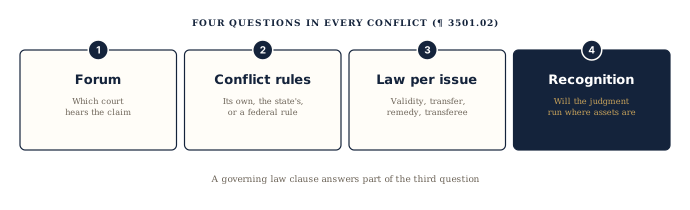
Four questions. Every conflict problem in asset protection reduces to four questions. The first is which court will hear the dispute, a question of jurisdiction addressed in this chapter only so far as it bears on the choice of law (see infra ch. 41). The second is which conflict rules that court applies: its own, those of the state in which it sits, or a federal rule. The third is which substantive law those rules select for each issue: the validity of the trust, the effect of a spendthrift clause, the avoidance of the funding transfer, and the rights of transferees. The fourth is whether a judgment rendered under that law will be recognized and enforced where the assets are. The planner who answers only the third question, by inserting a governing law clause in the trust deed, has addressed one quarter of the problem.
The settlor's home jurisdiction and the haven. The recurring conflict is between the law of the settlor's home jurisdiction, which usually allows creditors to reach a self-settled trust, and the law of the haven, which does not. The home court will usually have personal jurisdiction over the settlor and often over the transferees. It will apply its own conflict rules. Those rules may displace the chosen law on the ground that the home state has the more significant relationship to the trust or that the chosen law offends its public policy (see infra ¶¶ 3530, 3550). The haven court, if the dispute reaches it, will apply its own law and refuse to recognize a foreign judgment inconsistent with it (see infra ¶ 3560). The practical question is therefore which court will control the assets. A structure whose assets remain within reach of the home court is governed, in practice, by the home court's choice of law. A structure whose assets are held in the haven is governed, in practice, by the haven's.
The instruments. Four bodies of rules dominate the field. The Hague Convention on the Law Applicable to Trusts and on Their Recognition sets the choice of law for trusts in the states that are party to it, which include the United Kingdom and most of its overseas territories and Crown dependencies, and influences the statutes of non-party havens (see infra ¶ 3520). The Restatement (Second) of Conflict of Laws, particularly § 270, governs the validity of trusts in most American courts (see infra ¶ 3530). Section 10 of the Uniform Voidable Transactions Act, enacted in twenty-five states, sets the choice of law for avoidance claims (see infra ¶ 3540). The doctrine of comity, the Full Faith and Credit Clause, the uniform recognition acts and the offshore non-recognition statutes govern the effect of judgments (see infra ¶¶ 3560, 3570).
Organization of the chapter. Paragraph 3510 sets out the method: characterization, issue-by-issue analysis and the choice of conflict rules in state, diversity and bankruptcy courts. Paragraph 3520 addresses the Hague Trusts Convention. Paragraph 3530 addresses the Restatement rules for trusts and the cases applying them to self-settled trusts. Paragraph 3540 addresses choice of law for voidable transfer claims, including UVTA § 10. Paragraph 3550 addresses public policy and mandatory rules. Paragraph 3560 addresses the recognition of judgments between states, between the United States and foreign countries, and in offshore courts. Paragraph 3570 addresses comity. Paragraph 3580 sets out drafting and planning principles, and ¶ 3590 places conflict of laws in the Threat Matrix.