

¶ 501
Overview
Scope of the chapter. This chapter examines the rules of trust law that the terms of a trust cannot displace. Most of the law of trusts is default law. It supplies the answer when the instrument is silent, and the settlor may change it. A small body of rules is different. Those rules apply whatever the instrument says, and a provision that purports to override them is unenforceable to the extent of the conflict. The chapter identifies those rules, explains the reasons given for them, and shows how they constrain the design of a modern trust. It begins with the list in § 105(b) of the Uniform Trust Code, then turns to the common-law idea of an "irreducible core" of trusteeship, the duty of good faith and the requirement that a trust be for the benefit of its beneficiaries, the limits on exculpation in the United States and in the island jurisdictions, the duty to inform as a mandatory floor, and the rules that preserve a beneficiary's ability to enforce the trust. It closes with the academic debate over whether a trust is better understood as a contract or as a property arrangement, and with a drafting method.
Why mandatory rules matter to design. Modern trust practice relies heavily on settlor autonomy. Directed trusts divide the trustee's functions among several office-holders (see infra chs. 6 to 10). Protectors hold powers of amendment, removal and veto (see infra chs. 11 to 15). Silent-trust provisions postpone a beneficiary's knowledge of the trust (see infra ch. 25). Exculpation clauses lower the standard of care, and special-holdings provisions relieve the trustee of the duty to diversify (see infra ch. 31). Each of these techniques works only within the space the mandatory rules leave open. A drafter who uses them without knowing where the mandatory floor lies risks a clause that fails at the moment it is needed, which is usually in litigation after a loss. The mandatory rules are therefore the outer boundary of every design decision discussed in this book.
Two kinds of mandatory rule. Professor Langbein has suggested that the mandatory rules of trust law fall into two groups. The first consists of rules that defeat the settlor's intent in order to protect the beneficiaries or the public against the dead hand, such as the rule that a trust and its terms must be for the benefit of the beneficiaries. The second consists of rules that serve the settlor's intent by protecting the settlor, and the beneficiaries, against misunderstanding or imposition, such as the rule that an exculpation clause inserted by an overreaching trustee is ineffective. John H. Langbein, Burn the Rembrandt? Trust Law's Limits on the Settlor's Power to Direct Investments, 90 B.U. L. Rev. 375, 383 n.55 (2010) (summarizing John H. Langbein, Mandatory Rules in the Law of Trusts, 98 Nw. U. L. Rev. 1105, 1105–06, 1119–27 (2004)). The distinction is useful in practice. A rule of the first kind limits what a settlor may do even with full knowledge and independent advice. A rule of the second kind can often be satisfied by a process, such as independent advice or full disclosure to the settlor, that confirms the provision reflects the settlor's own choice.
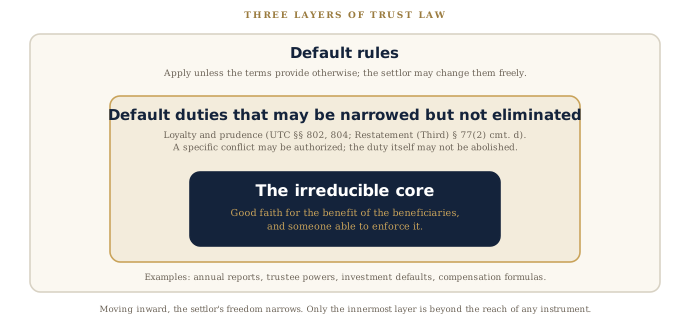
Mandatory rules and default rules that cannot be eliminated. A further distinction runs through the chapter. Some rules are mandatory in the strict sense: the instrument cannot vary them at all. Others are default rules that the instrument may modify or relax but may not eliminate altogether. The duties of loyalty and prudence are the principal examples of the second kind. Professor Langbein put the point this way: the two core rules of fiduciary administration "are default rules," yet "although the settlor can alter these rules, the settlor cannot eliminate them." Langbein, Burn the Rembrandt?, supra, at 384. The Restatement (Third) of Trusts takes the same position on prudence. Restatement (Third) of Trusts § 77(2) cmt. d (Am. L. Inst. 2007). The drafting question for this second group is one of degree: how far a duty may be narrowed before the narrowing amounts to elimination.
Relation to other chapters. The chapter states the mandatory rules in general terms and applies them to the techniques examined elsewhere. Settlor intent and the limits of settlor control are examined supra ch. 3, including the public-policy limits on dead-hand conditions at ¶ 370. The Uniform Trust Code and the non-uniform codes are compared supra ch. 4; the Delaware decision in McNeil v. McNeil is discussed at ¶¶ 450.06 to 450.09. Directed trustees' liability is examined infra ch. 10, protectors' duties infra ch. 13, silent trusts infra ch. 25, representation infra ch. 26, noncharitable purpose trusts and their enforcers infra ch. 27, and dispute-resolution clauses infra ch. 45.
Plan of the chapter. ¶ 510 examines § 105(b) of the Uniform Trust Code item by item and notes the variations in Texas and Wyoming. ¶ 520 examines the English doctrine of the irreducible core through Armitage v. Nurse. ¶ 530 examines the duty of good faith and the benefit-the-beneficiaries rule. ¶ 540 examines the American limits on exculpation, with Rutanen v. Ballard as the principal case. ¶ 550 examines gross negligence and the codes of Jersey, Guernsey, Belize and Nevis, with Spread Trustee Co. v. Hutcheson as the principal case. ¶ 560 examines the duty to inform. ¶ 570 examines standing and enforcement. ¶ 580 examines the contractarian debate. ¶ 590 sets out a drafting method.