

¶ 401
Overview
Scope of the chapter. This chapter describes the statutory frameworks within which a modern trust is designed. It begins with the Uniform Trust Code, the first national codification of the law of trusts, and examines its origins, its structure, the line it draws between default rules and mandatory rules, and the provisions its drafters described as innovative. It then turns to the pattern of enactment, including the extent to which enacting states have departed from the uniform text, and to two enactments that illustrate how far a state may vary the Code while keeping its name: Illinois and Wyoming. The second half of the chapter examines the trust statutes of the leading jurisdictions that have not enacted the Code, or have enacted only fragments of it: Delaware, South Dakota, Nevada and Alaska, which compete for trust business from other states, and New York, California and Texas, which have large resident trust populations and comprehensive statutes of their own. The chapter closes with a comparison of the codes and with the considerations that bear on choosing among them.
Why the governing code matters to design. Every provision of a trust instrument operates against a statutory background. The background supplies the rules that apply where the instrument is silent, fixes the rules that the instrument cannot displace, and determines the procedures by which the trust may later be changed. Two instruments with identical text can produce different results if they are governed by different codes. An instrument that waives the duty to inform beneficiaries, for example, is effective in some states for an indefinite period, effective in others only until the settlor dies or becomes incapacitated, and ineffective in others as to the beneficiary's right to receive the terms of the trust on request. See infra ¶ 490.03. The drafter's first statutory question is therefore which code will govern, and the second is how that code allocates freedom and constraint.
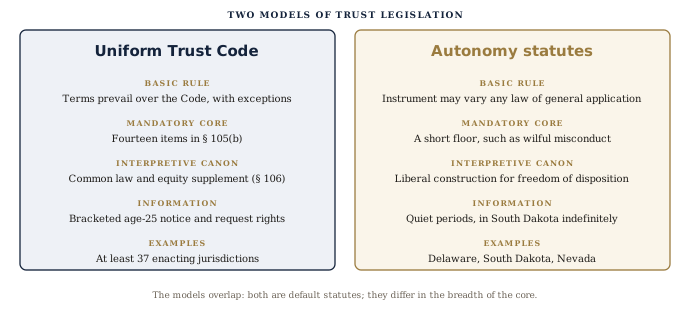
Two models of trust legislation. The statutes examined in this chapter reflect two models. The first, represented by the Uniform Trust Code, treats a trust statute as a comprehensive restatement of the common law with selected reforms. It supplies a complete set of default rules, identifies a limited mandatory core, and leaves the remainder of the law to the courts. See Unif. Trust Code § 106 (Unif. L. Comm'n 2000, amended 2018). The second model, represented most clearly by Delaware, South Dakota and Nevada, treats a trust statute as an instrument of settlor autonomy. These statutes declare that the terms of the governing instrument may expand, restrict, eliminate or otherwise vary the general law of trusts, direct that the statutes be construed to give maximum effect to freedom of disposition, and reserve a much smaller set of protections for beneficiaries. See, e.g., Del. Code Ann. tit. 12, § 3303(a); Nev. Rev. Stat. § 163.004(1), (4); S.D. Codified Laws § 55-1-53. The two models overlap. The Uniform Trust Code is also primarily a default statute, and the autonomy statutes contain mandatory rules of their own. The difference lies in the breadth of the mandatory core and in the interpretive presumption each model applies to the instrument.
Relation to other chapters. This chapter is a survey. It identifies the principal features of each code and compares them, but it does not examine any single doctrine exhaustively. The mandatory rules of trust law are examined in detail infra ch. 5; choice of governing law and situs supra ch. 2; directed-trust statutes infra chs. 6 and 7; protectors infra chs. 11 to 15; modification, decanting and nonjudicial settlement infra chs. 16, 17 and 19; trust migration infra ch. 20; silent trusts infra ch. 25; representation infra ch. 26; and self-settled spendthrift trusts infra ch. 37. Where this chapter describes a provision that is treated more fully elsewhere, it gives the cross-reference.
Plan of the chapter. ¶ 410 describes the origins and drafting of the Uniform Trust Code. ¶ 420 describes its structure and its treatment of default and mandatory rules. ¶ 430 examines the principal innovations. ¶ 440 examines the enactment pattern and the nonuniform variations, with Illinois and Wyoming as examples. ¶¶ 450 to 480 examine the codes of Delaware, South Dakota, Nevada, Alaska, New York, California and Texas. ¶ 490 compares the codes in a table and discusses the choice of governing law in light of the comparison.