

¶ 301
Overview
Scope of the chapter. This chapter examines the settlor: the person whose intention brings a trust into being, whose stated purposes govern its construction and administration, and whose retained powers determine how far the trust is in fact separate from the settlor's own estate. It considers the place of settlor intent in the Uniform Trust Code and the Restatement (Third) of Trusts, the powers a settlor may keep after the trust is created, the consequences of those powers in trust law, in creditor law and in tax law, the settlor's standing to enforce the trust, the limits that public policy places on the settlor's ability to govern the conduct of beneficiaries after the settlor's death, the doctrines of sham and illusory transfer under which a court will disregard a trust that the settlor never meant to be real, and the letter of wishes through which a settlor communicates intentions without creating enforceable terms.
The argument of the chapter. The settlor occupies two positions that pull in opposite directions. As author of the trust, the settlor is entitled to have the instrument read and administered to carry out the settlor's purposes, and the Uniform Trust Code makes most of its own rules yield to the terms of the trust. As transferor, the settlor must part with enough of the property for the trust to be something other than the settlor's own property in another form. A settlor who keeps the power to revoke, to amend, to direct investments, to veto distributions or to replace the trustee with a compliant successor may find that the law treats the trust as the settlor's own for the purpose that matters most: a creditor's claim, an elective share, a contempt order or an estate tax return. The design problem examined in this chapter is to give the settlor as much influence as the settlor's purposes require while keeping the trust effective for the purposes for which it was created.
Three questions. Every retained power raises three distinct questions, and the answers differ. The first is a trust-law question: whether the power is valid, how it is to be exercised and whether it is fiduciary or personal. The second is a question of protection: whether the power allows the settlor's creditors, a surviving spouse or a court to treat the trust property as the settlor's. The third is a tax question: whether the power causes the settlor to be treated as owner of the trust income or causes the trust property to be included in the settlor's gross estate. A power can be valid in trust law, harmless for tax purposes and fatal to protection, or the reverse. Table 3-1, see infra ¶ 350.07, sets the three questions side by side for the powers most often retained.
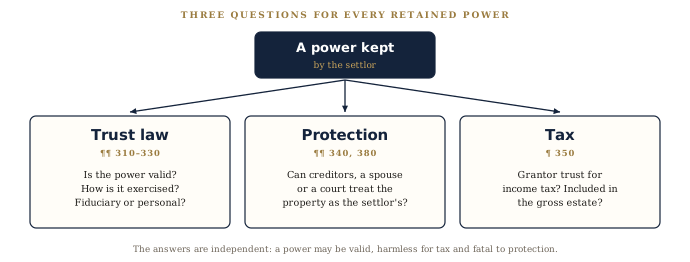
Organization of the chapter. ¶ 310 examines settlor intent as the governing principle of trust construction and modification. ¶ 320 addresses powers of revocation and amendment. ¶ 330 addresses powers of direction, veto and consent, and the settlor who serves as trustee, trust director or protector. ¶ 340 examines the consequences of retained powers for the settlor's creditors. ¶ 350 outlines the tax consequences and refers to the fuller treatment in Part IX. ¶ 360 addresses the settlor's standing to enforce the trust. ¶ 370 examines dead-hand control and the public policy limits on conditions and incentives. ¶ 380 addresses sham, illusory and alter-ego attacks. ¶ 390 addresses the letter of wishes and closes with a drafting checklist.
Terminology. In this chapter a retained power is any power over the trust or its property that the settlor holds after the trust is created, whether reserved in the instrument or conferred on the settlor in another capacity such as trustee, trust director or protector. A personal power is one the holder may exercise in the holder's own interest. A fiduciary power is one the holder must exercise in good faith for the purposes of the trust and the interests of the beneficiaries. The characterization of particular offices is examined in later chapters, see infra chs. 8 and 13, and is introduced here only so far as it bears on the settlor.