

¶ C01
Overview
Purpose of the appendix. This appendix sets out the two constitutional documents of a foundation established under the Foundations Act 2012 (No. 11) (Cook Is.), as amended by the Foundations Amendment Act 2013 (No. 13) and by the Trustee Companies Act 2014, sched. 1. Form 1 (¶ C10) is a foundation instrument. Form 2 (¶ C20) is a set of foundation rules. The commentary at ¶ C30 explains the clauses and refers to the paragraph of the volume in which the rule each clause applies is examined. The schedules at ¶ C40 complete the forms. In this appendix a section cited without the name of an Act is a section of the Foundations Act 2012 as amended.
Why the Act's own terms are used. The Act requires a foundation to have a "foundation instrument" and "foundation rules". §§ 5(1), 9(1). Each expression is defined to include any document, by whatever name called, that complies with the requirements of the Act for that document. § 3. A document headed "charter" or "plan" would therefore serve, but the forms use the statutory names so that every reference in the Act, in the Registrar's forms and in the forms themselves points to the same document. The Registrar's form for the instrument is headed "The Foundation Instrument". Form FA/5; see supra ¶¶ 1801.05, 1840.01.
How the forms were built. The forms collect the model provisions set out in chapters 18 to 20 and fit them into a complete pair of documents (see supra ¶¶ 1850.12, 1890.07, 1990.04, 2090.04). Where a chapter supplied a model provision, the form uses its text, adjusted only so that defined terms and cross-references agree and so that the provisions of different chapters do not conflict. Where no chapter supplied one, the clause is drafted from the text of the Act. No reported Cook Islands decision construes the Act (see supra ¶ 1801.03), so the forms rest on the statutory text and on the analysis in the chapters, and the commentary says where a clause depends on a reading the courts have not tested.
Two documents, one public. The foundation instrument is lodged with the application for establishment and entered in the register, and the register, including the instrument, is open to inspection by any person who pays the fee. §§ 4(4)(a), 48; see supra ¶¶ 1840.08, 1970.05. The foundation rules are not lodged. The trustee company that applies declares that it holds rules approved by the founder and by itself, and the foundation need supply a copy of the rules only to the members of its council, its registered agent, any enforcer and the founder, unless the rules provide otherwise. §§ 4(5)(b), 21(1); see supra ¶¶ 1850.02, 1970.07. Form 1 therefore states only what the Act requires the instrument to state, and everything else, including the identity of the beneficiaries and the purposes, is placed in Form 2. The Act permits this: it is enough for the instrument to provide that the persons to be benefited, or the assets to be held, are determined in accordance with the rules. § 7(5)–(6); see supra ¶¶ 1830.06–1830.07.
Assumed facts. The forms assume a private family foundation established on the instruction of an individual founder who does not reside in the Cook Islands, with non-charitable objects that consist of benefiting the founder's descendants and holding assets selected under the rules. They assume a council of two to five members, one of which is a trustee company licensed under the Trustee Companies Act 2014; an enforcer who is not the founder or a beneficiary; a charity as default beneficiary; and an investment portfolio held through a Cook Islands limited liability company wholly owned by the foundation. Where the facts differ, the bracketed alternatives and the commentary show what to change. The forms do not suit a charitable foundation, a foundation whose founder wishes to remain in control, or a foundation that is to trade.
No residence requirement. The Act sets no residence test for the founder, a dedicator, a council member, the enforcer or a beneficiary. The only resident the Act requires is the registered agent, which must be a trustee company residing in the Cook Islands. §§ 3 ("registered agent"), 12(1), 27(1); see supra ¶¶ 1860.02, 1910.07, 1960.02. The forms therefore contain no clause excluding residents. A foundation that is to be the beneficiary of a Cook Islands international trust is in a different position, because the International Trusts Act 1984 requires the beneficiaries of an international trust to be non-resident at all times, and a Cook Islands foundation probably does not fall within that Act's definition of a non-resident (see supra ¶¶ 2070.02, 3050.04).
The defaults the forms displace. The Act supplies several rules that apply "unless the foundation rules provide otherwise". The forms displace those that do not suit the assumed facts. The founder's rights vest in the council on the founder's death or dissolution unless the rules provide otherwise (§ 28(5)); Form 2 makes them lapse instead. The enforcer may sanction action outside the rules unless the rules provide otherwise (§ 13(9)); Form 2 excludes that power for the decisions that matter most. Further assets may be dedicated unless the rules provide otherwise (§ 14(3)); Form 2 requires the council's acceptance of each dedication. Persons appointed under the rules are entitled to agreed fees and reasonable expenses unless the rules provide otherwise (§ 19); Form 2 states the basis. Figure C.1 sets out each default and the clause that replaces it.
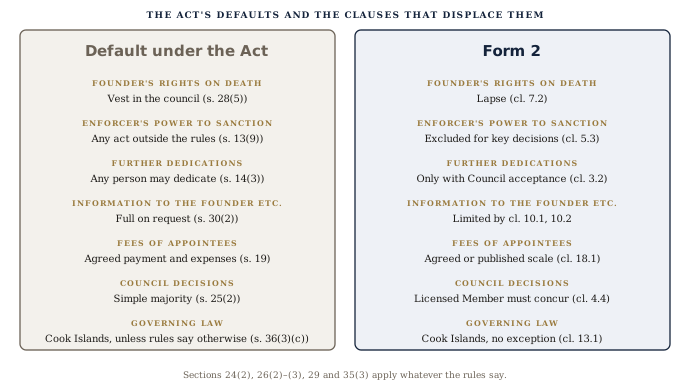
The rules the forms cannot change. Some provisions of the Act apply whatever the documents say. Neither document may relieve a person appointed under the rules from liability for wilful misconduct, wilful default or wilful negligence, and the foundation may not insure such a person against liability to the foundation. § 26(2)–(3); see supra ¶¶ 1930.02–1930.03. Council members must "act honestly and in good faith with a view to the best interests of the foundation" and exercise the care of a reasonably prudent person. § 24(2). A beneficiary who has become entitled to a benefit that is not provided may apply to the High Court within three years. § 29(2)–(4). A person with sufficient interest may apply to the Court for information that the rules withhold. § 30(6)–(7). The foundation may not directly engage in commercial trading that is not incidental to its objects. § 35(3). The forms are drafted on the footing that each of these rules applies.
Currency. The Act defines "dollar" and its symbol as the currency of New Zealand, so monetary amounts in the body of the Act, such as the NZ$1,000 debt that founds a creditor's winding-up petition and the NZ$10,000 maximum fine, are New Zealand dollars. §§ 3, 71(1)(f), 84(1). The fees in the Schedule to the Act and in the Registrar's list of forms are stated in United States dollars. See supra ¶¶ 1870.02, 1870.08. The forms state the currency of every amount they mention, and Schedule 1 to the forms lists the fees in the currency in which the Registrar charges them.
Order of establishment. A foundation is established by the Registrar on the application of a trustee company. It does not come into operation until it is endowed with its initial capital. §§ 4(1)–(2), 11(c), 14(1), 32–33; see supra ¶¶ 1860.05–1860.06, 1870.01–1870.06. Table C-1 sets out the steps in the order in which they are taken.
Table C-1. Order of establishment
| Step | Who acts | Document | Authority |
|---|---|---|---|
| 1. Due diligence on the founder and the source of the initial capital | Trustee company | Customer due diligence file | Financial Transactions Reporting Act 2017; ch. 28 |
| 2. Settle the foundation rules | Founder and trustee company | Form 2, approved by both | § 4(5)(b) |
| 3. Settle the foundation instrument | Founder and trustee company | Form 1 (Registrar's form FA/5) | §§ 5–8 |
| 4. Apply for establishment | Trustee company | Form FA/1 with the instrument, the § 4(5) declaration and the fee | § 4(2)–(5) |
| 5. Establishment and entry in the register | Registrar | First certificate of establishment (Form FA/9) | §§ 32–33 |
| 6. Accept office | Council members, enforcer | Schedules 3 and 4 | Form 2, arts. 4, 5 |
| 7. Endow the initial capital | Founder | Schedule 5 (dedication) | §§ 11(c), 14(1) |
| 8. Organise the holding company | Council | Articles of organisation; operating agreement (App. B) | Form 2, art. 9 |
| 9. Deliver the letter of wishes | Founder | Schedule 2 | Form 2, cl. 8.6 |
| 10. Renew annually | Registered agent | Form FA/3 and fee | § 4(7) |