
¶ 1901
Overview
The subject of the chapter. A Cook Islands foundation is a legal person that holds its assets for its objects and has no owner. Foundations Act 2012, § 34 (Cook Is.). It acts through persons who hold office under its foundation rules and under the Act. This chapter examines those persons and the rules that bind them: the council, which every foundation must have and which administers its assets and carries out its objects (see infra ¶¶ 1910–1930); the enforcer, an optional office with statutory powers to supervise the council (see infra ¶ 1940); the founder and any protector or other person given rights or functions by the foundation rules (see infra ¶ 1950); the beneficiaries, who have no interest in the assets but may compel a benefit to which they have become entitled (see infra ¶ 1960); the rights to information and the limits of confidentiality (see infra ¶ 1970); and the records the foundation must keep and the role of the registered agent in keeping them (see infra ¶ 1980). The chapter closes with the supervisory powers of the High Court, model governance provisions and a checklist (see infra ¶ 1990).
The statute and its name for the governing body. The Act calls the governing body of a foundation its "council." Id. §§ 11(a), 22. The term is used throughout the Act and in the forms the Registrar has published under it. The council is not optional: "A foundation shall have a council — (a) to administer the assets of the foundation; and (b) to carry out its objects." Id. § 22. The supervising office is called the "enforcer." Id. §§ 3, 13. The Act does not use the word "protector." A foundation may nevertheless confer protector-like powers on a person under the general power in section 18(2)(c) to appoint "persons (other than the members of the council of the foundation, the trustee company and any enforcer of the foundation) to carry out functions in respect of the foundation." Id. § 18(2)(c). This chapter uses "protector" only for such a person, and "enforcer" only for the statutory office.
Where the governance provisions sit. The Act divides a foundation's constitution into two documents. The foundation instrument is filed with the Registrar, entered in the register and open to public inspection. Id. §§ 4(4)(a), 48(2)–(3). It states the name, the objects and the registered agent. Id. §§ 6–8. The foundation rules are private. They are held by the registered agent and need not be supplied to anyone other than the council members, the registered agent, any enforcer and the founder. Id. §§ 4(5)(b), 21(1). Almost every governance provision belongs in the rules: the establishment of the council, the appointment and removal of its members, how it decides, the enforcer's appointment and the rights of the founder and others. Id. §§ 11–13, 18, 28. The drafting of the rules is therefore the drafting of the foundation's governance.
The source text. The Foundations Act 2012 (No. 11) was assented to on 3 July 2012 and came into force the day after assent. Id. § 2. It has been amended twice. The Foundations Amendment Act 2013 (No. 13) added a definition of "financial records" and a seventh item to the list of documents a foundation must keep at its registered office. The Trustee Companies Act 2014 replaced the definition of "trustee company" and the reference to the 1981–82 Act in section 87. Foundations Amendment Act 2013, §§ 4–5 (Cook Is.); Trustee Companies Act 2014, sched. 1 (Cook Is.). The Act is quoted in this chapter from the official printed text as published by the Financial Supervisory Commission, and the 2013 amendment from its printed text. The formation of a foundation, its nature and its objects are examined in chapter 18 (see supra ch. 18), and the use of foundations in planning, including the creditor-protection provisions of sections 36 to 40, in chapter 20 (see infra ch. 20).
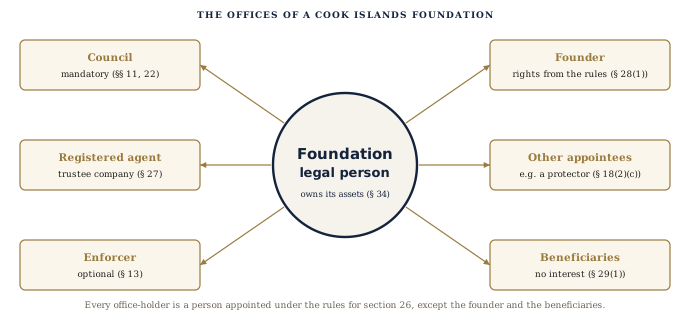
The structure of the Act's governance provisions. The Act states its governance rules in a sequence that this chapter follows. Sections 9 to 21 prescribe what the foundation rules must and may contain. Sections 22 to 26 deal with the council: its existence, membership, duties, decisions and the limits on exculpation. Section 27 deals with the registered agent. Sections 28 to 30 deal with the rights of the founder, of other persons named in the rules and of beneficiaries, and with the provision of information. Sections 41 to 45 deal with administration: service, records, financial statements and amendment of the instrument. Sections 75 to 82 give the High Court its supervisory jurisdiction. Sections 83 and 84 create offences and fix a single penalty. Table 19-1 summarizes the offices.
Table 19-1. The offices of a Cook Islands foundation
| Office | Mandatory? | Who may hold it | Principal source |
|---|---|---|---|
| Council | Yes; at least one member | Any person 18 or over who is not of unsound mind or disqualified; a trustee company; the registered agent | §§ 11, 22, 23 |
| Registered agent | Yes; only one at a time | A trustee company residing in the Cook Islands | §§ 3, 12, 27 |
| Enforcer | No | Any person other than a council member, except the founder or a trustee company on the council | § 13 |
| Founder | Yes (the person who instructed the trustee company) | Any person | §§ 3, 28 |
| Other appointees (e.g. a protector) | No | As the rules provide | §§ 18(2)(c), 28(2) |
| Beneficiaries | Only where the objects include benefits to persons | Persons specified in the instrument or determined under the rules or by the Court | §§ 3, 7(4)–(5), 29 |
Source: Foundations Act 2012, §§ 3, 7, 11–13, 18, 22–23, 27–29 (Cook Is.).
Comparison with the Nevis and Jersey models. The Cook Islands Act belongs to the family of offshore foundation statutes that give the governing body a council and a supervising officer a separate title. The Jersey statute uses a council and a mandatory "guardian" whose function is to ensure that the council carries out its functions. Foundations (Jersey) Law 2009, art. 13. The Cook Islands enforcer has the same core duty, but the office is optional. Foundations Act 2012, § 13(1), (6) (Cook Is.). The Nevis Multiform Foundations Ordinance uses a different vocabulary: a management board, an optional supervisory board and "subscribers." The Nevis structure is examined in Lighthouse on Nevis: Trusts, LLCs, and Multiform Foundations, ch. 19, and compared with the Cook Islands Act in Table 19-5 (see infra ¶ 1990.03).