

¶ 2601
Overview
The two forums. Every contest over a Belize structure has two forums. The first is the court where the creditor sues the settlor, the member or the founder, which for most structures examined in this book is an American court. The second is the High Court of Belize, where the trustee, the LLC or the foundation council holds the assets. The two courts apply different law to the same facts and answer different questions. The foreign court asks whether the debtor can be made to pay and whether the transfer to the structure should be disregarded under its own law. The Belize court asks whether a claim against the trust, the LLC or the foundation may be entertained at all, and its answer is governed by section 7 of the Trusts Act, sections 34 to 38 of the Limited Liability Companies Act and the non-recognition provisions of the Foundations Act (see supra chs. 11, 16, 17, 21). This chapter examines the first forum. It explains what foreign courts, and American courts in particular, have done and can do when a Belize structure comes before them. It also explains how the Belize trustee, manager or council responds.
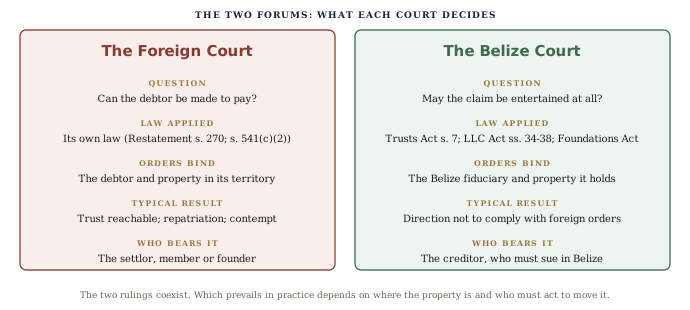
The settled pattern. The reported decisions involving Belize structures follow a pattern that is consistent across bankruptcy, consumer-protection and divorce litigation. The foreign court applies its own law to the structure, finds that the debtor's interest or the transferred property is reachable, and makes orders against the persons and property within its jurisdiction. The Belize trustee declines to act on those orders and, where asked, obtains a direction from the Belize court not to comply with any order of a foreign court. The foreign court does not obtain the assets held in Belize or held outside the United States by the Belize trustee. The debtor, who remains within the foreign court's jurisdiction, bears the consequences: contempt, coercive confinement, loss of a discharge in bankruptcy or an adverse judgment on the underlying claim. In re Brown, In re Rensin and the Harnack divorce litigation each illustrate the pattern (see infra ¶ 2630). The Sanctuary Belize litigation, in which a federal court in Maryland reached a Belize development through a receivership over the defendants and their companies, illustrates the different position of a structure whose managers and assets are within reach of the foreign court (see infra ¶ 2630.06).
Why the distinction matters. The settled pattern divides the risks of a Belize structure into two classes that call for different planning. The first class is the risk to the assets. That risk is governed by Belize law and by the location of the assets, and section 7(6), with its reading of "the claims of creditors in an insolvency" as a reference to the financial condition of non-payment (see supra ¶¶ 1150, 2330), gives the trust strong protection in Belize against foreign fraudulent-transfer claims by ordinary creditors as well as claims in a bankruptcy. The second class is the risk to the person. That risk is governed by foreign law and turns on the debtor's conduct: the timing of the transfer, the debtor's solvency when it was made, the powers the debtor kept and the debtor's candour in the foreign proceeding. A structure can succeed completely in Belize and still leave the debtor exposed at home. Most of the planning recommended in this chapter, and in chapter 27, concerns the second class.
Scope and sources. The chapter proceeds in the order in which a foreign court encounters a Belize structure. Paragraph 2610 examines the foreign court's jurisdiction over the settlor, the Belize trustee and the assets. Paragraph 2620 examines the choice-of-law rules under which American courts apply forum law to self-settled foreign trusts. Paragraph 2630 discusses the reported Belize decisions in full. Paragraph 2640 examines repatriation and turnover orders and civil contempt. Paragraph 2650 examines bankruptcy: the estate, the ten-year avoidance rule for self-settled trusts and the denial of discharge. Paragraph 2660 examines fraudulent-transfer judgments, alter-ego claims and reverse piercing against Belize entities. Paragraph 2670 examines discovery, section 1782 of title 28 and the international exchange of information. Paragraph 2680 examines regulatory and criminal exposure and the response of the Belize fiduciary, and paragraph 2690 draws the lessons together with a table of decisions and a checklist. The chapter relies on published opinions that have been read and on the primary sources collected for this book. Decisions reported only in commentary are not discussed. The Belize procedure that the trustee follows when a foreign order arrives is treated in chapter 25, and the design of structures in light of these decisions in chapter 27 (see supra ch. 25; see infra ch. 27).
Terms. In this chapter "foreign court" means a court outside Belize. "Settlor" includes a founder of a foundation and a member who transferred property to an LLC, where the context allows. "Repatriation order" means an order directing a person to cause property held abroad to be returned to the jurisdiction of the court that made the order or delivered to a receiver, trustee in bankruptcy or creditor. "Turnover order" includes an order under section 542 of the Bankruptcy Code and its state-law counterparts. "Belize fiduciary" means the trustee of a Belize trust, the manager of a Belize LLC or the council of a Belize foundation.
Summary of conclusions. Six conclusions emerge. (1) A foreign court with personal jurisdiction over the settlor can order the settlor to act, whatever the law governing the structure. (2) An American court asked whether a self-settled Belize trust protects its settlor will usually apply American law and conclude that it does not, as Brown and Rensin did. (3) That conclusion binds the settlor and the property within the court's reach. It does not bind a Belize trustee that has not appeared, or property held outside the court's territory, and the court may decline to adjudicate title to such property without the trustee, as in Rensin. (4) A settlor who cannot comply with a repatriation order because of a structure the settlor created faces contempt, and the self-created impossibility rule will usually defeat the defence. (5) In bankruptcy, a self-settled transfer made with actual intent within ten years may be avoided under section 548(e), and concealment of trust interests may cost the debtor the discharge, even though the trustee in bankruptcy cannot collect the Belize assets without proceedings in Belize. (6) A Belize judgment-recognition action by the foreign creditor or trustee meets section 7(6), sections 34 to 38 of the LLC Act or the Foundations Act, and the restricted recognition rules described in chapter 4 (see supra ¶¶ 440.03, 460.06, 480.02–480.07).