
¶ 401
Overview
The two questions. Every dispute that reaches Belize from abroad raises two questions of private international law. The first is which law governs the trust, company or foundation at the centre of the dispute. The second is what effect a Belize court will give to a judgment, order or insolvency proceeding of a foreign court that bears on it. The first is a question of choice of law. The second is a question of recognition and enforcement. A Belize structure is chosen because the answers to both questions differ from the answers a court in the client's home country would give, and the planner must understand both before advising on what the structure will do when it is tested.
The general law and the special statutes. Belize answers these questions on two levels. At the general level, it applies the common law of conflict of laws received from England, a small number of statutes of general application, principally the Reciprocal Enforcement of Judgments Act, Cap. 171, and the rules of court that govern service abroad and the taking of evidence. At the special level, each of the three statutes examined in this book contains its own rules. The Trusts Act sets out the proper law of a trust, permits that law to be changed and, in section 7(6), directs the court not to recognize foreign law or foreign orders against a Belize trust in three categories of claim. Trusts Act, Cap. 202, ss. 4, 7(6)–(7) (rev. ed. 2020) (Belize). The Limited Liability Companies Act provides that only judgments of a Belize court are enforceable against an LLC, its managers or its members in matters governed by that Act. Limited Liability Companies Act, Cap. 270:01, s. 38(1) (Belize). The International Foundations Act provides for disregarding foreign law that would impugn a foundation or a disposition to it. Fin. Servs. Comm'n, International Foundations Act, 2010: A Briefing Note ¶ 6. The special rules override the general rules where they apply, and section 7(7) of the Trusts Act says so in terms as to the Reciprocal Enforcement of Judgments Act.
Why the general law still matters. It might be thought that the special statutes make the general law irrelevant to a Belize structure. They do not, for three reasons. First, the special rules are confined to their subject matter. Section 7(6) of the Trusts Act applies to a trust "created under the law of Belize" and to the three categories it names; a claim outside those categories, or a trust governed by another law, falls back on the general rules. Trusts Act s. 7(6). Second, a creditor whose claim is not recognized under foreign law may still bring a claim in Belize under Belize law, and the general rules on service, evidence and interim relief govern that claim. Third, the general law governs the structures that sit beside the trust: a Belize company formed under the Belize Companies Act 2022, a bank account in a third country, or a foreign LLC owned by a Belize trustee. A planner who knows only the special statutes cannot predict how a Belize court will treat a claim that falls between them.
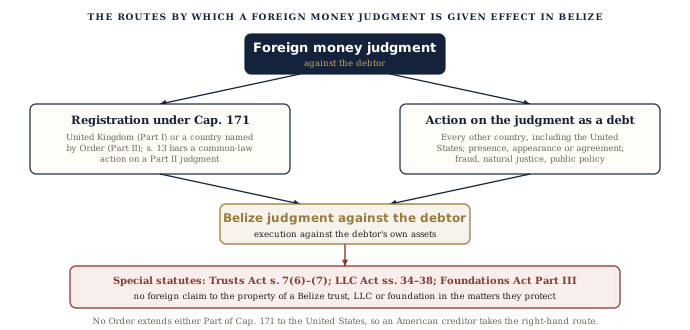
The position of the United States creditor. Most reported litigation about Belize structures has been brought by American creditors, and this chapter uses the American creditor as its principal example. Belize has not extended either Part of the Reciprocal Enforcement of Judgments Act to the United States, so an American judgment cannot be registered in Belize. The American creditor must sue in Belize on the judgment as a debt at common law, must show that the American court had jurisdiction over the debtor in the sense recognized by the common law and must overcome the defences of fraud, natural justice and public policy (see infra ¶¶ 440–450). If the claim is directed at the assets of a Belize trust, LLC or foundation, the special statutes then intervene (see infra ¶ 480). The result is that the American creditor's judgment, however large, is a starting point for new proceedings in Belize and has no direct effect there.
Foreign insolvency proceedings. A foreign trustee in bankruptcy or liquidator is in a different position from an individual judgment creditor. The common law has long given limited assistance to foreign insolvency officeholders, and the Insolvency and Bankruptcy Act 2025 contains a cross-border insolvency Part modelled on the UNCITRAL Model Law and a separate Part providing for orders in aid of foreign proceedings. Insolvency and Bankruptcy Act, No. 13 of 2025, pts. XVIII–XIX (Belize). Those Parts are scheduled to commence in June 2027. Fin. Servs. Comm'n, Public Notice FSC/CPR/001-17 (Apr. 2026). When they commence, they will apply only to proceedings in countries designated by notice, will be subject to a public policy exception and will not displace section 7(6)(c) of the Trusts Act, which bars the recognition of foreign insolvency claims against a Belize trust (see infra ¶ 470).
The approach of this chapter. This chapter describes the sources of Belize conflict of laws (see infra ¶ 410), the proper law of a trust (see infra ¶ 420), the law governing LLCs and foundations (see infra ¶ 430), the common-law recognition and enforcement of foreign money judgments (see infra ¶ 440) and the defences to it (see infra ¶ 450), the Reciprocal Enforcement of Judgments Act (see infra ¶ 460), foreign insolvency proceedings (see infra ¶ 470), the statutory non-recognition provisions in outline (see infra ¶ 480) and the procedure for service, evidence and interim relief, ending with the path an American creditor must follow (see infra ¶ 490). The non-recognition provisions are examined in full in their own chapters: section 7 of the Trusts Act in chapter 11, the LLC charging order in chapter 17, the foundation provisions in chapter 21, the meaning of "insolvency" in section 7(6)(c) in chapter 23 and the decisions of foreign courts in chapter 26.
A note on the courts' names. The court of first instance was long known as the Supreme Court of Belize, and the older statutes, including the Reciprocal Enforcement of Judgments Act, use that name. The Senior Courts Act 2022 and the civil procedure rules made under it refer to the High Court of Justice, which is the court established by section 94 of the Constitution. Senior Courts (Civil Procedure) Rules 2025, S.I. No. 1 of 2025, r. 2.4 (Belize) (definition of "High Court of Justice", citing Senior Courts Act, No. 27 of 2022). This chapter uses "the Belize court" where the distinction does not matter and the statutory name where it quotes a statute. The rules of 2025 came into force on January 2, 2025, and govern civil proceedings in the civil division of that court, though not insolvency proceedings. Id. rr. 2.1(2), 2.2(1), (3)(a).