

¶ 2001
Overview
The persons of a foundation. A Belize foundation is a legal person, and the persons who stand around it hold offices created by statute. The International Foundations Act, Cap. 24:02 (rev. ed. 2020), as amended by the International Foundations (Amendment) Act 2023, No. 49 of 2023, names five: the founder, the foundation council and its members, the protector, the beneficiaries and the registered agent, with a secretary required in some cases. Part VII of the Act, headed "The Registered Agent, Founder, Foundation Council, Protector and Beneficiary," sets out most of the rules, in sections 33 to 74. International Foundations Act, Cap. 24:02, ss. 33–74 (Belize) (rev. ed. 2020) ("IFA"). This chapter examines each office in turn. Chapter 19 examines the nature of the foundation, its charter and its registration (see supra ch. 19), and chapter 21 examines the endowment and the protection of the endowment against creditors (see infra ch. 21).
Citation. The Act appears in the 2020 revised edition as the International Foundations Act, Chapter 24:02, consolidating the amendments made by Act No. 17 of 2013. The 2023 Act substituted "foundation" for "international foundation" wherever the term appears, transferred administration to the Financial Services Commission and added beneficial-ownership, record-keeping and penalty provisions. No. 49 of 2023, ss. 2–5, 10, 19. Section references in this chapter are to the Act as amended in 2023. The Act is cited by the name the 2023 amending Act uses (on the short title, *see supra* ¶ 1920.04).
A statute that separates the offices. The Act does more than describe the offices. It keeps them apart. A founder may not serve as protector of the foundation he established. IFA s. 35(2). A member of the foundation council may not be a beneficiary. Id. s. 37. A member may not serve as protector, and a protector may not be a member. Id. ss. 36(3)(c), 57. A founder may be a beneficiary, including the sole beneficiary. Id. s. 35(3). And the founder may not keep any power to direct the council, any control over the endowment, or any power to amend the charter or dissolve the foundation. Id. s. 35(4)–(5). These rules have no counterpart in the Trusts Act, which permits a settlor to be a trustee, a beneficiary or a protector, and permits a protector to be a trustee or a beneficiary. Trusts Act, Cap. 202, ss. 9(2), 16(3), 17(2) (rev. ed. 2020) (see supra ¶¶ 910, 920). Figure 20.1 sets out the permitted and forbidden combinations.
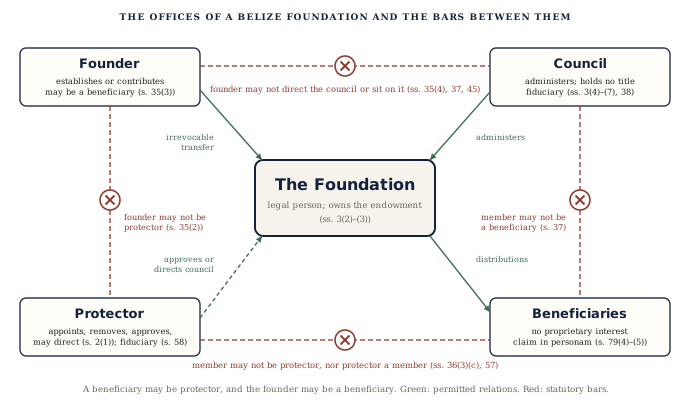
Fiduciary duties running to three persons. The council and each member owe a fiduciary duty "to the foundation, its founder and its beneficiaries." IFA s. 38(1)(b). The protector, who is not a member, "does owe a fiduciary duty to the foundation, its founder and beneficiaries." Id. s. 58. A trustee's duty runs to the beneficiaries, or to the purpose of a purpose trust (see supra ¶ 740). The foundation statute adds the founder as a person to whom duties are owed, although it denies the founder control. That combination gives the founder standing to complain of a breach without giving him a means to direct the endowment. Id. s. 64(2).
A low default standard of liability. The Act states a prudent-business-person standard of care for the council, "subject to the terms of the foundation and its by-laws." Id. s. 38(1)(b). Its liability provisions then define a breach of fiduciary duty as "an intentional and wilful fraudulent act or omission" that "results in actual prejudice," and its exculpation section relieves members and protectors of liability for any breach except their own intentional and wilful fraud, unless the charter, the by-laws or the Act provides otherwise. Id. ss. 64(1), 67(1). The effect, examined in ¶ 2040, is that a member is exposed to damages only for wilful fraud unless the charter imposes a stricter rule. Planners who want the council to answer for negligence must say so in the charter.
The 2023 reforms. The 2023 Act requires the foundation to identify its founder, its council members, its protector, its beneficiaries or classes of beneficiary, and its beneficial owners on registration, to keep a beneficial-ownership register at its registered agent's office, and to file that register with the Belize Companies and Corporate Affairs Registry. No. 49 of 2023, ss. 6, 10 (amending IFA s. 17 and inserting ss. 84A–84D). Confidentiality yields to these requirements. Id. s. 14 (replacing IFA s. 105). Paragraph 2080 examines the provisions.
Plan of the chapter. Paragraph 2010 examines the founder; ¶ 2020 the composition of the council; ¶ 2030 the council's powers and duties; ¶ 2040 liability, exculpation and relief; ¶ 2050 the protector; ¶ 2060 the beneficiaries; ¶ 2070 the registered agent, the secretary and the registers; ¶ 2080 beneficial ownership and U.S. tax points; and ¶ 2090 disputes, the court's powers, model by-law provisions and a checklist. No reported Belize decision construing Part VII was found. The analysis rests on the text of the Act.