

¶ 701
Overview
The trustee as the working part of the trust. A Belize trust exists, in the words of the statute, where a trustee "holds or has vested in him, or is deemed to hold or have vested in him, property which does not form, or which has ceased to form, part of his own estate" for the benefit of beneficiaries or for a valid purpose. Trusts Act, Cap. 202, s. 2 (rev. ed. 2020) (Belize). Every protective feature of the Act described elsewhere in this treatise depends on that holding. Section 7(6) protects property that is held by a trustee under a trust created under Belize law (see infra ch. 11). The registration of an international trust, on which the application of section 7 depends, is made by or through the trustee and its trust agent (see supra ch. 6). The information that Belize now requires a trust to keep and to produce is kept and produced by the trustee (see infra ¶ 750). A trust whose trustee holds no assets, makes no decisions and acts on the settlor's instructions gives little protection, and the cases discussed in this chapter and in chapter 26 show American courts treating such a trustee as a figurehead (see infra ¶ 790.05).
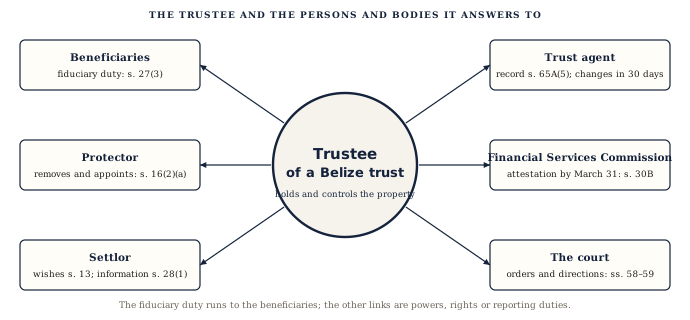
The statutory scheme. The Trusts Act deals with trustees in four groups of provisions. Part III (sections 16 to 26) governs the protector and the trustee as office-holders: who may hold office, how many trustees there may be, how they are appointed, how they renounce, resign or are removed, the nature of their interest in the trust property, and their dealings with third parties. Part IV (sections 27 to 43) sets out the trustee's duties and powers. Part VII (sections 50 to 56) governs liability for breach of trust, constructive trusts, tracing, relief and limitation. Part VIII (sections 57 to 60) gives the court its jurisdiction over trusts and trustees, including the power to give directions. Two Schedules supplement Part IV: Schedule I lists the authorised trustee investments, and Schedule II sets out the implied powers of trustees. The Trusts (Amendment) Act, 2023 added to these provisions a detailed record-keeping duty, a new information regime, a duty to disclose trustee status and an annual attestation of beneficial ownership. Trusts (Amendment) Act, 2023, No. 40 of 2023, ss. 2–4 (Belize) (assented to Sept. 5, 2023; gazetted Sept. 6, 2023). The history of the Act and the amendments is examined in chapter 5 (see supra ch. 5).
A code that replaced the old Trustee Act. The Trusts Act came into force on April 23, 1992 and repealed the Trustee Act, 1923, which continues to apply to trusts created before that date. Trusts Act ss. 69, 70(1)–(2). For this purpose a trust is created when property is first received by or vested in the trustee to be held on the terms of the trust. Id. s. 70(3). The 1992 Act is a self-contained statement of the trustee's position. Its duties of diligence, good faith, skill and prudence, its rules on unanimity, impartiality and delegation, and its provisions on liability and relief are expressed in the statute, and a Belize practitioner looks first to the statutory words. The English and Commonwealth case law on trustees remains persuasive on matters the Act does not resolve, and on the meaning of terms the Act borrows from equity, because Belize's legal system rests on the common law and the doctrines of equity received from England (see supra ch. 2).
Which trusts the provisions govern. Most of the provisions examined in this chapter apply only to trusts whose proper law is the law of Belize. Section 66(3) provides that sections 1 to 4, 7, 52 and 56, and Parts VIII, X and XI, apply to all trusts, and that the other sections of the Act apply only to trusts the proper law of which is the law of Belize. Trusts Act s. 66(3). Two consequences follow. First, the duties, powers and liability provisions of Parts III, IV and VII govern a trustee of a Belize-law trust wherever that trustee resides, and do not govern the Belize trustee of a trust governed by foreign law, whose duties are a matter for the foreign proper law. Second, the court's supervisory jurisdiction in Part VIII, the tracing provision in section 52 and the limitation rules in section 56 apply to every trust within the court's jurisdiction, whatever its proper law. The Belize court has jurisdiction where the proper law is Belize law, a trustee resides in Belize, trust property is situated in Belize, or any part of the administration is carried on in Belize. Id. s. 57.
The terms of the trust and the statute. Nearly every provision in Parts III and IV opens with the words "subject to the terms of the trust." The Act sets default rules that the trust instrument may vary, and identifies a smaller number of rules that the instrument may not displace. The most important of the mandatory rules are the trustee's general duties in section 27(1), the fiduciary duty owed to the beneficiaries or the purpose under section 27(3), the record-keeping and information duties added in 2023, and the rule in section 50(6) that nothing in the terms of a trust relieves a trustee of liability for breach of trust arising from his own fraud or wilful misconduct. Trusts Act ss. 27(1), (3), (7)–(7C), 28(1)–(1A), 50(6). Drafting a Belize trust instrument is therefore an exercise in choosing which defaults to accept, which to vary and how to vary them within the limits the Act sets. The sections of this chapter identify the defaults, the permitted variations and the drafting choices that follow.
Plan of the chapter. Section 710 considers who may be a trustee, including the 2023 requirement that every international trust have at least one Belize company or licensed trust company as trustee. Section 720 considers appointment, acceptance, resignation and removal. Section 730 considers the trustee's title to and dealings with trust property. Section 740 considers the general duties. Section 750 considers the records, information and reporting duties as amended in 2023, and the trustee's confidentiality. Section 760 considers the powers. Section 770 considers the exercise of discretions and the effect of the United Kingdom Supreme Court's decision in Pitt v. Holt. Section 780 considers remuneration, indemnity, exoneration and liability for breach of trust. Section 790 considers applications for directions and the trustee's position when a foreign court orders the settlor or the trustee to bring the trust property home. The licensing and supervision of trust service providers by the Financial Services Commission are examined in chapter 3, the protector in chapter 9 and litigation procedure in chapter 25 (see supra ch. 3; see infra chs. 9, 25).