

¶ 601
Overview
Scope of the chapter. The law of voidable transactions is the principal body of law against which every protective transfer is tested. Its core concepts date from the sixteenth century, and its statutory form has been revised several times. This chapter traces the law from its English origin through the three uniform acts adopted in the United States, identifies the features of the current act that most affect planning, explains the relationship between state law and the Bankruptcy Code, and notes the parallel doctrines in the other legal systems that matter to the featured jurisdictions. Chapter 7 analyzes the operative rules in detail: intent, the badges of fraud, solvency, value, remedies, transferee liability and criminal exposure (see infra ch. 7).
Why the history matters. A planner might ask why a practice treatise should spend a chapter on a statute of 1571. There are three reasons.
- The courts still use it. Judges construing the modern statutes cite the early cases to explain what the words mean, and the badges of fraud listed in the uniform acts are drawn directly from them. An argument about whether a debtor's retained control is a badge of fraud is an argument about Twyne's Case.
- The offshore statutes respond to it. The asset protection statutes of the Commonwealth jurisdictions were drafted as departures from the English law of fraudulent conveyances, which those jurisdictions inherited. Their provisions make sense only against the rules they displace (see infra ¶ 670.06).
- The policy has not changed. For four and a half centuries the law has asked the same question: whether a debtor has put property beyond the reach of creditors while keeping its benefit. Every protective structure is designed to give an answer to that question that a court will accept.
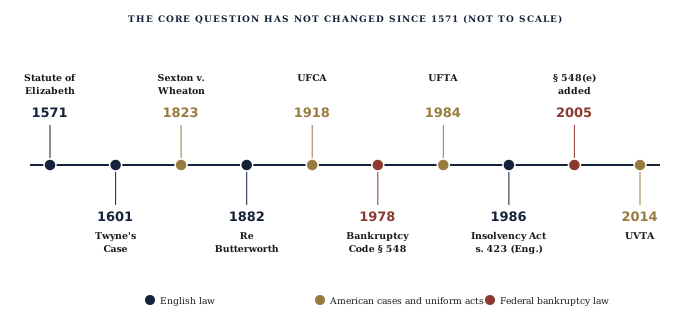
How to read the chapter. Paragraph 610 describes the English origin, including the Statute of Elizabeth, Twyne's Case and the later English decisions on voluntary settlements. Paragraph 620 traces the reception of the law in the United States. Paragraphs 630, 640 and 650 describe the three uniform acts. Paragraph 660 compares state law with the Bankruptcy Code. Paragraph 670 addresses the doctrines that persist alongside the statutes and the equivalent rules in the civil-law and offshore jurisdictions. Paragraph 680 compares the regimes, and ¶ 690 sets out a method for reading any voidable-transactions statute.