

¶ 3301
Overview
Why plans are layered. Few substantial plans place assets directly in a single trust or a single entity. The usual structure combines several vehicles, each formed under the law best suited to its function: a domestic limited liability company that holds real estate or an operating business in the state where the asset is located, a holding company formed in a jurisdiction with a strong charging-order statute, a trust that owns the holding company, and a custodian or bank in a third jurisdiction. Chapter 29 introduced the layered plan as a method of combining jurisdictions (see supra ¶ 2950). This chapter examines how such structures are attacked and how they should be designed so that each layer contributes to the protection of the whole.
The creditor's perspective. A creditor who confronts a layered structure does not need to defeat every layer. The creditor needs to find the weakest connection between the debtor and the assets and to persuade a court that the structure should be disregarded at that point. The doctrines available for that purpose are reverse veil piercing, which treats an entity as liable for its owner's debts; alter ego and nominee theories, which treat property held by an entity or trust as the debtor's own; the bankruptcy powers to bring the debtor's interests into the estate and to consolidate related entities; control-based remedies that reach assets the debtor can direct even if he does not own them; and the collapsing of multi-step transfers into a single avoidable transaction. Each is discussed in this chapter with the leading decisions.
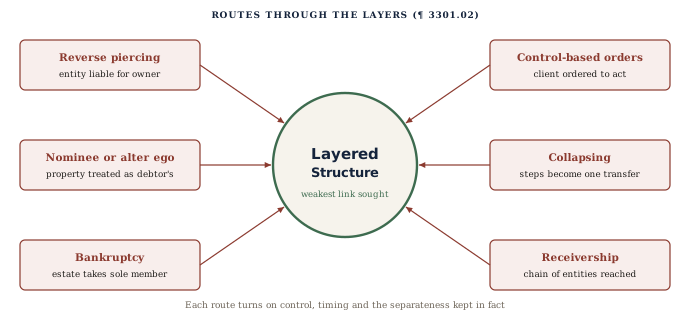
The planner's perspective. For the planner, a layered structure offers three advantages and one principal risk. The advantages are separation of functions, so that the entity holding a risky asset is distinct from the entity holding passive wealth; multiplication of procedural barriers, so that a creditor must litigate in several forums under several laws; and the ability to place each asset under the law that treats it best. The principal risk is that complexity without substance invites the conclusion that the structure is a device controlled by the debtor. A stack of entities with no separate business, no independent management and no observed formalities is easier to collapse than a single well-administered entity. The decisions discussed below repeatedly turn on control, commingling and the timing of formation, and seldom on the number of layers.
Organization of the chapter. Paragraph 3310 describes the common forms of layered structure and the function of each layer. Paragraphs 3320 and 3330 address reverse veil piercing and alter ego and nominee theories. Paragraph 3340 addresses single-member LLCs within a stack. Paragraph 3350 addresses control-based reach through freezing orders, discovery and turnover. Paragraph 3360 addresses bankruptcy, and ¶ 3370 addresses the collapsing of transactions and receiverships. Paragraph 3380 addresses the tax classification and reporting of stacked entities, and ¶ 3390 sets out design principles and a checklist.