

¶ 3101
Overview
The foundation as an alternative to the trust. The private foundation is the civil-law counterpart of the private trust. It is a legal person, created by a founder's unilateral declaration, that holds an endowment for purposes stated in its charter, including the benefit of the founder's family. It has no shareholders and no members. Its assets are owned by the foundation itself, its affairs are managed by a council, and its beneficiaries, unless the charter provides otherwise, have no proprietary interest in its assets. For a client from a civil-law country, the foundation is familiar where the trust is foreign. For a client in a common-law country, the foundation offers a separate legal person that can contract, hold title and sue in its own name, which some families and some counterparties prefer to a trust whose property is held by a trustee.
The spread of foundation statutes. Liechtenstein's foundation law, enacted in 1926 and comprehensively revised with effect from 1 April 2009, and Panama's private interest foundation law of 1995 are the models from which most other statutes derive. Beginning in the early 2000s, several common-law jurisdictions enacted foundation statutes of their own, among them Nevis (2004), the Bahamas (2004), Jersey (2009), Seychelles (2009), Belize (2010), the Isle of Man (2011), Guernsey (2012) and the Cook Islands (2012). The Cayman Islands chose a different route, permitting a company limited by shares or guarantee to be designated a foundation company (2017). In the United States, Wyoming enacted a statutory foundation act in 2019. These statutes vary widely. Some, such as Jersey's, are designed for wealth structuring and contain no special protection against the founder's creditors. Others, such as those of Nevis and the Cook Islands, import the protective features of their international trust statutes.
Hybrid entities. This chapter also addresses hybrid entities: vehicles that combine features of the trust and the company or that modify the ordinary rules of one to serve a function of the other. They include the Cayman foundation company, the Cayman STAR trust, the British Virgin Islands VISTA trust, the Bahamas executive entity and the Cook Islands LLC. Their relevance to asset protection lies in the way they separate control, benefit and enforcement, and in their use as components of larger structures (see infra ch. 33).
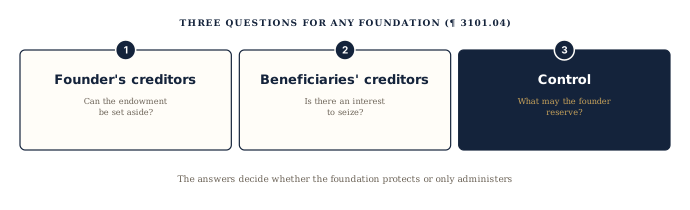
Three questions. For each foundation regime, the planner should ask three questions. The first concerns the founder's creditors: can a creditor of the founder set aside the endowment, and if so on what standard, within what period and in which court? The second concerns the beneficiaries' creditors: does a beneficiary have an interest that a creditor can seize, and does the statute permit the charter to exclude enforcement? The third concerns control: what powers may the founder reserve, and will those powers be treated, in the founder's home country, as amounting to ownership? The answers determine whether a foundation is a protective vehicle or a vehicle for succession and administration only.
Organization of the chapter. Paragraph 3110 addresses Liechtenstein. Paragraph 3120 addresses Panama, and ¶ 3130 addresses Jersey and Guernsey. Paragraph 3140 addresses the foundation statutes designed for asset protection, and ¶ 3150 addresses the Wyoming statutory foundation. Paragraph 3160 addresses United States tax classification and reporting. Paragraph 3170 addresses the treatment of foundations by courts in the United States and England. Paragraph 3180 addresses hybrid entities, and ¶ 3190 sets out the considerations for choosing among a trust, a foundation and a hybrid.