

¶ 3001
Overview
From jurisdiction to instrument. Part IV examined the jurisdictions in which a protective trust may be established and the method for choosing among them (see supra chs. 21–29). This chapter opens Part V, which concerns the architecture of cross-border structures, and turns from the choice of law to the instrument itself. A Cook Islands, Nevis or Belize statute supplies the legal setting. The trust deed decides how that setting is used: who holds the assets, who may benefit, who may change the trustee, what happens when a foreign court makes an order, and by what means the settlor's expectations are communicated to a fiduciary who owes him no duty to follow them. Two trusts governed by the same statute can perform very differently under pressure because of the way they are drafted and administered.
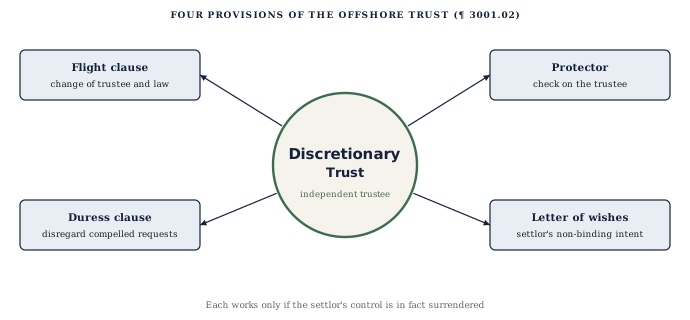
The four clauses in the title. The chapter is organized around four provisions that distinguish the offshore protective trust from a conventional discretionary trust: the flight clause, which permits a change of trustee, place of administration and governing law; the duress clause, which directs the trustee to disregard instructions given under compulsion; the protector, an office separate from the trustee that holds powers of appointment, removal and consent; and the letter of wishes, a non-binding statement of the settlor's intentions. Each was developed to answer a specific risk. Each has also been the subject of judicial attention, in the United States and in the offshore courts, that shows how the provision can fail. The governance chapters of Part III discussed the protector, the duress clause and the change of situs as features of trust governance generally (see supra ¶¶ 1920, 1930, 1970). This chapter treats them as drafting problems, with attention to the language of the clause, its interaction with the governing statute and the record that the trustee must keep to make it effective.
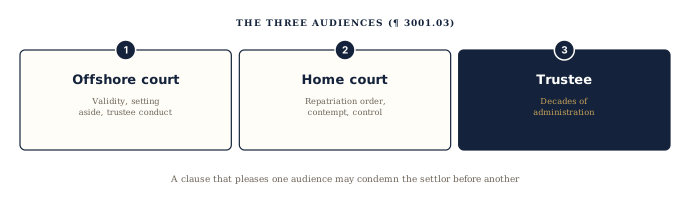
The three audiences. An offshore trust deed is read by three audiences, and the drafter must write for all of them. The first is the court of the governing law, which will decide whether the trust is valid, whether a disposition to it can be set aside and whether the trustee acted properly. That court applies the statute and its own trust jurisprudence and is generally receptive to protective provisions that the statute authorizes. The second is a court in the settlor's home country, typically a United States federal or state court, which may never decide the validity of the trust but may order the settlor to procure the return of the assets and may hold him in contempt if he does not. That court looks at the deed for evidence of the settlor's control and asks whether his claimed inability to comply was created by his own design. The third audience is the trustee, who must administer the trust for decades, apply its provisions to circumstances the drafter did not foresee and defend its decisions to the beneficiaries. A clause that impresses the first audience may condemn the settlor before the second, and a clause that satisfies both courts may be unworkable for the trustee.
The central tension. The design of an offshore trust involves a tension that no drafting technique fully resolves. The more control the settlor retains, the more likely a United States court will conclude that he can comply with a repatriation order, that the trust is his alter ego or that it is a sham. The less control he retains, the greater the risk that the trustee will make decisions he disagrees with, and the less willing he will be to fund the trust adequately. The four provisions discussed in this chapter are the principal tools for managing that tension. The flight and duress clauses move the decision away from the settlor when pressure arrives. The protector supplies a check on the trustee that does not depend on the settlor. The letter of wishes communicates the settlor's intentions without giving him enforceable rights. Each works only if the settlor's control is in fact surrendered and the trustee in fact exercises independent judgment (see infra ¶ 3060).
Organization of the chapter. Paragraph 3010 describes the architecture of the instrument as a whole. Paragraphs 3020 and 3030 address the governing law and flight provisions and the duress clause, with the United States contempt cases. Paragraphs 3040 and 3050 address the protector and the letter of wishes. Paragraph 3060 addresses reserved powers, control and the sham doctrine. Paragraph 3070 addresses the selection of the trustee and the administration of the trust. Paragraph 3080 addresses funding and the use of underlying companies. Paragraph 3090 sets out a drafting checklist.