

¶ 2801
Overview
Purpose of the chapter. Chapters 22 to 27 examined six jurisdictions in depth. Many others are used in practice, and the planner will meet them as the jurisdiction of an existing structure, as the home of a client's family office, or as an alternative a client has read about. This chapter profiles fourteen of them in brief: nine offshore jurisdictions and five American states, together with a note on two states that have declined to enact protective trust legislation. Each profile follows the same order: the governing statutes, the rule against foreign judgments and foreign law, the rule on setting aside transfers at the instance of creditors, the treatment of reserved powers or self-settled interests, the leading cases, and recent amendments.
How to use the profiles. The profiles are a starting point for comparison under the method of chapter 21 (see supra ¶ 2110). They do not substitute for advice from local counsel. Several profiles depend on official texts consolidated to dates in 2025 and 2026; others depend on secondary sources where official consolidations were not available. Points that could not be confirmed on an official source are attributed to the secondary source or marked for confirmation. Before relying on any profile, the planner should obtain the current consolidated statute and an opinion of local counsel.
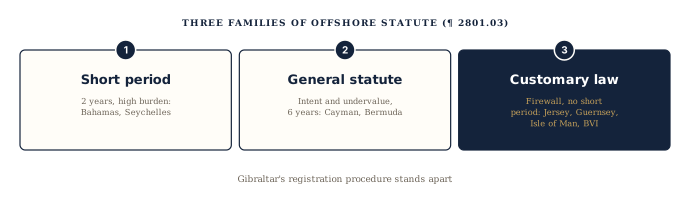
Three families of offshore statute. The offshore jurisdictions fall into three groups by the way they treat creditors.
- Jurisdictions with a short statutory limitation period and a high burden on the creditor, on the model of the Cook Islands and Nevis (see supra chs. 22–23). The Bahamas and the Seychelles belong here, each with a two-year period.
- Jurisdictions with a general fraudulent disposition statute that requires both intent and undervalue but allows a longer period, typically six years. The Cayman Islands and Bermuda belong here.
- Jurisdictions without a special statute, in which creditors rely on customary law or a general insolvency statute. Jersey, Guernsey, the Isle of Man, Singapore and the British Virgin Islands belong here, each with a strong firewall against foreign law and judgments on matters of heirship and family relationships. Gibraltar is a special case with a registration procedure (see infra ¶ 2820.05).
The American states. The domestic asset protection statutes were compared in chapter 18 (see supra ¶ 1830). This chapter profiles the four states most often chosen after Wyoming and Delaware, namely Nevada, South Dakota, Alaska and Ohio, and notes the positions of Tennessee, New Hampshire and Utah. It closes with Florida and Texas, which offer strong exemptions and no self-settled trust statute (see infra ¶ 2880.06).
Common questions for every jurisdiction. Whatever jurisdiction is under consideration, the planner should obtain answers to the same questions before recommending it.
- Does the statute give the creditor a claim against a transfer to a trust, and on what elements: intent alone, intent and undervalue, or insolvency?
- Who bears the burden, and to what standard?
- When does the limitation period start, how long is it, and can it be extended by discovery or concealment?
- Are future creditors excluded, and if so by what test: actual notice, reasonable foreseeability or existence of the claim?
- Will the courts enforce a foreign judgment against the trust, and does the firewall extend to insolvency claims or only to heirship and family claims?
- What powers may the settlor reserve without the trust being treated as a sham or as the settlor's property?
- How experienced are the courts with contested trust litigation, and to which court does appeal lie?
- What trustee industry exists, how is it regulated, and what does it cost?
- What reporting, beneficial ownership and information exchange obligations apply to the trust and its underlying companies?
The profiles in this chapter answer as many of these questions as the available sources allow. The questions left open are those for local counsel.