

¶ 2001
Overview
Scope of the chapter. Most asset protection plans move property from a person who faces exposure to a person or trust that does not: from a physician to a spouse, from parents to children, from an individual to a trust for the family. Chapters 17 through 19 examined the trusts that receive such property. This chapter examines the transfers themselves. A gift by a person with creditors, present or future, is the transaction voidable transfer law was written to examine. The question for the planner is how much a client may give, to whom, in what form and at what time, so that the gift will stand against the client's creditors.
The chapter examines the gift as a transfer under voidable transfer and bankruptcy law (see infra ¶ 2010), the solvency analysis that determines how much may be given (see infra ¶ 2020), transfers between spouses (see infra ¶ 2030), gifts to children and to trusts (see infra ¶ 2040), sales and loans within the family (see infra ¶ 2050), family entities and valuation discounts (see infra ¶ 2060) and the transfer tax framework (see infra ¶ 2070). It closes with the record a planner should build (see infra ¶ 2080) and the place of intrafamily transfers in the Threat Matrix (see infra ¶ 2090).
Why the gift is the weak point. A gift is, by definition, a transfer for no consideration. Every voidable transfer statute treats a transfer without reasonably equivalent value as suspect, and the constructive fraud provisions make it voidable without proof of intent if the transferor was insolvent or left with unreasonably small assets (see supra ch. 7). Transfers to family members are transfers to insiders, a badge of fraud under every modern statute. Unif. Voidable Transactions Act § 4(b)(1) (Unif. L. Comm'n 2014). The donor typically keeps some benefit, directly or through the family, which is another badge. Id. § 4(b)(2). A gift to a spouse or child is therefore examined more closely than any other transfer, and the burden of showing that it was made in good order falls in practice on the family.
The gifting question stated. The planner can reduce the gifting question to four parts:
- Solvency. Will the donor remain solvent, with a comfortable margin, after the gift, counting all debts and contingent liabilities at realistic values?
- Intent. Is the gift made for reasons other than defeating a known or foreseeable creditor, and does the record show those reasons?
- Form. Does the gift take a form that protects the property in the donee's hands and does not leave the donor with benefits that undermine it?
- Timing. Is the gift made at T0, before any claim is in view, and will the limitations periods run before any creditor is likely to sue?
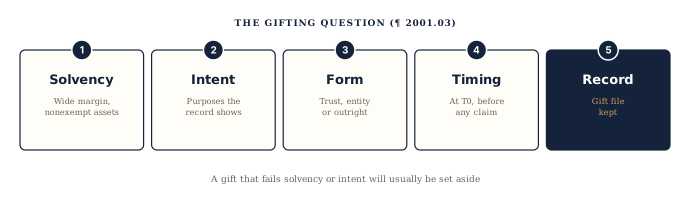
A gift that satisfies all four will stand against the donor's creditors. A gift that fails any one invites a challenge, and a gift that fails solvency or intent will usually be set aside.