

¶ C01
Introduction and Use of the Form
Purpose. This appendix sets out a form of memorandum of establishment and a form of by-laws for a private family foundation under the Multiform Foundations Ordinance, Cap. 7.08(N) (rev. ed. 2017) ("MFO" or "the Ordinance"), with a commentary and schedules. Together the two documents are the foundation's constitution (MFO §§ 2, 7). The form is drafted for the structure described in chapters 18 to 20: an ordinary foundation established by a single founder who is resident outside St. Christopher and Nevis, a management board that includes a licensed Nevis corporate services provider, an independent supervisory board, discretionary beneficiaries recorded in a confidential register, and protective, forfeiture and duress provisions. The form is original to the treatise. It is a teaching form and a starting point for counsel, and Nevis counsel must review it against the Ordinance and the Multiform Foundations Regulations, 2005, as they stand on the date of signing.
How the form is built. Each article and by-law carries forward a rule or a model provision from the chapters. The management-board, supervisory-board, conflicts, information and forfeiture by-laws adapt the five models at ¶¶ 1990.02 to 1990.06. The successor-founder, forfeiture and alienation-and-duress by-laws adapt the three models at ¶¶ 2090.02 to 2090.04. Where the chapters identify a point of the Ordinance that is untested or awkwardly drafted, the clause states a drafting choice and the commentary in ¶ C30 identifies the paragraph that discusses it. The form adds no requirement that the Ordinance does not impose. Where it goes further, as it does in requiring a solvency record for each subscription or the consent of the supervisory board to a change of form, it does so as a matter of drafting choice, and the commentary says so.
Conventions. Words in square brackets are choices or blanks to be completed: [name], [address], [date], [number], [amount]. Alternatives are shown as [first choice] [second choice], and the drafter deletes the one not used. Optional clauses are enclosed in square brackets as a whole. Defined terms are capitalized. Section references are to the Ordinance unless stated otherwise. The articles of the memorandum are cited as "Article" and the provisions of the by-laws as "By-law". The by-laws prescribed for an ordinary foundation in Part A of Schedule 4 to the Regulations are cited as "default by-law", to distinguish them from the form's own. The form uses the Ordinance's terms "management board", "supervisory board", "subscriber" and "beneficial entitlement", and calls the founder "the Founder", a word the Ordinance uses only inside its definition of "subscriber" (MFO § 2; see supra ¶ 1901.02).
The assumed facts. The form assumes a founder who is a natural person domiciled and resident outside the Federation, who is solvent and faces no known claim on the date of each subscription, and who wishes to provide for a spouse and descendants during life and after death without probate in any country (see supra ¶ 2010.01). It assumes that the foundation will hold its investments through a single-member Nevis limited liability company of which it is the sole member, with the operating agreement in Appendix B (see supra ¶¶ 2050.04–2050.06), that no land in the Federation will be held, and that every transaction will be with persons not resident in Nevis apart from the safe harbours in section 93(2), so that the exemption in section 93(1) applies (see supra ¶ 1880.09). A founder who is a United States person must also read chapter 29: whether the foundation is a trust or an entity for United States tax purposes depends on its terms (see supra ¶¶ 1890.06, 2960.03), and the form contains no United States tax provisions.
Why an ordinary foundation. The form designates the ordinary foundation as the stated multiform. The trust, company and partnership forms import the Nevis International Exempt Trust Ordinance, the corporation or LLC Ordinance, or partnership law "mutatis mutandis" (MFO § 10(9)), and with them rules the drafter may not intend (see supra ¶¶ 1830.08, 1890.07). The ordinary form keeps the foundation within one statute. The name therefore needs no word stating the form: section 14(1) requires only that it end with "Foundation" or "FDN", and section 14(5) adds a form word only for the trust, company and partnership forms (see supra ¶ 1860.06 and Table 18-2). A drafter who chooses another form must change the name, Article 6, the commentary references and the governance mapping in Table 19-1 (see supra ¶ 1910.05).
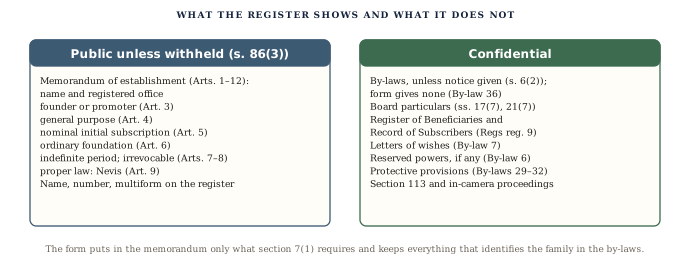
What is public and what is not. The Registrar's register is open to public inspection except for particulars withheld by notice in the prescribed form (MFO § 86(3)). The by-laws are confidential unless the foundation gives notice that they are to be public (§ 6(2)), and the particulars of the management board and supervisory board are not public unless notice is given (§§ 17(7), 21(7)). The memorandum is not protected in the same way. The form is built on that division. The memorandum contains only what section 7(1) requires, states the purpose in general terms and recites a nominal initial subscription. Everything that identifies the family, the beneficiaries, the reserved powers or the protective provisions is in the by-laws (see supra ¶¶ 2080.01–2080.02). The registration statement must say whether the by-laws are to be public (§ 4(i)), and the form's Schedule 6 says that they are not.
Order of establishment and funding. The order in which the documents are signed and the foundation is funded affects the protection it gives. The foundation does not exist until it is registered and its certificate issues (MFO § 3(4)), and the time rules in section 108(3) run from the date of each subscription (see supra ¶¶ 2030.02–2030.03, 2170.06). The usual sequence is in Table C-1.
Table C-1. Sequence of establishment, registration and funding.
| Step | Document or act | Who acts | Authority |
|---|---|---|---|
| 1 | Due diligence on founder, board members and beneficiaries; source of funds | Registered agent and licensed board member | Ch. 28 |
| 2 | Schedule of the founder's assets and liabilities; review of known claims | Founder and counsel | MFO § 108(1)–(2); ¶ 2030.02 |
| 3 | Name reserved | Registered agent | MFO § 14(4) |
| 4 | Acceptances of office (Schedule 4) | Board members, secretary | MFO §§ 17, 18, 21 |
| 5 | Memorandum and by-laws signed and legally acknowledged, with nominal initial subscription | Founder, or registered agent with witness | MFO §§ 7(3), 111 |
| 6 | Registration statement and fee delivered (Schedule 6) | Registered agent | MFO §§ 3(1), 4 |
| 7 | Certificate of establishment issued | Registrar | MFO § 5 |
| 8 | First meeting of the management board, one to three months after registration | Management board | MFO § 32; ¶ 1930.07 |
| 9 | Each substantial further subscription, with a solvency record under By-law 34 | Founder, management board | MFO § 108; ¶ 1990.05 |
| 10 | Annual return and fees before each anniversary of registration | Secretary, registered agent | MFO § 95; S.R.O. 11 of 2024 |
Registration before funding. Only a registered foundation can own property (MFO §§ 3(2), 3(4)), and a transfer made before registration is a transfer to no one, or to the registered agent as nominee, with consequences that the form does not attempt to manage. The form therefore recites a nominal initial subscription and provides in By-law 33 that the management board shall accept no further subscription until the certificate of establishment has issued and the solvency record for that subscription has been completed.
What the form does not contain. The form reserves no power to the Founder to revoke the foundation, to amend the constitution, to direct investments or distributions, or to appoint or remove members of either board, although section 7(2)(a) would permit each of them (see supra ¶ 1960.03). The omission is deliberate. A founder who holds such powers is likely to be treated by a foreign court as controlling the foundation and its assets, as the founder was in National Crime Agency v. Baker (see supra ¶ 1960.06), and is the person a foreign court will order to exercise them (see supra ch. 25). By-law 6 offers, in square brackets, a short list of personal powers with a successor-founder mechanism and a duress override, for a founder who insists on them. A drafter who uses it should first read ¶¶ 2080.03 to 2080.04 and chapter 25.