

¶ 2701
Overview
Scope of the chapter. This chapter examines the three channels through which information about a Nevis trust, limited liability company or multiform foundation, and about the persons behind it, passes from the Federation to the tax authorities of other countries. The first is exchange on request, under bilateral tax information exchange agreements, double taxation conventions and the multilateral Convention on Mutual Administrative Assistance in Tax Matters, carried out under the Saint Christopher and Nevis (Mutual Exchange of Information on Taxation Matters) Act, Cap. 20.60. The second is automatic exchange with the United States under the intergovernmental agreement that implements the Foreign Account Tax Compliance Act. The third is automatic exchange with other countries under the Common Reporting Standard, given effect by the Common Reporting Standard (Automatic Exchange of Financial Account Information) Act, Cap. 21.22. Chapter 26 examined the Federation's own taxes (see supra ch. 26). Chapter 28 examines the anti-money-laundering rules and the beneficial-ownership information that service providers must hold, which is the raw material for much of what is exchanged (see infra ch. 28). Chapter 29 examines the American returns that a United States person files about a Nevis structure (see infra ch. 29).
Why the subject belongs in a treatise on Nevis structures. Nevis law protects the confidentiality of a trust, company or foundation against private litigants. The Confidential Relationships Act makes unauthorized disclosure of confidential information an offence, and proceedings about an international trust are heard in private (see supra ¶ 580). None of that confidentiality runs against a foreign tax authority acting through the channels examined here. Each of the three statutes overrides the Confidential Relationships Act for its own purpose, and each protects the person who discloses in compliance with it. The practical result is that a Nevis structure is opaque to a judgment creditor and transparent to the tax authority of the country where its settlor, members, founder or beneficiaries reside. A planner who describes a Nevis structure to a client as private without that qualification misdescribes it.
Three channels compared. The channels differ in what triggers them, who supplies the information and how much the person concerned learns.
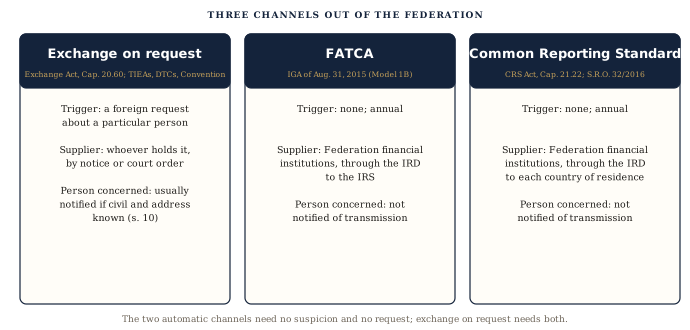
Exchange on request. A foreign competent authority asks for specified information about a particular person. The Financial Secretary, as the Federation's Tax Co-operation Authority, obtains it from whoever holds it, by notice or by court order, and sends it. The person concerned is usually told of a request that is not criminal, if the Authority knows where to find the person (see infra ¶ 2730).
FATCA. Financial institutions in the Federation identify accounts held by specified United States persons, or by entities with American controlling persons, and report them each year to the Inland Revenue Department, which sends the information to the Internal Revenue Service (see infra ¶¶ 2740–2750).
The Common Reporting Standard. Financial institutions identify accounts held by residents of other participating jurisdictions, and by entities whose controlling persons reside there, and report them to the Inland Revenue Department each year, which sends the information to each country of residence (see infra ¶¶ 2760–2770).
The two automatic channels require no suspicion and no request. The account holder is not notified of the transmission, though a well-run institution tells its customers at onboarding that their information may be reported.
The financial institution question. Under both automatic regimes, the first question about any Nevis entity is whether it is itself a financial institution. A trust whose trustee is a licensed trust company, or an LLC or foundation whose investments are managed with discretion by a bank or an investment manager, is commonly an investment entity, and so a reporting financial institution with registration, due diligence and filing obligations of its own. An entity that is not a financial institution has no obligations of its own; the bank or other institution that holds its accounts looks through it to its controlling persons and reports them. Either way, the persons behind the entity are identified. The classification decides only who reports, to which authority and in what form (see infra ¶¶ 2750, 2770; see supra ¶ 1780).
Limits of the chapter. The chapter states the Federation's legislation and the international instruments as they stood in November 2026. The Global Forum on Transparency and Exchange of Information for Tax Purposes reviews each member's laws and practice and publishes its findings; the latest completed second-round review of the Federation's exchange on request was published in 2018 and is used here (see infra ¶ 2730.06). Later monitoring reports and the Global Forum's reviews of automatic exchange should be checked for current ratings. American law is stated only so far as needed to explain the agreement; the United States returns are examined in chapter 29.
Terms. "Cap. 20.60" or "the Exchange Act" refers to the Saint Christopher and Nevis (Mutual Exchange of Information on Taxation Matters) Act. "The CRS Act" refers to the Common Reporting Standard (Automatic Exchange of Financial Account Information) Act, Cap. 21.22, and "the Regulations" to the regulations made under it, which the revised edition prints as its Third Schedule. "The Standard" is the Common Reporting Standard approved by the Council of the Organisation for Economic Co-operation and Development on July 15, 2014, with its Commentaries. "The agreement" or "the IGA" is the agreement between the Federation and the United States to improve international tax compliance and to implement FATCA, signed on August 31, 2015. "The Convention" is the Convention on Mutual Administrative Assistance in Tax Matters as amended by the 2010 Protocol.