

¶ 2101
Overview
Scope of the chapter. This chapter examines the rule under which a creditor of a settlor may reach property transferred to a Nevis international trust on the ground that the transfer defrauded that creditor. The rule is section 26 of the Nevis International Exempt Trust Ordinance, read with the limitation and procedural provisions of section 50. Nevis International Exempt Trust Ordinance, Cap. 7.03(N), §§ 26, 50 (rev. ed. 2017) ("NIETO"). The chapter also treats the parallel rules for transfers to a Nevis limited liability company and subscriptions to a multiform foundation, which follow the same design with different time periods. Nevis Limited Liability Company Ordinance, Cap. 7.04(N), § 61 (rev. ed. 2020) ("NLLCO"); Multiform Foundations Ordinance, Cap. 7.08(N), § 108 (rev. ed. 2017) ("MFO").
The design in one sentence. Nevis does not refuse to hear a creditor who says a transfer to a trust defrauded it. It hears the claim, but only if the creditor proves beyond reasonable doubt that the settlor's principal intent was to defraud that particular creditor and that the transfer left the settlor without the means to pay it; only if the transfer fell within one year after the creditor's cause of action accrued; only if the creditor sues in Nevis within two years of the transfer; and only to the extent of the settlor's former interest in the property. NIETO §§ 26(1), (3)–(4), (6), 50(1). Each of those conditions narrows the English rule that Nevis inherited, and each is examined below.
Why the chapter matters. Section 26 is the provision on which the protective value of a Nevis trust most depends. The bond, the refusal to recognize foreign judgments and the firewall provisions all assume that the creditor must sue afresh in Nevis (see infra chs. 22–23). When it does, section 26 decides what it must prove. A planner who understands the section can fund a trust in a way that a Nevis court will uphold. A planner who misreads it may fund the trust in a way that protects the assets in Nevis but exposes the settlor to an order in the settlor's home court (see infra ¶ 2180.05; ch. 25).
Plan of the chapter. Paragraph 2110 describes the English law of fraudulent conveyances that Nevis received and then displaced for international trusts. Paragraph 2120 examines the elements of section 26. Paragraph 2130 addresses the standard and burden of proof. Paragraph 2140 examines the time rules: when a cause of action accrues, the one-year rule of section 26(3) and the two-year limitation of section 50. Paragraph 2150 treats the solvency inquiry and its safe harbor. Paragraph 2160 describes the remedy and the protections given to beneficiaries. Paragraph 2170 compares the parallel rules for LLCs and foundations. Paragraph 2180 compares the Cook Islands, Belize and the United States, and explains how a foreign court sees the same transfer. Paragraph 2190 draws the planning lessons and closes with a checklist.
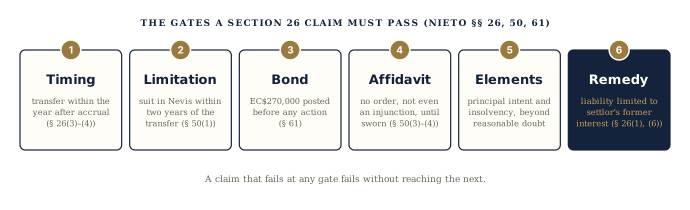
Terms. In this chapter transfer includes the settlement of a trust and any later disposition of property to it, as section 26 does. Accrual means the date on which the creditor's cause of action accrued, as defined in section 26(8). T0, T1 and T2 describe the timing of a transfer relative to a claim: before any claim exists, after the facts giving rise to a claim but before suit, and after suit or judgment. The terms are used in the same sense as in Lighthouse on Asset Protection, which carries the fuller comparative discussion of timing.
No reported Nevis decision. No reported decision of the High Court or the Eastern Caribbean Court of Appeal construing section 26 or section 50 has been located as of November 2026. The analysis in this chapter rests on the text of the Ordinance, on the English authorities that explain the rules it displaces, and on decisions of the Cook Islands courts on the provision from which section 26 is drawn. Proceedings concerning international trusts are heard in camera, so the absence of reported decisions does not mean that no claims have been brought (see supra ¶ 580).