

¶ 1401
Overview
The subject. This chapter examines the duties that the managers, officers and members of a Nevis limited liability company owe in running its affairs, the extent to which an operating agreement may shape those duties, and the provisions of the Nevis Limited Liability Company Ordinance that allocate the cost of claims arising from them. The Ordinance addresses the subject in four places: a standard of care for managers and officers in section 53, a validation rule for conflicted transactions in section 65, an indemnification and insurance code in section 66, and a passing reference in section 59(2) to the "fiduciary obligations for which members are responsible, if any". NLLCO §§ 53, 59(2), 65, 66. Everything else comes from the general law that section 3(2) directs the court to consult.
Why the subject matters in Nevis. A Nevis LLC is most often used as a holding vehicle: for a family's investments, for an operating business conducted elsewhere, or as the asset-holding entity beneath a trust (see infra ch. 30). In those structures the manager is frequently a professional, a family member or the trustee of a trust that owns the membership interests, and the members are frequently unrelated to the day-to-day decisions. The duties of the manager are the members' principal protection against misuse of the company's assets. They are also, from the manager's side, the principal source of personal exposure, which is why the indemnification and insurance provisions deserve as much attention in the operating agreement as the duties themselves.
The Ordinance compared. The Ordinance takes a position between the two American models examined in Lighthouse on Limited Liability Companies. The Delaware act states no duties, imports them from equity and allows the LLC agreement to eliminate them, subject to the implied covenant of good faith and fair dealing. Del. Code Ann. tit. 6, § 18-1101(c), (e). The Revised Uniform Limited Liability Company Act states the duties of loyalty and care in the statute and limits the agreement's power to alter them. Rev. Unif. Ltd. Liab. Co. Act §§ 105, 409 (2013). The Nevis Ordinance states a standard of care, says nothing in terms about loyalty, and contains no provision of the kind found in Delaware that permits the agreement to expand, restrict or eliminate duties. The comparative treatment of the American models appears in Lighthouse on Limited Liability Companies (see Lighthouse on Limited Liability Companies chs. 3, 21–24).
The sources of law. Three bodies of law supply the content of the duties of a Nevis LLC manager. The first is the Ordinance. The second is the common law and equity of England as received in the Federation (see supra ch. 2), which supplies the rules on fiduciary loyalty developed for trustees, agents, partners and company directors. The third is the construction of "similar laws in other jurisdictions", to which section 3(2) refers. NLLCO § 3(2). The High Court has held that section 3(2) is a rule about the meaning of the Ordinance and does not license the import of foreign remedies that the Ordinance does not contain (see supra ¶¶ 260.05, 1220.06; infra ¶ 1420.05). English company-law decisions on directors' duties are therefore likely to be the Nevis court's first point of reference on loyalty, and American LLC decisions its point of reference on the meaning of terms the Ordinance shares with American statutes.
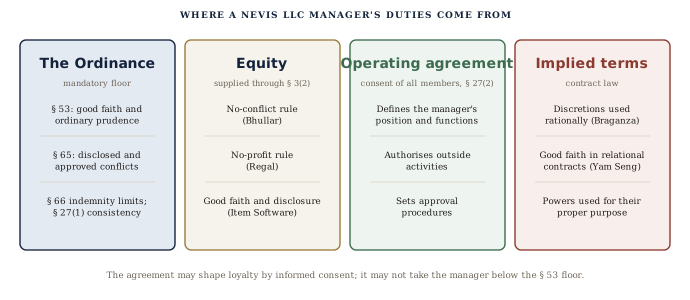
Plan of the chapter. Paragraph 1410 sets out what the Ordinance says and what it omits. Paragraph 1420 identifies who owes duties and to whom, and examines the High Court's refusal in SM Life Ventures to import American close-corporation duties among members. Paragraph 1430 examines the duty of loyalty, with case discussions of Regal (Hastings) Ltd v. Gulliver and Bhullar v. Bhullar. Paragraph 1440 examines good faith and the duty to disclose, with a case discussion of Item Software (UK) Ltd v. Fassihi, and the interests of creditors when the company is in financial difficulty. Paragraph 1450 examines the statutory standard of care. Paragraph 1460 examines the operating agreement's power to modify duties and the terms the law implies into it. Paragraph 1470 examines conflicted transactions under section 65. Paragraph 1480 examines exculpation, indemnification, advancement and insurance. Paragraph 1490 examines enforcement and remedies and closes with model provisions and a checklist. Members' rights and the operating agreement generally are examined in chapter 13 (see supra ch. 13); charging orders in chapter 15 (see infra ch. 15); and judicial dissolution in chapter 16 (see infra ch. 16).