

¶ 101
Overview
Scope of the chapter. Nevis is an island in the Leeward Islands of the Eastern Caribbean. It is the smaller of the two islands that form the Federation of Saint Christopher and Nevis, an independent state since September 19, 1983. For four decades it has also been a center for international trusts, limited liability companies, business corporations and foundations formed for owners who live elsewhere. This chapter explains how a small island within a federation came to legislate for that business, what the Constitution allows it to do, and what follows for a planner who uses Nevis law. The later chapters examine each statute in detail; this chapter supplies the constitutional and institutional frame in which they operate.
The constitutional basis of the Nevis statutes. The statutes on which this treatise is built are not Acts of the federal Parliament. They are Ordinances of the Nevis Island Legislature, made under a grant of legislative power in Chapter X of the Constitution of Saint Christopher and Nevis. The Constitution gives the Nevis Island Legislature exclusive power to make laws for Nevis on a list of "specified matters" in Schedule 5, which includes "industries, trades and businesses." Const. of Saint Christopher and Nevis 1983, §§ 37(2), 103(1), sched. 5, pt. 1, item 14. The Nevis International Exempt Trust Ordinance, the Nevis Limited Liability Company Ordinance, the Nevis Business Corporation Ordinance and the Multiform Foundations Ordinance all rest on that grant. A planner who relies on any of them is relying, at one remove, on the federal bargain struck in 1983 (see infra ¶¶ 110, 120).
Four statutes, one registry. Four Ordinances carry most of the international business conducted in Nevis:
- the Nevis Business Corporation Ordinance, Cap. 7.01(N), first enacted in 1984 and replaced by Ordinance No. 1 of 2017 with effect from January 1, 2018;
- the Nevis International Exempt Trust Ordinance, Cap. 7.03(N), in force since May 1, 1994;
- the Nevis Limited Liability Company Ordinance, Cap. 7.04(N), first enacted in 1995 and replaced by Ordinance No. 2 of 2017 with effect from January 1, 2018; and
- the Multiform Foundations Ordinance, Cap. 7.08(N), enacted as Ordinance No. 2 of 2004.
Entities formed under them are registered with the Nevis registry of companies, trusts and foundations, and the service providers who form and administer them are licensed and supervised by the Nevis Branch of the Financial Services Regulatory Commission (see infra ¶ 150). The growth of each statute is traced at ¶ 140.
Why the frame matters. A trust deed or operating agreement that chooses Nevis law draws its strength from three sources: the text of the Ordinance; the courts that will apply it, which are the courts of the Eastern Caribbean Supreme Court with a final appeal to the Judicial Committee of the Privy Council; and the political and constitutional arrangements that keep the Ordinance in force and allow it to be amended. Practitioners tend to study the first and take the other two for granted. The second is examined in chapter 3 (see infra ch. 3). The third is the subject of this chapter. It explains why the Nevis statutes can be amended quickly by a small legislature, why a few subjects, such as taxation of income, lie outside Nevis's competence, and why the Federation's international commitments reach Nevis entities even though Nevis makes its own business law (see infra ¶¶ 120, 170).
The size of the sector. The Federation's 2021 national risk assessment published the number of entities on the Nevis registry for each year from 2016 to 2020. At the end of the period the registry held 9,104 business corporations, 3,433 limited liability companies, 553 international exempt trusts, 16 qualified foreign trusts and 107 multiform foundations, a total of 13,213 entities, up from 7,542 in 2016. National Risk Assessment for St. Kitts and Nevis 2021, at 23 tbl. 6 (source: Registry of Companies, Trusts and Foundations, Nevis). The figures show an LLC sector that nearly doubled in five years and a trust sector that grew by more than four-fifths. They are examined at ¶ 140.07.
The plan of the chapter. The chapter proceeds in order. It describes the Federation and its history (see infra ¶ 110); the Constitution of 1983 and the competence of the Nevis Island Legislature (see infra ¶ 120); how Nevis law is made, published and consolidated (see infra ¶ 130); the growth of the financial-services statutes (see infra ¶ 140); the institutions that administer them (see infra ¶ 150); Nevis in comparison with the Cook Islands and Belize (see infra ¶ 160); international standards and information exchange (see infra ¶ 170); the considerations that bear on a decision to use Nevis (see infra ¶ 180); and the plan of the treatise (see infra ¶ 190).
¶ 110
The Federation and Its History
Colonial origins. English settlers arrived on Saint Christopher, commonly called St Kitts, in the 1620s, and a party from St Kitts settled Nevis in 1628. The two islands were contested with France for much of the seventeenth and eighteenth centuries, and British sovereignty was settled by the Treaty of Versailles in 1783. That separate history is the first thing to understand about the Federation. Nevis did not grow out of St Kitts; it was joined to it, and the terms of the joining have been the main question of the islands' constitutional politics ever since.
Union and the West Indies. In 1883 St Kitts, Nevis and Anguilla were combined under a single administration with a single legislature sitting on St Kitts. The islands then passed through the larger regional experiments of the twentieth century, including membership as a single unit of the West Indies Federation from 1958 until its dissolution in 1962. When the federation failed, the United Kingdom offered its smaller Caribbean colonies "associated statehood," a status under which the colony governed itself in internal matters while the United Kingdom kept responsibility for defense and external affairs. Saint Christopher, Nevis and Anguilla became an associated state in 1967, under a constitution order of that year that remained in force until independence.
Anguilla's departure. Associated statehood did not hold the three islands together. Anguilla rejected government from St Kitts almost at once after 1967 and was administered separately by the United Kingdom, and its separation from the associated state was formalized by 1980. The episode shaped the 1983 settlement. It showed that a small island which did not consent to its government from a larger neighbor could not be held by legal forms alone. It also gave Nevisian politicians a precedent that they invoked in the negotiations that followed. A constitution that kept Nevis in the Federation would have to give Nevis real powers and a lawful way out.
Independence and the 1983 Constitution. The constitutional conference held in London in 1982 agreed that St Kitts and Nevis would become independent as a federal state, with entrenched autonomy for Nevis. The Saint Christopher and Nevis Constitution Order 1983, made on June 22, 1983, provided that the Constitution set out in its first schedule would take effect on September 19, 1983, and revoked the associated-state constitution order of 1967 from the same date. Saint Christopher and Nevis Constitution Order 1983, S.I. 1983/881, § 3. The Constitution declares that Saint Christopher and Nevis is "a sovereign democratic federal state." Const. of Saint Christopher and Nevis § 1(1). It is a Commonwealth realm: the Crown is represented by a Governor-General, with a Deputy Governor-General in Nevis appointed on the advice of the Premier of Nevis. Id. § 23(2). Chapter X of the Constitution creates the Nevis Island Legislature, the Nevis Island Assembly and the Nevis Island Administration, and gives the Legislature its own legislative competence (see infra ¶ 120).
An asymmetric federation. The Federation has two units, but only one has its own legislature. St Kitts has no separate island assembly; its affairs are governed by the federal Parliament and Government. Nevis has both a voice in the federal Parliament, through the members elected from Nevis constituencies, and its own island legislature and administration for the specified matters. Students of federalism describe the result as an asymmetric federation. For the practitioner the asymmetry has a simple consequence: there are two bodies of law that may govern a client's entity. A company or trust formed in St Kitts is governed by federal Acts, such as the Companies Act, Cap. 21.03, the Trusts Act, Cap. 5.19, and the Foundations Act, Cap. 21.19; an entity formed in Nevis is governed by the Nevis Ordinances. National Risk Assessment for St. Kitts and Nevis 2021, at 24 (listing both sets of statutes). The two regimes have separate registries and different rules. This treatise is concerned with the Nevis regime.
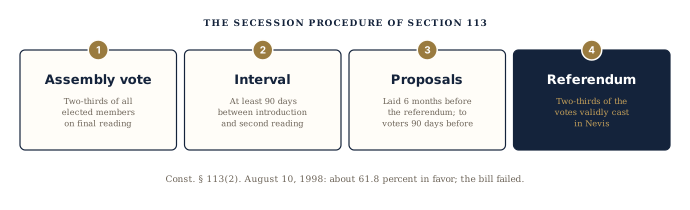
The 1998 secession referendum. The Constitution allows Nevis to leave the Federation, but only by a demanding procedure (see infra ¶ 120.07). That procedure has been used once. In a referendum held on August 10, 1998, 2,427 votes, about 61.8 percent of the votes cast, were in favor of secession and 1,498 against. The proposal failed because it fell short of the two-thirds majority the Constitution requires. The result is important in two ways. It shows that secession is a real political question, which a planner should not dismiss. It also shows that the constitutional safeguards work as designed: a clear majority was not enough, and the Federation continued without disruption to the Nevis statutes or the entities formed under them.
The currency and the region. The Federation is a member of the Eastern Caribbean Currency Union and uses the Eastern Caribbean dollar, which is fixed to the United States dollar at EC$2.70 to US$1. The fixed rate matters to the Nevis statutes because several of them state monetary amounts in Eastern Caribbean dollars. The creditor's bond under the trust Ordinance, for example, is EC$270,000, which is about US$100,000. Nevis International Exempt Trust Ordinance, Cap. 7.03(N), § 61 (rev. ed. 2017) (see infra ch. 22). The Federation is also a member of the Eastern Caribbean Supreme Court system, which supplies its courts (see infra ¶ 150.05; ch. 3).
¶ 120
The 1983 Constitution and the Competence of the Nevis Island Legislature
The Nevis Island Legislature. The Constitution establishes for Nevis a legislature styled the Nevis Island Legislature, consisting of the Crown and the Nevis Island Assembly. Const. of Saint Christopher and Nevis § 100. The Assembly has elected members, one for each Nevis electoral district, and nominated members. The number of nominated members is at least three and no more than two-thirds of the number of elected members; one-third of them are appointed on the advice of the Leader of the Opposition in the Assembly and the rest on the advice of the Premier. Id. § 101. The structure mirrors the federal National Assembly on a smaller scale.
The Nevis Island Administration. Executive authority for Nevis's affairs lies with the Nevis Island Administration, consisting of a Premier and at least two other members. The Governor-General appoints as Premier the elected member of the Assembly who appears likely to command the support of a majority of the elected members, and appoints the other members on the Premier's advice. The Administration is collectively responsible to the Assembly. Id. § 102. Section 106 gives the Administration exclusive responsibility for the administration of Nevis's affairs in a list of subjects, among them airports and seaports, education, health and welfare and labor, subject to a rule that it may not act against national policy on matters of national concern without the prior concurrence of the Prime Minister. Id. § 106. The Administration keeps its own Nevis Island Consolidated Fund. Id. § 108.
The grant of legislative power. The key provision for this treatise is section 103(1):
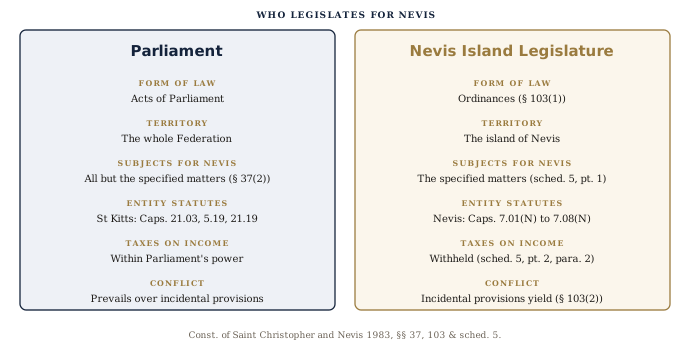
The "specified matters" are listed in Part 1 of Schedule 5. They include agriculture; amenities for tourists; borrowing by the Administration; economic planning and development other than national planning and development; the employment of persons who are not citizens; hotels, restaurants and casinos; housing; "industries, trades and businesses"; land and buildings, other than land vested in the Crown for the Government's use, including the holding of land by persons who are not citizens; electricity and water; roads; and any matter incidental or supplementary to a listed matter. Id. sched. 5, pt. 1. Every Nevis financial-services Ordinance is, constitutionally, a law about "industries, trades and businesses."
Exclusivity. The grant is exclusive. Parliament may make laws for the peace, order and good government of the whole Federation, but its power to make laws for Nevis "shall not extend to any of the specified matters." Id. § 37(1)–(2). On those matters only the Nevis Island Legislature can legislate for Nevis. Three qualifications apply. First, Parliament may legislate on a specified matter for Nevis where the law declares that it was enacted at the request and with the consent of the Nevis Island Administration; the provision then takes effect as if the Nevis Island Legislature had made it and may be amended or revoked by that Legislature. Id. § 37(3). Second, the Governor-General may, in the interests of external affairs or defense, proclaim that a federal law on a specified matter applies in Nevis, but only on the advice of the Prime Minister given with the concurrence of the Premier. Id. § 37(4), (7). Third, Parliament may add to the list of specified matters by a bill supported by two-thirds of all the Representatives, but it may not shorten the list in that way. Id. § 37(6).
The limits of Nevis's competence. Two limits on Nevis's power matter to the financial-services statutes. The first concerns incidental provisions. A Nevis Ordinance may contain incidental and supplementary provisions that relate to matters outside the specified list, but where such a provision conflicts with a law enacted by Parliament, the federal law prevails. Id. § 103(2). A Nevis trust or LLC Ordinance that contains a rule of procedure, evidence or court jurisdiction relies on that incidental power, and its rule is secure only so long as no federal law contradicts it. The second limit concerns taxation. Part 2 of Schedule 5 lets Nevis impose fees and charges for services, rates and taxes on land and buildings, and certain taxes on hotels, alcohol and tobacco, but it expressly withholds any power to impose taxes on income or capital gains, duties on imports or exports, or taxes on the succession to or transfer of property. Id. sched. 5, pt. 2, paras. 1–2. The tax exemptions in the Nevis Ordinances therefore operate against a background in which the power to tax income lies with the federal Parliament (see infra ch. 26).
Entrenchment. The Nevis provisions of the Constitution are protected against amendment by the federal majority. A bill to alter the Constitution requires the votes of two-thirds of all the Representatives in the National Assembly. Id. § 38(2). A bill to alter the provisions listed in Part 1 of Schedule 1, which include section 37, Chapter X (except sections 104 and 108(2)) and Schedules 2 and 5, or the entrenched provisions of the Supreme Court Order listed in Part 2 of that schedule, also requires an interval of ninety days between its introduction and its second reading and the approval of two-thirds of the valid votes cast in a referendum held in St Kitts and two-thirds of those cast in a referendum held in Nevis. Id. § 38(3) & sched. 1. Schedule 2, which is entrenched in the same way, guarantees Nevis at least three of the federal constituencies, and at least one-third of them if their number rises above eleven. Const. of Saint Christopher and Nevis sched. 2, r. 1. Changes to the way section 104 applies the federal parliamentary provisions to the Nevis Island Assembly require the request or consent of the Assembly by resolution. Id. § 38(5). The double referendum requirement means that the voters of St Kitts cannot by themselves remove Nevis's legislative competence.
Secession. Section 113 gives Nevis a lawful means of leaving the Federation. The Nevis Island Legislature may provide that Nevis shall cease to be federated with St Kitts, and that the Constitution shall no longer have effect in Nevis. Id. § 113(1). The bill must be supported on its final reading by at least two-thirds of all the elected members of the Assembly; there must be an interval of at least ninety days between its introduction and its second reading; full and detailed proposals for the future constitution of Nevis must be laid before the Assembly for at least six months before the referendum and made available to voters at least ninety days before it; and the bill must be approved in a referendum in Nevis by at least two-thirds of all the votes validly cast. Id. § 113(2). Only persons entitled to vote in Nevis elections may vote, and the Supervisor of Elections conducts the referendum. Id. § 113(3)–(8). If Nevis secedes, the transitional provisions of Schedule 3 take effect. Id. § 115. The 1998 referendum failed the two-thirds requirement (see supra ¶ 110.06).
Secession and the Nevis statutes. Secession would end the application of the federal Constitution in Nevis, but it would not by itself repeal the Nevis Ordinances. Those Ordinances are laws of Nevis, made by the Nevis Island Legislature, and a newly independent Nevis would ordinarily continue its existing laws under the transitional provisions of its new constitution. The practical risks of secession lie elsewhere: in the period of uncertainty before and after a vote, in the treatment of federal laws that support the Nevis regime (the regulator's statute, the anti-money-laundering laws and the tax information exchange agreements are federal), and in the new state's relationship with the Eastern Caribbean Supreme Court and the Privy Council. These risks are considered at ¶ 180.04.
Disputes between the Administration and the Government. The High Court has original jurisdiction, to the exclusion of any other court, in any dispute between the Nevis Island Administration and the federal Government that involves a question on which the existence or extent of a legal right depends. Id. § 112. The provision has not been the subject of reported litigation over the financial-services statutes, but it supplies the forum in which a dispute over whether a federal Act intrudes on a specified matter would be decided.

¶ 130
Making Nevis Law: Ordinances, Assent, Publication and the Revised Editions
Bills and assent. The Constitution applies to the Nevis Island Assembly, with modifications, the provisions that govern the federal National Assembly's procedure, including the provisions on the passage of bills, assent and publication. Const. of Saint Christopher and Nevis § 104(1). As applied, the power to make laws is exercised by bills passed by the Assembly and assented to on behalf of the Crown; when assent is given, the bill becomes law and is published in the Gazette. Id. §§ 42(1)–(3), 104(1). No law comes into operation until it has been published in the Gazette, but the Legislature may postpone its coming into operation. Id. §§ 42(4), 104(1). The Nevis financial-services Ordinances frequently use that power: an Ordinance is passed and published, and a commencement order or a section of the Ordinance fixes the date on which it takes effect. The Nevis Trust and Corporate Service Providers Ordinance 2021, for example, was brought into force by a separate commencement order. The planner who reads an Ordinance must therefore confirm both its publication and its commencement.
Financial measures. A bill that would impose or alter taxation, other than by reduction, or charge the Nevis Island Consolidated Fund may proceed in the Nevis Island Assembly only on a recommendation signified by the Premier. Id. §§ 43, 104(1). Fees payable on the formation and annual renewal of entities are fixed by regulations made under the Ordinances, which Nevis amends from time to time. The most recent round of fee regulations for trusts, corporations, LLCs and foundations was made in 2024. E.g., Nevis International Exempt Trust (Fees) (Amendment) Regulations, 2024, S.R.O. No. 12 of 2024 (N); Multiform Foundations (Amendment) Regulations, 2024, S.R.O. No. 11 of 2024 (N).
Citation. Nevis Ordinances are cited by chapter number in the revised laws, with the suffix "(N)" to mark a Nevis Ordinance: the trust Ordinance is Cap. 7.03(N), the LLC Ordinance Cap. 7.04(N). Subsidiary legislation is cited by statutory rules and orders number, also marked "(N)". Federal Acts carry chapter numbers without the suffix, so that the federal Financial Services Regulatory Commission Act is Cap. 21.10. An amending Ordinance enacted after the most recent revised edition is cited by its own number and year, as in the Nevis Limited Liability Company (Amendment) Ordinance, No. 4 of 2025. This treatise cites the revised edition by chapter and section, with the date of the edition, and adds the amending Ordinance where a section has been changed since. Section numbers are given with "§" in keeping with the Bluebook practice of the companion volumes.
The Revised Editions. The current consolidated texts of the Nevis Ordinances are revised editions prepared by the Law Commission under the Law Commission Act, Cap. 1.03, and printed for the Government by the Regional Law Revision Centre in Anguilla. Each edition states the date as at which it shows the law and lists the enactments it consolidates. The editions relied on in this treatise are:
Table 1-1. The principal Nevis financial-services Ordinances
| Ordinance | Chapter | Enactment consolidated | Revised edition | Later amending Ordinances |
|---|---|---|---|---|
| Nevis Business Corporation Ordinance | Cap. 7.01(N) | No. 1 of 2017, in force Jan. 1, 2018 (replacing the 1984 Ordinance); amended Nos. 6 of 2018, 6 of 2019 | As at Dec. 31, 2020 | 2022; No. 2 of 2023; No. 5 of 2025 |
| Nevis International Exempt Trust Ordinance | Cap. 7.03(N) | In force May 1, 1994; amended Nos. 2 of 1995, 2 of 2000, 4 of 2009, 1 of 2011, 2 of 2015 | As at Dec. 31, 2017 | None located |
| Nevis Limited Liability Company Ordinance | Cap. 7.04(N) | No. 2 of 2017, in force Jan. 1, 2018 (replacing the 1995 Ordinance); amended Nos. 7 of 2018, 7 of 2019 | As at Dec. 31, 2020 | No. 2 of 2022; No. 3 of 2023; No. 4 of 2025 |
| Multiform Foundations Ordinance | Cap. 7.08(N) | No. 2 of 2004; amended No. 2 of 2011 | As at Dec. 31, 2017 | None located |
Sources: the revised editions and amending Ordinances published by the Financial Services Regulatory Commission (Nevis Branch), https://www.nevisfsrc.com (last visited Nov. 5, 2026).
Renumbering. Revision renumbers sections. A section inserted by an amending Ordinance as section 8A, for example, appears in the revised edition under a new whole number, with the following sections renumbered after it, and the revised edition notes the change in the margin. The trust Ordinance's fraudulent-disposition section, originally section 24, is section 26 in the 2017 revised edition, and its foreign-judgments section, originally section 28, is now section 30. Older secondary sources and court decisions cite the original numbers. A planner who finds a reference to "section 24 of the Nevis trust Ordinance" should read it as a reference to what is now section 26 and should check that the text has not been changed since.
Drafts and proposals. Not every published text is law. A 2020 consultation draft of a replacement trust Ordinance used a different section numbering; there is no record of its enactment, and the Financial Services Regulatory Commission continues to publish Cap. 7.03(N) as the governing text. The fee regulations made in December 2024 recite section 64 of Cap. 7.03(N) as their authority, which confirms that the 1994 Ordinance, as revised, remains in force. The planner should cite the revised edition and should not cite the draft.
Federal Acts that affect Nevis entities. Federal law also governs parts of the Nevis regime. The regulator is a federal body created by the Financial Services Regulatory Commission Act, Cap. 21.10, which was amended in 2026. The anti-money-laundering statutes, the tax information exchange agreements and the legislation implementing FATCA and the Common Reporting Standard are federal. So are the Virtual Asset Act 2020 and its amendments. Each of these laws reaches Nevis entities and the service providers who administer them (see infra ¶¶ 150, 170; chs. 27–28). A complete statement of the law governing a Nevis structure therefore cites both Nevis Ordinances and federal Acts.
The common law and English authority. The Ordinances do not codify all of the law that governs a Nevis trust, company or foundation. Matters the Ordinances do not address are governed by the common law and equity, which Nevis receives from England, and the courts of the Eastern Caribbean Supreme Court treat English decisions as highly persuasive. Some Nevis Ordinances themselves refer to the general law: the Multiform Foundations Ordinance, for example, applies the trust, corporation, LLC or partnership law of Nevis to a foundation, according to its stated form, where its constitution chooses no other law. Multiform Foundations Ordinance, Cap. 7.08(N), § 10(9) (rev. ed. 2017). The reception of English law and the weight of English authority are examined in chapter 2 (see infra ch. 2).
¶ 140
The Growth of the Financial-Services Statutes
The pattern. Nevis built its financial-services law in stages over four decades: a business corporation statute in 1984, an international trust statute in force in 1994, an LLC statute in 1995, an offshore banking statute in 1996 and a foundations statute in 2004. In 2017 it replaced the corporation and LLC statutes with new Ordinances, and since 2018 it has amended all of them to meet international standards on tax and transparency. Each stage answered a demand from the international market or a requirement imposed from outside, and each is visible in the text of the current law.
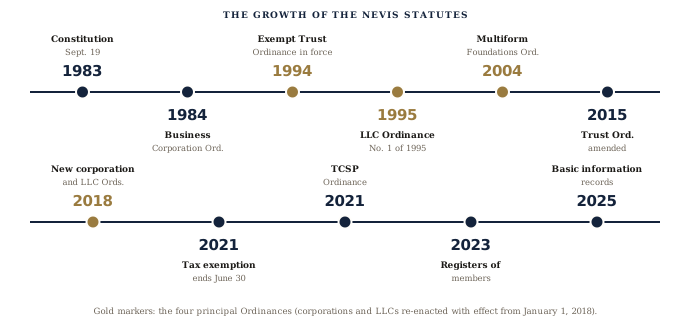
1984: the business corporation. The first statute was the Nevis Business Corporation Ordinance of 1984, enacted in the year after independence. The Nevis financial services department described it in 2000 as "modeled in large part on the United States Delaware Corporate statutes," combined with English law. Agatha Jeffers-Gooden, International Financial Services in Nevis (Nevis Fin. Servs. Dev. & Mktg. Dep't, Nov. 10, 2000). A Nevis corporation is the island's version of what other jurisdictions call an international business corporation. Its shareholders, directors and officers may be of any nationality and resident anywhere, it may redomicile into and out of Nevis, and must keep a licensed Nevis registered agent, whose office is its registered office. Fin. Servs. Regul. Comm'n (Nevis Branch), Corporations, https://www.nevisfsrc.com/services/ibcs/ (last visited Nov. 5, 2026). The 1984 Ordinance was repealed and replaced by the Nevis Business Corporation Ordinance, No. 1 of 2017, which took effect on January 1, 2018 and has since been amended several times. Nevis Business Corporation Ordinance, Cap. 7.01(N), long title (rev. ed. 2020). Corporations are treated in this treatise only where they are used with trusts, LLCs and foundations (see infra chs. 17, 30).
1994: the international exempt trust. The Nevis International Exempt Trust Ordinance came into force on May 1, 1994. It followed the model of the Cook Islands International Trusts Act 1984, which had established the modern asset-protection trust: a statutory rule that a transfer to the trust can be attacked only on proof beyond reasonable doubt of the settlor's principal intent to defraud the particular creditor, short limitation periods, non-recognition of foreign judgments, and express validation of settlor-retained powers and protectors. Nevis Int'l Exempt Trust Ordinance, Cap. 7.03(N), §§ 26, 30, 50 (rev. ed. 2017). Nevis added features of its own, including the creditor's bond and a one-year rule for transfers made after a cause of action accrued (see infra ¶ 160.03; chs. 21–22). The Ordinance has been amended five times, most extensively in 2015, when an amending Ordinance substituted or inserted many sections, including the provision on the creditor's bond. Id. § 61 (as amended by Ordinance No. 2 of 2015). Part II of this treatise examines the Ordinance in full (see infra chs. 5–11).
1995 and 2017: the limited liability company. Nevis enacted an LLC Ordinance in 1995, the Nevis Limited Liability Company Ordinance, No. 1 of 1995 (N), following the American model of a company with members and managers whose rights are fixed by an operating agreement. In 2017 it repealed the 1995 Ordinance and replaced it with the Nevis Limited Liability Company Ordinance, No. 2 of 2017, in force from January 1, 2018. Companies validly registered under the 1995 Ordinance continued to be registered under the new one, and causes of action accrued or pending at its commencement were preserved. Nevis Ltd. Liab. Co. Ordinance, Cap. 7.04(N), § 104(1)–(2), (4) (rev. ed. 2020). The 2017 Ordinance made the charging order the exclusive remedy of a member's judgment creditor whether the company has one member or many, barred foreclosure, limited a charging order to three years without renewal and expressly allowed an LLC, if its operating agreement so provides, to pay its members' income taxes directly to the taxing authority without the payment being treated as a distribution. Nevis Ltd. Liab. Co. Ordinance, Cap. 7.04(N), § 60(5), (6), (15), (18) (rev. ed. 2020). It has since been amended five times: in 2018 and 2019 to end the LLC tax exemption, in 2022 to add mergers and dissenters' rights, in 2023 to provide for electronic filing and registers of members and managers, and in 2025 to require basic information records. Part III examines the Ordinance (see infra chs. 12–17).
2004: the multiform foundation. The Multiform Foundations Ordinance, No. 2 of 2004, introduced a vehicle unique to Nevis. A multiform foundation is registered with a stated "multiform" that determines how it is treated: as a trust, a company, a partnership or an ordinary foundation. If the multiform is a trust, its by-laws are treated as the trust deed, its management board as the trustees, its subscriber as the settlor and its supervisory board as the protector; if a company, the corporation or LLC Ordinance applies to it with the necessary changes; if a partnership, the Nevis law of partnerships or the LLC Ordinance applies. Multiform Foundations Ordinance, Cap. 7.08(N), § 10(9) (rev. ed. 2017). The foundation may change its multiform during its life, subject to the Registrar's power to reject a constitution that does not conform to the stated form. Id. § 10(2), (7). The Minister may by regulation add other multiforms. Id. § 10(10). The Ordinance was amended in 2011, and regulations made under it have been amended several times, most recently in 2024. Part IV examines the foundation (see infra chs. 18–20).
2018 onward: the international-standards amendments. The amendments of the past decade have a common source. In 2017 and 2018 the European Union and the OECD pressed small financial centers to end preferential tax regimes for entities owned by non-residents and to improve the availability of beneficial-ownership information. The Federation committed to reform. Nevis amended its corporation and LLC Ordinances in 2018 and 2019 so that the exemption of Nevis companies from Nevis tax on income and assets originating outside the Federation ended, at the latest, on June 30, 2021. Nevis Ltd. Liab. Co. Ordinance § 96(1), (5). In 2021 it enacted the Nevis Trust and Corporate Service Providers Ordinance, which licenses and supervises the professionals who form and administer Nevis entities. In 2023 and 2025 it required LLCs and corporations to keep registers of members and managers and records of basic information (see infra ¶ 170; ch. 28). These measures changed the economics and the transparency of Nevis entities without changing the protective rules on which their use in planning depends.
The registry in numbers. The national risk assessment published in 2021 reported the number of entities on the Nevis registry at each year end from 2016 to 2020.
Table 1-2. Entities on the Nevis registry, 2016–2020
| Entity | 2016 | 2017 | 2018 | 2019 | 2020 |
|---|---|---|---|---|---|
| Business corporations | 5,388 | 6,481 | 7,484 | 8,256 | 9,104 |
| Limited liability companies | 1,826 | 2,134 | 2,482 | 2,917 | 3,433 |
| International exempt trusts | 299 | 338 | 397 | 471 | 553 |
| Qualified foreign trusts | 8 | 8 | 8 | 8 | 16 |
| Multiform foundations | 21 | 38 | 81 | 94 | 107 |
| Total | 7,542 | 8,999 | 10,452 | 11,746 | 13,213 |
Source: National Risk Assessment for St. Kitts and Nevis 2021, at 23 tbl. 6 (citing the Registry of Companies, Trusts and Foundations, Nevis).
Three points stand out. The LLC population grew by 88 percent over the period and the trust population by 85 percent, while corporations grew by 69 percent. Foundations grew fivefold from a small base. And the trust figures are small in absolute terms: 553 registered international trusts in 2020. A Nevis trust is a specialist instrument used by a limited number of clients, usually together with an LLC, while corporations and LLCs serve a much larger market for holding and trading companies.
The pace of change. A small legislature can amend its law quickly. The Nevis Ordinances have been amended often, sometimes in several respects in a single year, and fee and forms regulations change more often still. That responsiveness is an advantage when a gap in the law needs to be filled or an international standard met, and a risk when an amendment is made without wide consultation. The practical lesson is that no Nevis structure should be set up on the basis of a secondary summary of the law. The planner should obtain the current revised edition and every later amending Ordinance and regulation, and should ask Nevis counsel to confirm that nothing later has been gazetted (see supra ¶ 130.04).

¶ 150
The Institutions
The institutional map. Five sets of institutions administer the Nevis regime: the Nevis Island Administration, which proposes the Ordinances and makes the regulations under them; the Nevis Island Assembly, which enacts the Ordinances; the Financial Services Regulatory Commission and its Nevis Branch, which supervise service providers and financial businesses; the Nevis registry of companies, trusts and foundations, which registers entities; and the courts of the Eastern Caribbean Supreme Court and the Privy Council. Figure 1.4 shows how they relate. This section describes each in outline; the regulator is treated fully in chapter 4 and the courts in chapter 3 (see infra chs. 3–4).
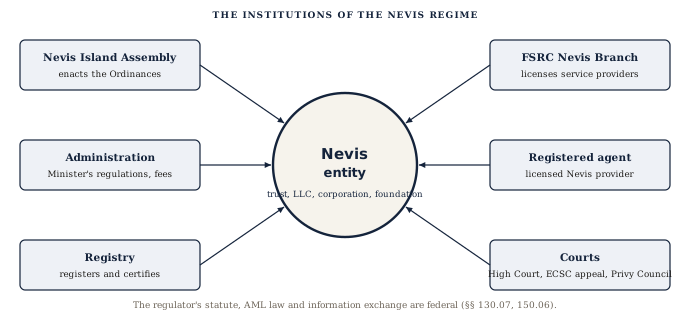
The Administration and the Minister. The Nevis Ordinances give rule-making powers to the Minister named in each Ordinance, a member of the Nevis Island Administration. The Minister makes the fee and forms regulations under each Ordinance and, under the Multiform Foundations Ordinance, may by regulation add new multiforms and specify their terms. Multiform Foundations Ordinance, Cap. 7.08(N), § 10(8), (10) (rev. ed. 2017). Policy for the financial-services sector is set by the Administration, which also conducts its international marketing. In the trust Ordinance, the creditor's bond is deposited with the Permanent Secretary in the Ministry of Finance of the Administration. Nevis Int'l Exempt Trust Ordinance, Cap. 7.03(N), § 61 (rev. ed. 2017).
The regulator. The Financial Services Regulatory Commission is a federal body established by the Financial Services Regulatory Commission Act, Cap. 21.10, and amended most recently by the Financial Services Regulatory Commission (Amendment) Act, 2026, No. 5 of 2026, with administrative penalty regulations made in the same year. Its Nevis Branch, in Charlestown, supervises the Nevis financial sector. Fin. Servs. Regul. Comm'n (Nevis Branch), Supervision, https://www.nevisfsrc.com/regulatory-framework/supervision/ (last visited Nov. 5, 2026). The Branch licenses and supervises trust and corporate service providers under the Nevis Trust and Corporate Service Providers Ordinance 2021, as well as international banks, insurers, money services businesses and virtual asset businesses. It publishes the revised editions of the Ordinances, the amending Ordinances and the fee regulations, and its list of licensed trust and corporate service providers had fifty entries in November 2026. The Commission's federal constitution and Nevis Branch reflect the division of the Constitution: Nevis makes its own business law, while the supervisory framework that international standards require is built on a federal statute (see infra ch. 4).
The registry. Entities formed under the Nevis Ordinances are registered in Nevis by the Registrar of Companies and the registrars of trusts and foundations. The registry issues certificates of incorporation, formation, registration and establishment, certificates of good standing and incumbency, and records amendments, dissolutions and continuations. The trust register is not open to public inspection except with the trustee's written authority. Nevis Int'l Exempt Trust Ordinance § 46. The 2021 risk assessment describes the registries as maintaining electronic and manual records and working closely with the Financial Intelligence Unit. National Risk Assessment for St. Kitts and Nevis 2021, at 22–23. Every Nevis entity must keep a Nevis registered agent, a licensed service provider whose office serves as its registered office, and the registry deals with the agent.
The courts. Civil proceedings in Nevis are heard by the High Court of Justice of the Eastern Caribbean Supreme Court, sitting in the Nevis Circuit. Appeals lie to the Court of Appeal of the Eastern Caribbean Supreme Court and from there to the Judicial Committee of the Privy Council. The Eastern Caribbean Supreme Court was established in 1967 by the West Indies Associated States Supreme Court Order, No. 223 of 1967, and serves nine member states and territories. E. Caribbean Sup. Ct., About the Court, https://www.eccourts.org/about-the-court/ (last visited Nov. 5, 2026). Several of the Order's provisions are entrenched in the Federation's Constitution, so that they may be changed only by the procedure, including the double referendum, that applies to the Nevis provisions themselves. Const. of Saint Christopher and Nevis § 38(3) & sched. 1, pt. 2. The regional character of the court, whose judges sit across the member states and are not appointed by the Nevis Island Administration, is examined in chapter 3 (see infra ch. 3).
The Financial Intelligence Unit and other federal bodies. The Federation's Financial Intelligence Unit, its anti-money-laundering supervisory arrangements and its competent authority for tax information exchange are federal bodies whose powers reach Nevis entities and providers. They are described in Part VI (see infra chs. 27–28).
¶ 160
Nevis in Comparative Perspective
The peer jurisdictions. Among the jurisdictions whose statutes were written for owners who live elsewhere, three are most often compared: the Cook Islands, Nevis and Belize. Each has a trust statute, an LLC statute and a foundation statute, and each is the subject of a companion volume in this series. The comparison helps the planner choose among them and helps the reader of this treatise see which Nevis rules are common to the group and which are Nevis's own. The fuller comparative treatment of the trust statutes appears in Lighthouse on Asset Protection, and of the LLC statutes in Lighthouse on Limited Liability Companies (see also infra app. E).
Political status. The three differ first in their constitutional position. The Cook Islands has been self-governing in free association with New Zealand since August 4, 1965, under the Cook Islands Constitution Act 1964 (N.Z.); New Zealand retains responsibility for defense and foreign affairs in consultation with the Cook Islands government. Belize, formerly British Honduras, has been independent since 1981 and has a single national legislature. Nevis, as this chapter has shown, is one island of an independent federation with its own legislature for business law. Only Nevis makes its financial-services law through a sub-national legislature, and only Nevis carries a constitutional right of secession.
The trust statutes. The Cook Islands International Trusts Act 1984 created the modern asset-protection trust, and its protective provisions, inserted from 1989 onward, are the model Nevis followed in 1994. Both require a creditor to prove beyond reasonable doubt that the transfer was made with principal intent to defraud that creditor and rendered the settlor insolvent; both refuse to enforce foreign judgments; both impose short limitation periods. Nevis departs from the model in three respects: a creditor must post a bond of EC$270,000 before suing; a transfer made more than one year after the creditor's cause of action accrued is protected, where the Cook Islands period is two years; and the foreign-judgments provision applies notwithstanding any treaty. Belize took a different approach. Its Trusts Act, enacted in 1992, contains no fraudulent-disposition code of the Cook Islands or Nevis kind. Instead, section 7(6) directs the Belize court not to set aside a Belize trust or recognize any claim against its property under foreign law or a foreign court order relating to marriage, succession or "the claims of creditors in an insolvency." Trusts Act, Cap. 202, § 7(6) (rev. ed. 2020) (Belize). Insolvency is a financial condition, distinct from the formal proceeding of bankruptcy, and the provision reaches the fraudulent-transfer claims of creditors of an insolvent settlor.
Table 1-3. Nevis, the Cook Islands and Belize compared
| Feature | Nevis | Cook Islands | Belize |
|---|---|---|---|
| Constitutional status | Island of a federation with its own legislature for business law (1983) | Self-governing in free association with New Zealand (1965) | Independent state (1981) |
| Trust statute | Nevis International Exempt Trust Ordinance, Cap. 7.03(N) (in force 1994) | International Trusts Act 1984 | Trusts Act, Cap. 202 (1992) |
| Creditor's fraud claim | Principal intent to defraud and insolvency, beyond reasonable doubt (§ 26) | Same elements and standard (§ 13B) | Trusts: no fraud code; § 7(6)(c) refuses foreign-law claims of creditors in an insolvency, including fraudulent-transfer claims. LLCs and foundations: own fraudulent-transfer rules (LLC Act s. 37; Foundations Act s. 83) |
| Transfer after accrual protected | After 1 year (§ 26(3)) | After 2 years, or if no suit within 1 year of transfer (§ 13B(3)) | Not applicable |
| Bond before suit | EC$270,000 (§ 61) | None by statute | None by statute |
| Foreign judgments | Not enforced, notwithstanding treaties (§ 30) | Not enforced (§ 13D) | Not recognized as to matters in § 7(6) |
| LLC statute | Nevis Limited Liability Company Ordinance, Cap. 7.04(N) (2017) | Limited Liability Companies Act 2008 | Limited Liability Companies Act, Cap. 270:01 (as renamed and amended 2023) |
| Foundation statute | Multiform Foundations Ordinance, Cap. 7.08(N) (2004) | Foundations Act 2012 | International Foundations Act 2010 |
| Highest court | Privy Council | Court of Appeal of the Cook Islands; Privy Council with leave (Constitution art. 59(3)) | Caribbean Court of Justice (since 2010) |
Sources: Nevis Int'l Exempt Trust Ordinance, Cap. 7.03(N) (rev. ed. 2017); International Trusts Act 1984 (Cook Is.), as amended; Trusts Act, Cap. 202 (rev. ed. 2020) (Belize); Lighthouse on Asset Protection chs. 22–24; Lighthouse on Limited Liability Companies ch. 54.
The LLC statutes. All three jurisdictions have LLC statutes that make the charging order a member's creditor's principal or exclusive remedy. The Nevis statute is unusual in three ways: it makes the charging order exclusive for single-member as well as multi-member companies, it limits the life of a charging order to three years without renewal, and permits the company to pay its members' income taxes directly to the taxing authority without treating the payment as a distribution. Nevis Ltd. Liab. Co. Ordinance, Cap. 7.04(N), § 60(5), (15), (18) (rev. ed. 2020). The Belize statute was renamed and substantially amended in 2023, when Belize repealed the LLC's tax exemption and added beneficial-ownership and record-keeping provisions. Limited Liability Companies Act, Cap. 270:01 (Belize), as amended by Act No. 29 of 2023 and Act No. 48 of 2023. The Cook Islands statute of 2008 has one of the strongest charging-order provisions in any jurisdiction, and revisions to it are pending before the Cook Islands Parliament. The three statutes are compared in detail in Lighthouse on Limited Liability Companies ch. 54.
The foundation statutes. The three foundation statutes differ more than the trust and LLC statutes. The Cook Islands Foundations Act 2012 creates a civil-law style foundation with its own legal personality, governed by a council, and the Belize International Foundations Act 2010 provides for an international foundation with its own protective provisions, including non-recognition of foreign judgments. The Nevis multiform foundation is different in kind: it declares a form, and is then treated as a trust, a company, a partnership or a foundation according to that form (see supra ¶ 140.05). The multiform concept gives the planner flexibility that the other statutes lack, but it also means that the law governing a Nevis foundation depends on its stated form, and that a foreign court or tax authority may classify it by looking past the label to the form chosen (see infra chs. 18–20, 29).
Records of decided cases. The Cook Islands has the longest public record of decided cases on its trust statute, because several foreign creditors have litigated there and its decisions are reported. Nevis hears trust proceedings in camera, and few decisions applying its trust Ordinance have been reported. Nevis Int'l Exempt Trust Ordinance § 63. The best-known Nevis outcome is known only from an American appellate decision reciting that a bankruptcy trustee's action in the Nevis High Court was dismissed. SEC v. Brennan, 230 F.3d 65, 68–69 (2d Cir. 2000) (see infra ch. 25). A client who places the highest weight on a long public record of judicial decisions may prefer the Cook Islands; a client who values the bond, the shorter one-year period, proximity to the Americas and an integrated trust and LLC regime may prefer Nevis.

¶ 170
International Standards and Information Exchange
Why international standards bind Nevis. International standards on tax transparency and anti-money laundering are addressed to states, and the state is the Federation. The Federation is a member of the Caribbean Financial Action Task Force, a participant in the OECD Global Forum on Transparency and Exchange of Information for Tax Purposes, a party to an intergovernmental agreement with the United States under FATCA and a participating jurisdiction under the Common Reporting Standard. Its performance under each regime is assessed for the Federation as a whole. Because Nevis legislates for its own entities, the Federation can meet those standards only if Nevis amends its Ordinances, and much of the amending legislation described at ¶ 140.06 was enacted for that reason. This section summarizes the Federation's standing; Part VI examines each regime (see infra chs. 26–29).
Anti-money laundering. The Federation's fourth-round mutual evaluation by the Caribbean Financial Action Task Force was adopted in November 2021. The Federation was re-rated on several recommendations in its second enhanced follow-up report in December 2023, and its fourth enhanced follow-up report, published in October 2025, showed thirty-five of the forty Recommendations of the Financial Action Task Force rated compliant or largely compliant. The Federation remains subject to enhanced follow-up. The Federation's national risk assessments, including the report published in 2021, describe the supervisory framework for legal persons and arrangements and the roles of the registries and the Financial Intelligence Unit. National Risk Assessment for St. Kitts and Nevis 2021, at 22–24. Trust and corporate service providers are subject to customer due diligence and source-of-funds requirements, and a client should expect intake scrutiny comparable to that of any well-regulated center (see infra ch. 28).
Exchange of information on request. The OECD Global Forum rated St Kitts and Nevis "largely compliant" with the standard for exchange of information on request in its 2014 (Phase 2) review and in its 2018 second-round review, which covered requests received from July 1, 2014 to June 30, 2017. The Federation's tax information exchange agreements and its participation in the multilateral framework are federal instruments; they reach Nevis entities through the information that Nevis registered agents and service providers must hold and produce (see infra ch. 27).
Automatic exchange. The Federation signed a Model 1B intergovernmental agreement with the United States under FATCA on August 31, 2015, under which Federation financial institutions report accounts held by United States persons to the IRS through the Federation's competent authority. It began automatic exchange under the Common Reporting Standard in 2018. A Nevis trust or LLC that is a financial institution for these purposes, as many trust-owned investment entities are, has reporting obligations of its own, and one that is not will usually be reported on by the bank or custodian where its accounts are held (see infra ch. 27).
The European Union list. St Kitts and Nevis was placed on the European Union's list of non-cooperative jurisdictions for tax purposes (Annex I) in 2018, moved to the list of jurisdictions under monitoring (Annex II) on May 25, 2018 after committing to reform its preferential tax regimes, and was removed from Annex II on February 18, 2020, once the reforms had been made. The reforms included the ending of the Nevis LLC and corporation tax exemptions for income and assets originating outside the Federation by June 30, 2021 (see supra ¶ 140.06; infra ch. 26). The episode illustrates the mechanism described at ¶ 170.01: the listing was of the Federation, and the cure was Nevis legislation.
Beneficial ownership. Nevis does not maintain a public register of beneficial owners. Its LLCs and corporations must keep registers of members and managers and records of basic information, under amendments made in 2023 and 2025, and licensed service providers hold beneficial-ownership information on their clients that the authorities can obtain. Nevis Ltd. Liab. Co. Ordinance, Cap. 7.04(N), § 67A (as amended by Ordinances No. 3 of 2023 and No. 4 of 2025). For a client from the United States, the domestic rules matter as well: under the federal Corporate Transparency Act as narrowed by FinCEN's 2025 interim final rule and its 2026 final rule, a Nevis LLC that registers to do business in a state may have reporting obligations, but entities formed in the United States and United States persons among a foreign entity's beneficial owners are exempt. Beneficial Ownership Information Reporting Requirement Revision and Deadline Extension, 90 Fed. Reg. 13,688 (Mar. 26, 2025) (see infra chs. 28–29).
Citizenship by investment. The Federation's citizenship-by-investment program is a federal program, regulated under federal legislation. It has attracted international attention: in 2014 the Financial Crimes Enforcement Network of the United States Treasury warned financial institutions that the program was being abused to obtain passports for illicit financial activity, in an advisory it rescinded on February 24, 2026. FinCEN Advisory FIN-2014-A004 (May 20, 2014) (rescinded Feb. 24, 2026). The program is not part of the Nevis trust, LLC or foundation regime, and a client need not hold or seek citizenship to use those entities. Its reputational effects may nonetheless touch Nevis structures in the eyes of some banks, and the planner should be ready to explain the difference.
¶ 180
Choosing Nevis: Practitioner Considerations and Risks
The decision. A planner who recommends Nevis is choosing a body of law, a court system, a regulator, a service-provider market and a political arrangement. The earlier sections of this chapter describe each. This section draws them together into the considerations that bear on the choice, and identifies the risks a client should be told about. The detailed planning analysis for each vehicle appears in the later chapters, and the integrated design of a Nevis structure is the subject of chapter 30 (see infra ch. 30).
The case for Nevis. Five features of Nevis law and practice account for its use:
- An integrated set of statutes. Nevis offers a trust, an LLC, a corporation and a foundation under Ordinances drafted to work together. A multiform foundation may serve as trustee of a Nevis international trust, a Nevis LLC may be owned by a Nevis trust, and the protective rules of each statute support the others (see infra chs. 17, 20, 30).
- Strong protective rules. The trust Ordinance requires proof beyond reasonable doubt, protects transfers made more than a year after a cause of action accrued, refuses foreign judgments notwithstanding any treaty and requires a creditor to post a bond of EC$270,000 before suing. The LLC Ordinance makes the charging order the exclusive remedy for single-member and multi-member companies alike and limits it to three years (see infra chs. 15, 21–23).
- A regional court with a final appeal to the Privy Council. Disputes are decided by judges of the Eastern Caribbean Supreme Court, who are not appointed by the Nevis Island Administration, with a final appeal to London (see infra ch. 3).
- Proximity. Nevis lies in the Eastern Caribbean, in the same time zone as the eastern United States during part of the year and a short flight from Miami, which suits clients in the Americas who wish to meet their trustee.
- A mature provider market. The Commission's published list of licensed trust and corporate service providers had fifty entries in November 2026, which gives the client a real choice of trustee and agent (see infra ch. 4).
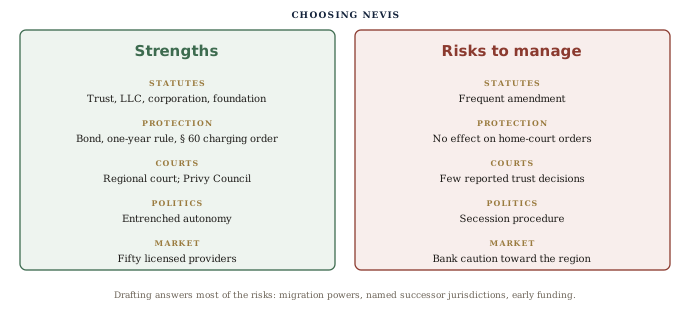
Legislative change. The responsiveness of a small legislature cuts both ways (see supra ¶ 140.08). The Nevis Island Legislature can amend an Ordinance in weeks, and the Ordinances have been amended many times. An amendment that strengthens the protective rules usually applies to existing structures; an amendment that weakens them may also do so unless it is expressed to apply only to future transfers. The planner should protect the client against adverse change by drafting: by giving the trustee or manager power to change the governing law of the trust or to continue the LLC in another jurisdiction, and by naming in advance the jurisdictions to which the structure may move (see infra chs. 11, 16). The client should be told that Nevis law may change and how the structure is designed to respond.
Constitutional and political risk. The constitutional risk specific to Nevis is secession (see supra ¶¶ 110.06, 120.07–.08). The procedure is demanding, it has failed once, and a newly independent Nevis would be expected to continue its existing Ordinances. The risk lies in transition: a period in which the status of federal laws on which the Nevis regime relies, such as the regulator's statute, the anti-money-laundering laws and the tax information exchange agreements, would have to be settled, and in which banks and counterparties might hesitate. The same drafting that protects against legislative change protects against this risk. A second political risk is federal intervention in a specified matter. The Constitution makes that difficult, by limiting Parliament's power over specified matters and by entrenching the Nevis provisions behind a double referendum (see supra ¶¶ 120.04, 120.06), but it does not make it impossible for federal law to affect Nevis structures through the matters that remain federal, such as taxation, court procedure and international obligations.
Reputational and banking risk. Nevis entities are lawful vehicles used by large numbers of legitimate owners, but some banks treat them with caution because of past listings and because the citizenship-by-investment program has drawn scrutiny (see supra ¶¶ 170.05, 170.07). The practical response is to bank the structure where it is understood, which usually means in a jurisdiction other than Nevis with a bank that has an established relationship with the client's Nevis provider, and to keep the structure's records in a form that answers a bank's questions. The structure should be transparent to the authorities entitled to information about it; its protection comes from the substantive law.
The client's home jurisdiction. No Nevis rule binds the courts of the client's home jurisdiction. An American court with jurisdiction over a settlor applies its own fraudulent-transfer law and may order the settlor to repatriate assets or hold the settlor in contempt for failing to do so, whatever Nevis law provides. The protection Nevis offers is the protection of assets that are outside the reach of the home court, held by a trustee or manager who is not subject to its orders. That protection depends on the structure's being established at a time and for purposes that the home court will respect. The interaction between Nevis structures and foreign courts is examined in chapter 25 (see infra ch. 25), and in Lighthouse on Asset Protection.
Federal and Nevis vehicles. A client in the Federation may be offered either a St Kitts vehicle under federal law or a Nevis vehicle under a Nevis Ordinance. The two are different. A St Kitts foundation under the Foundations Act, Cap. 21.19, or a trust under the Trusts Act, Cap. 5.19, is not governed by the Nevis Ordinances and does not carry their protective rules. The planner should confirm which statute governs any entity described as a "St Kitts and Nevis" entity, and should ensure that the formation documents and the registration certificate identify the Nevis Ordinance under which it is formed.

¶ 190
Plan of the Treatise and How to Use It
The structure. The treatise is divided into seven Parts, which follow the same order in every jurisdiction volume of the series, so that a reader comparing Nevis with the Cook Islands or Belize can move between volumes by Part:
- Part I, Nevis and Its Legal System (chs. 1–4): this chapter; the sources of Nevis law, including the reception of English law (ch. 2); the courts (ch. 3); and the regulator and service providers (ch. 4).
- Part II, International Exempt Trusts (chs. 5–11): the trust Ordinance, from its scope and registration through creation, trustees, beneficiaries, protectors and reserved powers, purpose and charitable trusts, and variation, migration and termination.
- Part III, Limited Liability Companies (chs. 12–17): the 2017 Ordinance, members and managers, fiduciary duties, the charging order under section 60, transfers and fundamental changes, and the LLC in international structures and United States classification.
- Part IV, Multiform Foundations (chs. 18–20): the foundation's nature and formation, its governance and its uses in planning.
- Part V, Creditor Protection and Litigation (chs. 21–25): fraudulent dispositions, the creditor's bond and other conditions on suit, foreign judgments, litigation in Nevis, and Nevis structures before foreign courts.
- Part VI, Tax, Reporting and AML (chs. 26–29): Nevis taxation, information exchange, anti-money laundering and beneficial ownership, and United States tax and reporting.
- Part VII, Planning and Forms (ch. 30): the design of an integrated Nevis structure and a drafting guide.
Appendices A through E contain forms of trust deed, operating agreement and foundation charter, compliance checklists and a comparative table of Nevis, the Cook Islands and Belize.
Paragraph numbering and citation. The treatise is cited by paragraph. Each chapter begins at ¶ N01, its sections are numbered in tens (¶ N10, ¶ N20 and so on), and paragraphs within a section carry two-digit decimals (¶ 1560.03). The numbering leaves room for later editions to insert material without renumbering. Cross-references within the treatise use see supra and see infra with a paragraph or chapter number. Statutes are cited by name, chapter and section, with the date of the revised edition; cases follow the Bluebook. The companion volumes are cited by title.
Statutory text. The treatise quotes the Ordinances where their words matter and paraphrases them elsewhere. Quotations are from the revised editions and amending Ordinances listed in Table 1-1. Because the Ordinances change, every quotation and paraphrase is stated as of November 2026, and the reader should confirm the current text before relying on it (see supra ¶ 130.04).
Examples, Planning Notes and Comments. Each chapter contains numbered Examples, which apply the law to facts; Planning Notes, which draw practical conclusions for the drafter or adviser; and Comments, which explain the reasons for a rule or the limits of what is known about it. Case discussions set out the facts, proceedings, holding and lessons of the leading decisions. The Examples are illustrations. They describe the result the law would produce on the stated facts, and a reader should not assume that the same result will follow on different facts.
The readers. The treatise is written for lawyers, trustees, family-office advisers and compliance officers who use Nevis entities for clients, for lawyers acting for creditors who must deal with them, and for students of comparative trust and company law. It assumes familiarity with the general law of trusts and companies and explains Nevis law against that background. Readers in the United States will find the United States tax and reporting rules for Nevis entities collected in chapter 29 and the treatment of Nevis structures in American courts in chapter 25.
Using the companion volumes. Lighthouse on Asset Protection examines asset-protection planning across jurisdictions, including Nevis, the Cook Islands and Belize, and the American law of fraudulent transfers, contempt and bankruptcy that governs the settlor at home. Lighthouse on Limited Liability Companies examines LLC law in the United States and in the leading international jurisdictions, including Nevis. This treatise does not repeat their comparative analysis; it states Nevis law in full and refers to the companion volumes for the wider context.