
¶ 701
Overview
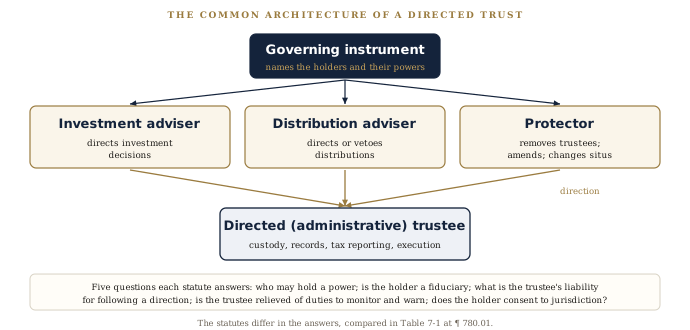
Scope of the chapter. Chapter 6 examined the directed trust as a concept and the Uniform Directed Trust Act as the national model. This chapter examines the statutes of the six states whose directed-trust provisions most often govern trusts designed for divided administration: Delaware, South Dakota, Nevada, Wyoming, Alaska and Tennessee. Each of these states enacted its own statute before, or independently of, the uniform act, and none of them has replaced its statute with the uniform text. Each statute answers the same set of questions. Who may hold a power of direction? Is the holder a fiduciary? What standard of liability applies to the trustee who follows a direction? Does the directed trustee have any residual duty to monitor the holder of the power, to warn beneficiaries or to share information? Does the holder of the power submit to the jurisdiction of the state's courts? The answers differ in ways that matter to the design of a trust, and the differences are the subject of this chapter.
Why the statutes matter. A directed trust divides the functions that the common law assigned to a single trustee. Investment decisions may be assigned to an investment adviser, distribution decisions to a distribution adviser or committee, and decisions about the trust's structure to a protector. The trustee who remains, often a corporate trustee in the governing state, performs custody, recordkeeping, tax reporting and the other administrative functions that give the trust its connection to that state. The arrangement works only if the law protects the trustee from liability for decisions it did not make. The Restatements recognized a power in a third person to direct the trustee, but they left uncertain the trustee's duty when it was directed to do something it considered imprudent. Restatement (Second) of Trusts § 185 (Am. L. Inst. 1959); Restatement (Third) of Trusts § 75 (Am. L. Inst. 2007); see supra ¶ 150.01. The directed-trust statutes replace that uncertainty with a defined allocation of responsibility. The allocation each statute chooses affects the fee a corporate trustee will charge, the scrutiny it will apply to directions and the remedies a beneficiary will have if a direction causes loss.
The common architecture. Despite their differences in vocabulary, the six statutes share a structure with five parts. First, each statute authorizes the governing instrument to name a person, other than the trustee, who holds a power to direct, consent to or disapprove the trustee's decisions. Delaware calls that person an adviser; South Dakota, Wyoming and Tennessee use the terms trust advisor and trust protector; Nevada uses directing trust adviser and trust protector; Alaska distinguishes a trustee advisor from a trust protector. Second, each statute states whether the holder of the power is a fiduciary, and most make the holder a fiduciary by default while allowing the instrument to provide otherwise. Third, each statute limits the liability of the trustee who follows a direction. Fourth, most statutes relieve the directed trustee of duties to monitor the holder of the power, to advise it and to warn beneficiaries of disagreement. Fifth, most statutes provide that a person who accepts appointment as an adviser or protector submits to the jurisdiction of the state's courts. Table 7-1 at ¶ 780.01 compares the statutes on these five points.
The variables that matter most. Two variables account for most of the practical difference between the statutes. The first is the floor on the directed trustee's liability. Delaware preserves liability for the directed trustee's own wilful misconduct. Del. Code Ann. tit. 12, § 3313(b). The Uniform Directed Trust Act uses the same floor. Unif. Directed Trust Act § 9(b) (Unif. L. Comm'n 2017). Nevada, Wyoming and Alaska state no such exception in their liability provisions, and South Dakota's principal provision protects the excluded fiduciary from loss caused by following a direction even where the adviser breached its duties or exceeded its authority. The second variable is the fiduciary status of the person who gives the direction. Where the directed trustee is protected, the beneficiary's remedy lies against the holder of the power, and that remedy exists only if the holder is a fiduciary. A statute that allows the instrument to make the holder of a power a nonfiduciary, and also exonerates the trustee who follows that holder's directions, can leave a beneficiary with no remedy for a loss. Wyoming addresses this problem expressly for distribution powers. Wyo. Stat. Ann. § 4-10-718(g). The other statutes address it, if at all, through general rules discussed in ¶ 780.
Terminology. This chapter uses each state's statutory terms when describing that state's statute and uses the uniform act's term trust director when describing the class of persons who hold powers of direction generally. The term directed trustee refers to a trustee that is subject to a power of direction, and the term excluded fiduciary, which South Dakota, Wyoming and Tennessee use, refers to a fiduciary from whom the instrument has withdrawn a power and assigned it to another person. The two terms overlap. A trustee that must follow an investment adviser's directions is both a directed trustee and, in the statutes that use the term, an excluded fiduciary with respect to investment decisions. The distinction between a power to direct and a power held exclusively by a cotrustee, which Delaware draws in separate sections, is examined in ¶ 720.
Relation to other chapters. This chapter is a statutory survey. The concept of direction and its history are examined supra chs. 1 and 6. The distinction between delegation and direction is examined infra ch. 9, and the case law on the liability of directed trustees and directing parties is examined infra ch. 10. The roles and duties of trust protectors are examined infra chs. 11 to 15. Investment advisers and special-holdings directions for concentrated positions are examined infra chs. 8 and 31. The choice of governing law and situs, which determines which of these statutes applies, is examined supra ch. 2.
Plan of the chapter. ¶¶ 710 and 720 examine Delaware: the adviser provisions of § 3313 and the excluded-cotrustee and information provisions of §§ 3313A and 3317. ¶ 730 examines South Dakota's chapter 55-1B. ¶ 740 examines Nevada's provisions in NRS chapter 163. ¶ 750 examines Wyoming's provisions in article 7 of its Uniform Trust Code. ¶ 760 examines Alaska. ¶ 770 examines Tennessee. ¶ 780 compares the statutes with each other and with the uniform act, and ¶ 790 discusses the choice among them and the drafting of a directed trust under each.