

¶ 101
Overview
Scope of the chapter. This chapter traces the development of the private express trust from a device for holding land to a structure for governing wealth over long periods. It also sets out the vocabulary and the method used throughout the treatise. It begins with the medieval use and the Statute of Uses, follows the passive trust into American law, and examines the managerial trust that emerged in the nineteenth century and was transformed by the prudent investor rule in the twentieth. It then describes the codification of trust law in the Uniform Trust Code and the Restatement (Third) of Trusts, the division of trustee functions among directed trustees, trust directors and protectors, the repeal of the rule against perpetuities in a growing number of states, and the statutory tools that now permit a trust to be changed after it has been created. It closes with the institutions that have grown up around the modern trust, the competition among jurisdictions for trust business, and a method for designing a trust instrument that will remain workable for the period it is meant to last.
The argument of the chapter. For most of its history the trust was understood as a conveyance: a settlor transferred property to a trustee, who held legal title for the benefit of others, and the law of trusts was a body of property rules about who owned what and when. That understanding remains the doctrinal foundation. In practice, a long-term trust now functions as a governance structure. The instrument allocates authority among several persons, defines the standards by which each exercises that authority, provides for the replacement of those persons, and contains procedures for amending the arrangement as circumstances change. The questions that dominate modern trust design are questions of governance: who decides, by what standard, subject to whose review, with what information, and through what procedure the structure adapts when the family, the assets, the tax law or the governing law changes. The chapter explains how the law came to permit trusts to be built in this way and what limits remain.
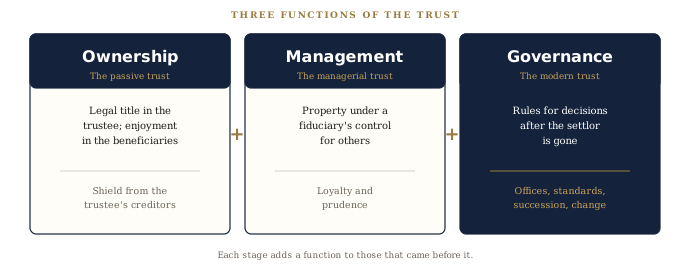
Three functions of the trust. Three functions of the trust recur in every chapter of this treatise. The first is the ownership function: the trust separates legal title, held by the trustee, from beneficial enjoyment, held by the beneficiaries, and so shields the trust property from the personal creditors of the trustee. The second is the management function: the trust places property under the control of a person who is subject to fiduciary duties, so that assets can be administered for persons who are minors, incapacitated, inexperienced or not yet born. The third is the governance function: the trust supplies a durable set of rules for decisions that will arise after the settlor is no longer able or willing to make them. The passive trust served the first function alone. The managerial trust added the second. The modern trust is distinguished by the weight it places on the third.
Default rules and mandatory rules. The law of trusts is predominantly a law of default rules that the terms of the trust may vary. The Uniform Trust Code states the principle directly: except as otherwise provided in the terms of the trust, the Code governs the duties and powers of a trustee, relations among trustees, and the rights and interests of a beneficiary. Unif. Trust Code § 105(a) (Unif. L. Comm'n 2000, amended 2018). A short list of rules cannot be varied by the terms of the trust. Those rules include the requirements for creating a trust, the duty of the trustee to act in good faith and in accordance with the terms and purposes of the trust and the interests of the beneficiaries, the requirement that a trust and its terms be for the benefit of its beneficiaries, and the power of a court to take action and exercise jurisdiction as may be necessary in the interests of justice. Id. § 105(b). The design of a modern trust takes place in the space between the defaults and the mandatory core. The mandatory rules are examined infra ch. 5.
Terminology. This treatise uses the following terms. The settlor is the person who creates the trust or contributes property to it. The trustee holds title to the trust property and administers it. A trust director is a person, other than a trustee, who holds a power under the terms of the trust to direct the trustee or to act in respect of the trust, and a directed trustee is a trustee whose powers are subject to the direction of a trust director. These terms follow the Uniform Directed Trust Act. A protector is a person who holds powers of oversight or modification, commonly including powers to remove and appoint trustees, to amend administrative terms, or to change the governing law or place of administration. Statutes and instruments use the terms adviser, advisor, trust protector, investment committee and distribution committee for persons holding particular powers; the treatise uses the term the source uses when discussing it. See infra chs. 6 to 15.
Plan of the chapter. ¶ 110 examines the medieval use and the Statute of Uses. ¶ 120 follows the passive trust and its principal doctrines into American law. ¶ 130 describes the managerial trust and the development of the investment standard. ¶ 140 describes codification. ¶ 150 explains the division of the trustee's office. ¶ 160 addresses duration and the means by which a trust can be changed. ¶ 170 describes the institutions that administer and oversee modern trusts. ¶ 180 examines the competition among jurisdictions and the criticism it has attracted. ¶ 190 sets out the design method applied in the remaining chapters and describes the organization of the treatise.
¶ 110
The Use and the Statute of Uses
The medieval use. The trust descends from the use, an arrangement under which a landowner conveyed land to one or more persons, the feoffees to uses, who held the legal estate for the benefit of another, the cestui que use. Uses were employed from the thirteenth century onward for several purposes. They allowed a landowner to provide for persons who could not hold land directly, including religious houses restricted by the mortmain statutes. They allowed a landowner, in substance, to dispose of land at death at a time when the common law did not permit freehold land to be devised by will. They were also used to avoid the feudal incidents, the payments owed to the lord on the death of a tenant and the succession of an heir, because the feoffees, usually several in number and replaced as they died, did not die out together and the land did not descend.
Enforcement in Chancery. The common-law courts did not recognize the interest of the cestui que use. The feoffees held the legal estate, and at law they owned the land. The Chancellor, acting on the conscience of the feoffees, came during the fifteenth century to compel them to hold and deal with the land as the terms of the use required. The interest of the cestui que use became an equitable interest, protected by a court that acted in personam against the feoffee. Two features of the modern trust date from this period. The first is the separation of the legal estate from the beneficial interest, enforced by a court of equity. The second is the personal obligation of the holder of legal title, which is the root of fiduciary duty.
The Statute of Uses. By the early sixteenth century the use had become a general device for avoiding the feudal incidents, and the Crown, as the ultimate feudal lord, bore much of the resulting loss of revenue. The Statute of Uses, 27 Hen. 8, c. 10, enacted in 1536, responded by executing the use: where a person was seised of land to the use of another, the statute transferred the legal estate to the person entitled to the use. The feoffees dropped out of the title, and the cestui que use became the legal owner, subject to the incidents of legal ownership. Pressure from landowners led to the Statute of Wills, 32 Hen. 8, c. 1 (1540), which permitted the devise of most land by will and removed one of the reasons for which uses had been employed.
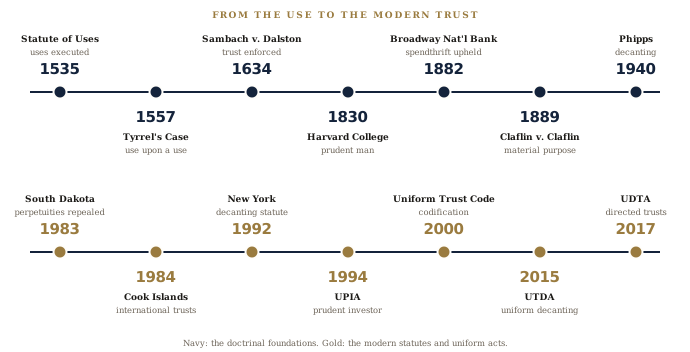
Uses the statute did not execute. The statute applied to a person seised of land to the use of another. Its terms and its construction left several arrangements outside it. It did not reach uses of personal property or of leaseholds, because a person holding those interests was not seised of a freehold. It was held not to reach active uses, under which the feoffees had duties to perform, such as collecting rents and paying them over or selling the land and dividing the proceeds, because the feoffees needed the legal estate in order to perform those duties. The most consequential exception concerned the use upon a use. In Tyrrel's Case (1557), the common-law court held that where land was conveyed to A to the use of B to the use of C, the statute executed the first use in B, and the second use, in favor of C, was void as repugnant. In Sambach v. Dalston (1634), Chancery enforced the second use as a trust. By the late seventeenth century the conveyancing form "unto and to the use of B in trust for C" was established, and the trust as a distinct equitable institution emerged from the space the statute had left.
Active and passive trusts. The distinction between active and passive arrangements survived the statute and remains part of American trust law. A trust under which the trustee holds bare legal title with no duties to perform is a passive or dry trust. In jurisdictions that adopted or follow the Statute of Uses, a passive trust of land is executed, and the beneficiary takes the legal title. Restatement (Third) of Trusts § 6 (Am. L. Inst. 2003). The Uniform Trust Code states the requirement in modern form: a trust is created only if, among other things, the trustee has duties to perform. Unif. Trust Code § 402(a)(4). The requirement is minimal in practice, because almost any trust instrument imposes some duty of administration, but it marks the doctrinal boundary between a trust and a nominee arrangement.
The legacy for modern design. The history of the use explains three features of the modern trust that a drafter should keep in view. First, the trust has always been a means of avoiding legal rules applicable to the owner of property. The feudal incidents have been replaced by estate and income taxes, creditor claims, forced heirship and probate administration, but the structural technique is the same. Second, the trust has always depended on a court of equity willing to supervise the person who holds title. The jurisdiction of the court remains a mandatory feature of trust law. See Unif. Trust Code § 105(b)(13); infra ch. 5. Third, the law has repeatedly drawn the line between a trust and a bare holding of title by asking whether the holder has duties to perform. A modern instrument that divides powers among several persons must still leave the trustee with an office that is recognizably fiduciary. See infra chs. 9 and 10.
¶ 120
The Trust in Nineteenth-Century American Law
Reception. The American states received the English law of trusts with the rest of the common law and equity, and several received the Statute of Uses as part of that inheritance or enacted statutes of their own to the same effect. Others abolished the distinction between legal and equitable estates in the course of codification. In either case the basic structure of the private express trust carried over intact: a settlor, a trustee holding title subject to fiduciary obligations, and beneficiaries holding equitable interests enforceable against the trustee and against third parties who take with notice of the trust. Nineteenth-century American courts then developed two doctrines that distinguished American trust law from English law and that remain central to trust design: the material purpose doctrine and the enforceability of spendthrift restraints.
The English rule of beneficiary control. Under the rule associated with Saunders v. Vautier (1841), English law permits adult beneficiaries of full capacity who together hold the entire beneficial interest to terminate the trust and call for the property, whatever the settlor intended. The rule treats the beneficial interest as property belonging to the beneficiaries and the settlor's directions about the timing of enjoyment as restraints that the owners may disregard. Offshore trust jurisdictions that draw on English law have in several instances altered the rule by statute so that a settlor may exclude it. See infra ch. 15.
The American rule: material purpose. American courts rejected the English rule. The leading decision is the Massachusetts case discussed below, which held that a trust cannot be terminated by the beneficiaries, even if all of them consent, while a material purpose of the settlor remains unaccomplished.
Spendthrift trusts. The second American departure concerned restraints on alienation. English law held that a restraint on the voluntary or involuntary alienation of an equitable life interest was void, so that the creditors of a beneficiary could reach the beneficiary's interest whatever the instrument said. In Nichols v. Eaton, 91 U.S. 716 (1875), the Supreme Court, in dictum, questioned the English rule and stated that a testator could provide that the income of a trust would not be subject to the debts of the beneficiary. In Broadway National Bank v. Adams, 133 Mass. 170 (1882), the Supreme Judicial Court of Massachusetts upheld a spendthrift provision against a creditor of the life beneficiary, reasoning that the creditor had no right to complain of a limitation that the owner of the property had placed on the gift, because the creditor could have learned of it and had extended credit without relying on the trust property. Most American jurisdictions followed. Spendthrift provisions are now valid by statute or decision in every state, subject to statutory exceptions for particular creditors. See Unif. Trust Code §§ 502, 503; infra ch. 36.
The significance of the two doctrines. The material purpose doctrine and the spendthrift doctrine have a common premise: the settlor, as the owner who chose to make the gift, may define the beneficiary's interest in a way that limits what the beneficiary and the beneficiary's creditors can do with it. That premise distinguishes the American trust from a vehicle that the beneficiaries own outright in equity. It also explains why American trust law has been receptive to the long-term trust. A settlor who can bind the beneficiaries to a schedule of distribution, and who can protect their interests from their creditors, can design a structure that endures. The modern techniques examined in this treatise build on that foundation.
Merger. A trust also fails where the same person is the sole trustee and the sole beneficiary, because the legal and equitable interests merge and no one holds an enforceable obligation against anyone else. Unif. Trust Code § 402(a)(5). The rule is rarely an obstacle in practice because a remainder beneficiary or a co-trustee prevents the merger. It becomes relevant when a trust is designed so that one individual is the trustee and the only current beneficiary and the remainder interests are illusory or contingent on events that will not occur.
The passive trust in modern practice. The passive trust has not disappeared. The nominee trust and the land trust, used in several states to hold title to real estate, are arrangements under which a trustee holds title and acts only on the direction of the beneficiaries. Courts have struggled with their classification, treating some as trusts and others as agency arrangements. The modern directed trust raises a related question: if the trustee's powers are subject to direction in every important respect, at what point does the trustee cease to be a trustee in any meaningful sense? The answer given by the directed-trust statutes is examined infra chs. 6 to 10, and the classification of land and nominee trusts infra ch. 33.

¶ 130
The Managerial Trust
From land to financial assets. In the nineteenth century the typical trust asset changed. Family wealth increasingly took the form of corporate shares, bonds, mortgages and other financial assets, and the trustee's principal task became the management and investment of a portfolio. The trust became, in Professor Langbein's description, a vehicle for the management of financial assets, and the trustee's office acquired the character of a professional service. John H. Langbein, The Contractarian Basis of the Law of Trusts, 105 Yale L.J. 625, 637–43 (1995). The law of trusts responded by developing standards for investment and by extending to the trustee a body of duties, chiefly loyalty and prudence, that governed the exercise of managerial discretion.
The prudent man rule. The first general standard for trust investment in American law was stated in Massachusetts.
Legal lists and the conservative reaction. Many states did not follow Harvard College for much of the nineteenth and early twentieth centuries. New York and other states adopted restrictive rules, and later "legal list" statutes, limiting trustees to government bonds, first mortgages on real estate and similar fixed-income investments unless the instrument provided otherwise. Even in prudent-man states, courts applied the rule asset by asset, so that a speculative investment was imprudent in itself whatever its place in the portfolio, and trustees who departed from conventional investments bore the risk of surcharge for any loss. The practical effect was to encourage conservative portfolios and to make express investment powers in the instrument a standard feature of drafting.
The prudent investor rule. In 1992 the American Law Institute adopted the Restatement (Third) of Trusts: Prudent Investor Rule, and in 1994 the Uniform Law Commission promulgated the Uniform Prudent Investor Act. The Act, now enacted in nearly every state, changed the investment standard in five principal respects. First, it judges the prudence of an investment in the context of the trust portfolio as a whole and as part of an overall investment strategy having risk and return objectives reasonably suited to the trust. Unif. Prudent Investor Act § 2(b) (Unif. L. Comm'n 1994). Second, it makes the tradeoff between risk and return the trustee's central consideration. Third, it removes categorical restrictions on types of investments: a trustee may invest in any kind of property or type of investment consistent with the standards of the Act. Id. § 2(e). Fourth, it requires the trustee to diversify unless the trustee reasonably determines that, because of special circumstances, the purposes of the trust are better served without diversifying. Id. § 3. Fifth, it reverses the former rule against delegation and permits the trustee to delegate investment and management functions, subject to duties of care in selecting, instructing and monitoring the agent. Id. § 9. Professor Langbein, the reporter for the Act, described its effect as a reorientation of trust investment law toward modern portfolio theory. John H. Langbein, The Uniform Prudent Investor Act and the Future of Trust Investing, 81 Iowa L. Rev. 641 (1996).
The default character of the investment rules. The Uniform Prudent Investor Act states that the prudent investor rule is a default rule that may be expanded, restricted, eliminated or otherwise altered by the provisions of a trust, and that a trustee is not liable to a beneficiary to the extent the trustee acted in reasonable reliance on those provisions. Unif. Prudent Investor Act § 1(b). That provision is the doctrinal basis for much of modern trust design. A settlor who wishes the trust to hold a family business, a concentrated position, real estate or an illiquid investment may relieve the trustee of the duty to diversify. Courts have nonetheless construed such provisions narrowly where the instrument authorizes retention without directing it, and a trustee who relies on a permissive retention clause may still be held to the duty of prudence in deciding whether to retain. See infra chs. 31 and 32.
The professionalization of trusteeship. The managerial trust also produced the professional trustee. Trust companies, first chartered in the early nineteenth century, became the dominant trustees of large trusts in the twentieth century, and the regulation of trust companies became part of banking law. The corporate trustee offered continuity, specialized investment management and the capacity to pay a surcharge. It also brought institutional practices, fee structures and risk aversion that families sometimes found ill suited to their assets or their aims. The modern techniques of directed trusts and private trust companies emerged in large part from that tension. See infra ¶¶ 150, 170.
¶ 140
Codification
Before codification. Until the late twentieth century the law of trusts in most American states was found principally in judicial decisions, supplemented by statutes on particular subjects: trust investment, trustees' powers, accountings, the rule against perpetuities and the rights of creditors. The Restatement of Trusts (1935) and the Restatement (Second) of Trusts (1959), both prepared with Austin Wakeman Scott as reporter, supplied the principal synthesis, and Scott's treatise was the leading secondary authority. The common-law method left significant gaps. Many states had no clear authority on the duty to inform beneficiaries, the creation and rights of trust protectors, the modification of irrevocable trusts by agreement, the representation of minor and unborn beneficiaries, or the law governing a trust administered in more than one state.
The Uniform Trust Code. The Uniform Law Commission approved the Uniform Trust Code in 2000, the first comprehensive codification of the law of trusts proposed for enactment in the states. The Code has been amended several times since, most recently in 2018. It has been enacted, with variations, in a majority of the states and the District of Columbia. Its principal features for trust design are its statement that most of its rules are defaults, § 105(a); its list of mandatory rules, § 105(b); its provisions for nonjudicial settlement agreements, § 111, and for representation of beneficiaries, art. 3; its rules for the modification and termination of noncharitable irrevocable trusts by consent and by the court, §§ 410–417; its codification of the spendthrift doctrine and its exceptions, art. 5; its rules on the revocable trust, art. 6; and its statement of the trustee's duties and powers, arts. 8 and 9. The Code is examined in detail infra ch. 4.
The Restatement (Third) of Trusts. The American Law Institute published the Restatement (Third) of Trusts in four volumes, the first two in 2003 and the third, which absorbed the 1992 Prudent Investor Rule, in 2007, with Edward C. Halbach, Jr. as reporter. The Restatement (Third) was prepared in coordination with the Uniform Trust Code, and the two works generally take consistent positions. Its treatment of discretionary interests and creditors' rights, §§ 50 and 60, departed from the Restatement (Second) and attracted criticism from practitioners and legislatures in several states, some of which enacted statutes rejecting it. See infra ch. 38.
The non-UTC jurisdictions. Several states with large trust industries have not enacted the Uniform Trust Code, or have enacted only parts of it, and have instead maintained and amended their own statutes. Delaware, Nevada, South Dakota and Alaska are the most significant for trust design, together with New York and California, whose trust law affects a large share of American trusts by reason of the residence of settlors and beneficiaries. Wyoming enacted a version of the Uniform Trust Code and has amended it extensively. The leading non-UTC jurisdictions are examined infra ch. 4, and the directed-trust statutes of Delaware, South Dakota, Nevada, Wyoming, Alaska and Tennessee infra ch. 7.
Codification and design. Codification affected trust design in three ways. First, it made the default rules accessible and predictable, so that a drafter could identify what the instrument needed to address. Second, it placed limits on the settlor's freedom in a single list of mandatory rules, so that design could proceed with greater confidence about the outer boundary. Third, it supplied statutory procedures, such as nonjudicial settlement agreements, virtual representation and modification by consent, that allow a trust to be adjusted without the expense of litigation. Each of those procedures is a default that the terms of the trust may restrict or expand within the mandatory limits. A modern instrument should address each expressly.

¶ 150
Unbundling the Trustee
The unified office. The traditional trustee held every power over the trust property and bore every duty that attached to those powers: custody, investment, distribution, accounting, tax compliance and the defense of the trust in litigation. If the settlor wished someone else to influence a decision, the traditional devices were limited. The settlor could name co-trustees, who would ordinarily act jointly; could give a beneficiary a power of appointment; or could give a third party a power to direct the trustee, which the Restatement (Second) of Trusts recognized but which left uncertain the trustee's duty when following a direction it considered imprudent. Restatement (Second) of Trusts § 185 (Am. L. Inst. 1959).
Pressures toward division. Three developments made the unified office difficult to sustain for many long-term trusts. First, the prudent investor rule and the duty to diversify exposed a trustee to liability for holding concentrated or unconventional assets that the family wished to keep. Second, the growth of the corporate trustee meant that the trustee was often an institution with standardized investment products and fee schedules, while the family wished to retain an independent investment manager or to keep control of a closely held business. Third, the extension of trust duration, discussed in ¶ 160, meant that a trust might outlast any trustee the settlor knew and that the trust would need some means of oversight and adjustment that did not depend on litigation.
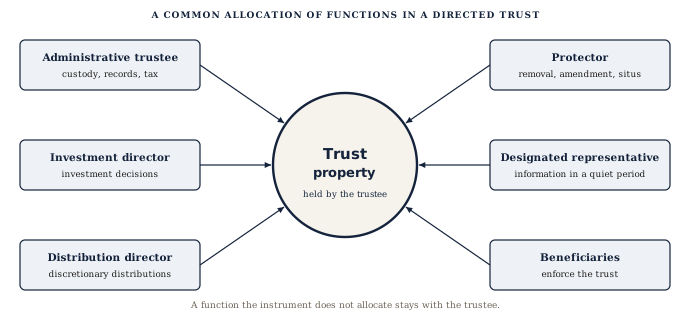
The directed trust. The response was the directed trust, under which the instrument divides the trustee's functions and allocates some of them to persons other than the trustee. In its common form, an investment adviser or investment committee directs the trustee's investment decisions, a distribution adviser or committee directs or consents to discretionary distributions, and the trustee retains custody, recordkeeping, tax compliance and the remaining administrative functions. Delaware enacted the principal early statute, now codified at Del. Code Ann. tit. 12, § 3313, which provides that where an instrument gives a fiduciary or other person authority to direct the trustee, the trustee is not liable for following the direction except in cases of willful misconduct. South Dakota, Nevada, Alaska, Wyoming, Tennessee and other states enacted comparable statutes, differing in the standard that applies to the directed trustee and in whether the director is a fiduciary. See infra ch. 7.
The Uniform Directed Trust Act. The Uniform Law Commission approved the Uniform Directed Trust Act in 2017, replacing the brief and uncertain treatment of powers to direct in § 808 of the Uniform Trust Code. The Act adopts the term trust director for a person who holds a power of direction and directed trustee for the trustee subject to it. Its central allocation is that a trust director is subject to the same fiduciary duties as a trustee in a like position, Unif. Directed Trust Act § 8 (Unif. L. Comm'n 2017), while a directed trustee must take reasonable action to comply with a direction and is liable for doing so only for its own willful misconduct, id. § 9. The Act also relieves the directed trustee of any duty to monitor the trust director, to inform the beneficiaries about the director's conduct or to advise the director. Id. § 11. The Act is examined infra ch. 6.
The protector. The protector entered American practice from the offshore trust jurisdictions, where settlors who created trusts in a distant jurisdiction with a local trustee wanted a person they trusted to watch over the trustee. A protector commonly holds powers to remove and replace the trustee, to consent to distributions or to the addition and exclusion of beneficiaries, to amend administrative provisions, and to change the governing law or place of administration. The statutes of most offshore trust jurisdictions recognize the office, and American statutes and the Uniform Trust Code now do as well. Whether a protector is a fiduciary, and to whom any duties run, is one of the most contested questions in modern trust law. The answer varies by statute and by instrument. See infra chs. 11 to 15.
The allocation of functions. The modern instrument can be read as an allocation of functions among offices. Figure 1.3 shows a common allocation. Each office carries its own powers, standard of conduct and liability rules, and the instrument must specify how the offices interact: who must inform whom, who resolves a deadlock, and who replaces an officeholder who resigns, dies or becomes incapacitated.
¶ 160
Duration and Change
The rule against perpetuities. For most of the history of Anglo-American trust law the duration of a private trust was limited indirectly by the rule against perpetuities, which required that a contingent interest vest, if at all, within a life in being at the creation of the interest plus twenty-one years. The rule, settled in its classic form after the Duke of Norfolk's Case (1682) and stated by John Chipman Gray as "no interest is good unless it must vest, if at all, not later than twenty-one years after some life in being at the creation of the interest," John Chipman Gray, The Rule Against Perpetuities § 201 (4th ed. 1942), limited the period during which property could be held in trust for successive generations to roughly a century. The Uniform Statutory Rule Against Perpetuities (1986), enacted in many states, substituted a ninety-year wait-and-see period for interests that would violate the common-law rule.
Repeal. Beginning in the 1980s, a number of states repealed the rule for interests in trust or extended the permitted period to several hundred years or more. South Dakota abolished the rule by statute in 1983. Delaware abolished it for interests in trust in personal property, retaining a 110-year limit on real property held directly in trust. Del. Code Ann. tit. 25, § 503. Alaska, Nevada, Wyoming, Tennessee and other states followed with repeals or very long periods. One impetus was federal: the generation-skipping transfer tax, enacted in its present form in 1986, allowed each transferor an exemption that could be allocated to a trust, and a trust that could last indefinitely allowed the exempt amount to grow for the benefit of many generations without further transfer tax. Jesse Dukeminier & James E. Krier, The Rise of the Perpetual Trust, 50 UCLA L. Rev. 1303 (2003). The dynasty trust is examined infra ch. 22, and its transfer-tax design infra ch. 23.
Duration as a design problem. A trust that may last for centuries must be designed for conditions its settlor cannot foresee. The beneficiary class will grow and divide, the family's assets will change, the tax law will change many times, and the governing law itself may become unsuitable. The dead-hand problem that the rule against perpetuities addressed does not disappear when the rule is repealed. It becomes a problem for the instrument to solve. A long-term trust therefore needs mechanisms for change that do not depend on the consent of all beneficiaries, many of whom will be minors or unborn, and that do not require a court proceeding for every adjustment. The law now offers several.
Judicial modification. Courts have long had equitable power to modify administrative terms when circumstances not anticipated by the settlor would defeat or substantially impair the trust's purposes. The Uniform Trust Code extends the power to dispositive terms: the court may modify the administrative or dispositive terms of a trust or terminate the trust if, because of circumstances not anticipated by the settlor, modification or termination will further the purposes of the trust. Unif. Trust Code § 412(a). The Code also permits modification to achieve the settlor's tax objectives, id. § 416, and permits modification or termination with the consent of all beneficiaries if the court concludes that the change is consistent with a material purpose, id. § 411(b). Judicial modification is examined infra ch. 16.
Decanting. Decanting is the exercise of a trustee's power to distribute principal by distributing it to a second trust with different terms. The doctrinal basis is the trustee's discretionary power of distribution: a trustee with power to distribute principal to a beneficiary may, on this theory, distribute it in further trust for the same beneficiary.
Decanting statutes. New York enacted the first decanting statute in 1992. N.Y. Est. Powers & Trusts Law § 10-6.6. Many states followed, with statutes differing in the breadth of discretion required, the protections given to beneficiaries' vested interests, the notice required and the treatment of fixed income interests and charitable interests. The Uniform Law Commission approved the Uniform Trust Decanting Act in 2015, which distinguishes between a trustee with expanded distributive discretion, who may decant broadly, and a trustee with limited discretion, who may change only administrative terms and certain other matters. Unif. Trust Decanting Act (Unif. L. Comm'n 2015). Decanting is examined infra chs. 17 and 18.
Nonjudicial settlement and migration. The Uniform Trust Code permits interested persons to enter into a binding nonjudicial settlement agreement with respect to any matter involving a trust, to the extent the agreement does not violate a material purpose and includes terms a court could properly approve. Unif. Trust Code § 111. With the Code's representation provisions, which permit a parent to represent a minor or unborn child and a person with a substantially identical interest to represent another, §§ 301–305, the nonjudicial settlement agreement allows many adjustments to be made without litigation. The Code also permits the trustee to transfer the principal place of administration to another state or country, subject to notice to the qualified beneficiaries and their right to object. Id. § 108. A change of the place of administration may change the governing law of administrative matters and the state income tax treatment of the trust. See infra chs. 19 and 20.

¶ 170
Governance Institutions
Institutions around the trust. The division of the trustee's office and the extension of trust duration produced institutions that did not exist in their present form a generation ago. The private trust company allows a family to serve as its own trustee through a corporate entity. The family office supplies investment, accounting and administrative services to a family's trusts and entities. Statutes permitting silent or quiet trusts, designated representatives and noncharitable purpose trusts allow the settlor to control the flow of information to beneficiaries and to hold assets for purposes that no individual beneficiary can enforce. Each is examined in Part VI of this treatise. This paragraph describes their place in the structure of the modern trust.
Private trust companies. A private trust company is a corporation or limited liability company formed to serve as trustee of trusts for a single family, without offering fiduciary services to the public. Several states provide for private or family trust companies by statute, with regulatory regimes ranging from a charter and supervision comparable to a public trust company to a lighter regime for companies that serve only family members. Offshore jurisdictions have provided for private trust companies for longer. A private trust company allows family members and trusted advisers to sit on the board that makes trustee decisions, gives the trust a trustee with perpetual existence, and allows the family to design the trustee's internal governance through the company's constitution, committees and policies. It also creates a corporate governance problem layered on top of the trust: who owns the company, who appoints its directors, and by what means its decisions are insulated from the personal interests of family members who are also beneficiaries. See infra ch. 28.
The family office. A family office provides services to a family's trusts, entities and members, which may include investment management, accounting, tax compliance, bill payment, insurance and philanthropic administration. The family office is usually an entity separate from any trust and is owned by family members or by a trust. Its relationship to the trustee must be defined by contract, and the trustee's duties to monitor the services it receives from the family office depend on whether the family office acts as the trustee's agent under a delegation, as a trust director under the instrument, or as a service provider retained by the trust. See infra ch. 29.
Information and the silent trust. The traditional rule required the trustee to keep the beneficiaries reasonably informed about the trust and its administration, and the Uniform Trust Code states the duty in detail. Unif. Trust Code § 813. Settlors of large trusts often wish to delay or limit the information that young beneficiaries receive, out of concern that knowledge of substantial wealth will affect a beneficiary's education, work or relationships. Several states, including Delaware, South Dakota and Nevada, permit the terms of the trust to restrict or eliminate the duty to inform for a period, in some cases on condition that a designated representative receive the information and represent the beneficiary's interests during the quiet period. The tension between silence and accountability is direct: a beneficiary who does not know of the trust cannot enforce it. See infra chs. 25 and 26.
Purpose trusts. The common law did not enforce a private trust without a beneficiary who could enforce it, with narrow exceptions for trusts for the care of animals and the maintenance of graves. The Uniform Trust Code permits noncharitable purpose trusts enforceable by a person appointed in the instrument or by the court. Unif. Trust Code § 409. Several states and offshore jurisdictions go further and permit purpose trusts of unlimited duration, enforced by an enforcer, which are used to hold the shares of a private trust company, to hold a family business and to hold assets for purposes that a family wishes to pursue over generations. See infra ch. 27.
Tax considerations. The governance institutions described above have income, gift, estate and generation-skipping transfer tax consequences. A family member who serves as a director of a private trust company or a member of a distribution committee may hold, or be treated as holding, powers that cause inclusion of trust property in the family member's gross estate or that make the trust a grantor trust as to that person. The Internal Revenue Service addressed private trust companies in Notice 2008-63, 2008-31 I.R.B. 261, which set out proposed guidance on the governance arrangements that would avoid estate inclusion. The design of distribution committees and the tax effect of powers held by family members are examined infra chs. 28 and 40.
¶ 180
Jurisdictional Competition and Its Critics
The market for trust law. A settlor in one state may ordinarily create a trust governed by the law of another and administered there, provided the trust has a sufficient connection with the chosen jurisdiction. See infra ch. 2. That freedom created a market in which states compete for trust business by offering favorable law: repeal of the rule against perpetuities, directed-trust statutes, self-settled spendthrift trusts, silent-trust provisions, decanting statutes and the absence of a state income tax on trusts created by nonresidents. The leading empirical study found that states that abolished the rule against perpetuities and did not tax trust income attributable to out-of-state settlors attracted substantial new trust assets: through 2003, abolition increased a state's reported trust assets by $6 billion on average, and the findings implied that roughly $100 billion in trust funds had moved. States that abolished the rule but taxed such income attracted no measurable increase. Robert H. Sitkoff & Max M. Schanzenbach, Jurisdictional Competition for Trust Funds: An Empirical Analysis of Perpetuities and Taxes, 115 Yale L.J. 356 (2005).
The offshore jurisdictions. International trust jurisdictions compete in the same market, principally for settlors concerned with asset protection, confidentiality or the stability of the governing law. The Cook Islands International Trusts Act 1984 was an early statute designed to attract such trusts, and Nevis, Belize and other jurisdictions followed with statutes of their own. The offshore statutes contributed several of the techniques that American states later adopted, including the protector, the purpose trust and the express exclusion of foreign judgments. The asset protection features of those statutes are examined in the companion volume, Lighthouse on Asset Protection, and their trust-design features infra chs. 15 and 37.
Taxation of trusts by the states. State income taxation has become one of the principal factors in the choice of jurisdiction. States tax trusts on various bases: the residence of the settlor when the trust became irrevocable, the residence of the trustee, the place of administration and the residence of the beneficiaries. A trust that is resident in a state under several of those tests at once may be taxed by more than one state on the same income. The Supreme Court has placed a constitutional limit on taxation based on beneficiary residence alone.
The critics. The competition among states has been criticized on several grounds. Commentators have argued that perpetual trusts allow the dead hand of the settlor to govern property for generations who could not have been known to the settlor, that they contribute to the concentration of wealth, and that the long-term costs of administering trusts with hundreds of beneficiaries were not foreseen when the perpetuities rule was repealed. Others have argued that the competition is a race to the bottom that weakens the protections the law gives to beneficiaries, such as the duty to inform and the trustee's full fiduciary responsibility. Defenders respond that the competition has produced useful innovations, such as the directed trust and decanting, that were later adopted by the uniform acts, and that settlors and beneficiaries benefit from the ability to choose a body of law suited to their trust. Dukeminier & Krier, supra ¶ 160.02.
Consequences for the drafter. The drafter need not resolve the policy debate. Three practical consequences follow from it. First, the law of the favored jurisdictions changes frequently, and an instrument should include mechanisms, such as a protector's power to change the governing law, that allow the trust to respond if the chosen law becomes unfavorable. Second, a trust connected with several states may be subject to the mandatory rules or the tax of a state other than the one whose law the settlor chose, and the design must account for every state with a plausible claim. Third, a court asked to enforce a provision that departs from conventional trust law may examine it with care, particularly if the provision eliminates a beneficiary's information or remedies. Provisions that rest on a statute of the governing jurisdiction, and that are supported by a substantial connection with that jurisdiction, are the most likely to be respected elsewhere. See infra ch. 2.

¶ 190
A Method for Designing the Modern Trust
The design questions. The remaining chapters of this treatise examine particular techniques. Each technique answers one or more of a small number of design questions that arise in every long-term trust. The questions are stated here so that the reader can locate each technique within the overall structure of the instrument. They are: (1) what the trust is for, and what purposes the settlor intends to be material; (2) which jurisdiction's law will govern validity, construction and administration, and where the trust will be administered; (3) who will hold each power over the trust, by what standard each will act, and with what liability; (4) how officeholders will be appointed, removed and replaced; (5) what information each beneficiary will receive, and when; (6) how the trust may be changed, by whom, and within what limits; (7) how the trust property will be held, including through entities, and on what terms particular assets will be managed; (8) how the beneficial interests will be protected from creditors and marital claims; (9) how the trust will be taxed; and (10) how disputes will be resolved.
Order of decision. The order of the questions matters. The settlor's purposes come first because they determine which other choices are material and because courts will measure later modifications against them. The choice of jurisdiction comes second because it determines which design tools are available. The allocation of powers comes third, and the remaining questions follow from it. A drafter who begins with tax objectives or with a particular statutory feature, and works backward, frequently produces an instrument whose governance provisions do not fit the family or the assets. Figure 1.4 summarizes the order.
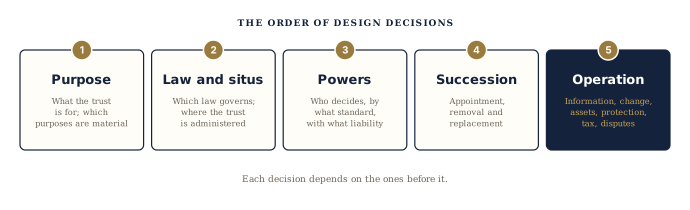
Table of design questions. Table 1-1 lists the design questions and the chapters of this treatise in which each is examined.
Table 1-1. Design questions and where the treatise treats them
| Design question | Principal techniques | Chapters |
|---|---|---|
| Purpose | Statement of purposes; material purpose; settlor intent | 1, 3, 24 |
| Law and situs | Governing law clauses; place of administration; nexus | 2, 4, 5, 7, 20 |
| Allocation of powers | Directed trusts; trust directors; advisers; delegation | 6 to 10 |
| Oversight and succession | Protectors; removal and appointment; deadlock | 11 to 15, 44 |
| Information | Duty to inform; silent trusts; designated representatives | 25, 26 |
| Change | Modification; decanting; nonjudicial settlement; migration; merger and division | 16 to 21 |
| Duration and beneficiaries | Dynasty trusts; GST design; beneficiary classes and standards | 22 to 24 |
| Institutions | Purpose trusts; private trust companies; family governance | 27 to 29 |
| Holding assets | Entities; concentrated positions; business succession; real estate; physical assets; digital assets | 30 to 35 |
| Protection | Spendthrift provisions; self-settled trusts; discretionary interests; marital claims | 36 to 39 |
| Tax | Grantor trust design; incomplete-gift nongrantor trusts; spousal trusts; classification | 40 to 43 |
| Disputes and drafting | Trustee selection; arbitration and forum clauses; clause guide | 44 to 46 |
Coordination. The design questions interact. A protector's power to change the governing law may affect the trust's state income tax status. A distribution committee composed of family members may affect the estate tax treatment of those members. A silent-trust provision may affect the enforceability of a nonjudicial settlement agreement if the beneficiaries who sign it do not know the terms of the trust. An entity that holds trust assets may have its own governance documents that allocate power differently from the trust instrument. The drafter should test each provision against the others.
Organization of the treatise. The treatise is organized in ten parts. Part I (chs. 1 to 5) addresses the foundations: the modern trust, choice of law and situs, settlor intent, the Uniform Trust Code and the leading non-UTC jurisdictions, and the mandatory rules. Part II (chs. 6 to 10) addresses directed trusts. Part III (chs. 11 to 15) addresses trust protectors. Part IV (chs. 16 to 21) addresses the means of changing a trust. Part V (chs. 22 to 24) addresses duration and beneficiary design. Part VI (chs. 25 to 29) addresses information, representation and the governance institutions. Part VII (chs. 30 to 35) addresses the holding of particular assets in trust, including real estate and physical assets such as gold, silver, art and collectibles. Part VIII (chs. 36 to 39) addresses spendthrift and protective design. Part IX (chs. 40 to 43) addresses the tax architecture of the modern trust. Part X (chs. 44 to 46) addresses practice: trustee selection, disputes and the drafting of the instrument. Appendices compare state law, annotate the Uniform Directed Trust Act and the Uniform Trust Decanting Act, and supply model clauses and forms.