

¶ 4201
Overview
Scope of the chapter. A spousal lifetime access trust is an irrevocable trust that one spouse creates and funds for the benefit of the other spouse, usually with the couple's descendants as additional or remainder beneficiaries. The creating spouse, called in this chapter the donor spouse, makes a completed gift that uses the donor's gift tax exemption and, if allocated, the generation-skipping transfer tax exemption. The other spouse, the beneficiary spouse, may receive distributions for as long as the marriage and the beneficiary spouse's life continue. The family therefore keeps an indirect line of access to property that has left both spouses' taxable estates. This chapter examines the design of that trust: its income, gift and estate tax profile, the limits on gift splitting, the exemption environment after the 2025 legislation, the reciprocal trust doctrine that governs two trusts created by spouses for each other, the source of the property used to fund the trust, the risk that the donor benefits indirectly, the effect of community property, and the alternatives and companions to the structure, chiefly the lifetime qualified terminable interest property trust and the incomplete-gift nongrantor trust.
What other chapters cover. Several subjects that bear on spousal trusts are treated elsewhere and are cross-referred here. The grantor trust rules, including section 677(a) and the power of substitution, are examined in chapter 40 (see supra ch. 40). The effect of divorce on a spousal trust, including the repeal of section 682 for instruments executed after 2018, the floating definition of spouse and the case law on trusts created during a marriage, is examined in chapter 39 (see supra ¶ 3970). The default meaning of "spouse" in a trust instrument and the effect of divorce-revocation statutes are covered in chapter 24 (see supra ¶ 2440). Self-settled trusts, including statutes that permit the donor to be added as a beneficiary of a spousal trust, are covered in chapter 37 (see supra ch. 37), and incomplete-gift nongrantor trusts in chapter 41 (see supra ch. 41). The companion volume, Lighthouse on Asset Protection, examines the spousal lifetime access trust from the creditor's side, including its protection against each spouse's creditors and the argument that reciprocal trusts are self-settled (companion volume, ¶ 1780). This chapter takes the designer's view of the tax structure and its interaction with the marriage.
Why the structure is used. The spousal trust answers a problem that every married couple with a taxable estate faces when it considers a large lifetime gift. A gift to descendants or to a trust for descendants uses exemption and removes future growth from the donor's estate, but the couple loses the property. A gift to the other spouse outright qualifies for the marital deduction and moves nothing out of the couple's combined estate. The spousal trust sits between those two. Because the beneficiary spouse's interest terminates at death and the property then passes to others, the gift does not qualify for the gift tax marital deduction and therefore uses exemption. I.R.C. § 2523(b)(1). Because the beneficiary spouse can receive distributions, the couple has not surrendered the property's use as fully as it would by a gift to descendants. Because the trust is ordinarily a grantor trust as to the donor spouse, the donor pays the income tax on trust income, which reduces the donor's estate further without additional gift tax (see supra ¶ 4060).
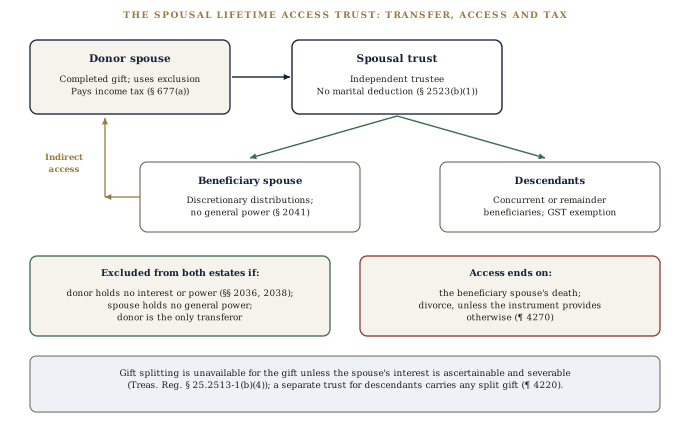
The exemption environment. The structure became common in the years before 2026 because the basic exclusion amount under the 2017 legislation was scheduled to fall by about half at the end of 2025, and couples sought to use the higher amount before it expired. The 2025 legislation removed that scheduled reduction. Section 2010(c)(3) now sets the basic exclusion amount at $15,000,000, indexed for inflation for decedents dying in calendar years after 2026. I.R.C. § 2010(c)(3)(A)–(B), as amended by Pub. L. No. 119-21, § 70106(a), 139 Stat. 72, 162 (2025). The generation-skipping transfer tax exemption equals the basic exclusion amount. Id. § 2631(c). The Service has confirmed both figures at $15,000,000 for 2026. Rev. Proc. 2025-32, § 2.14. Without a scheduled reduction, the reason to make a spousal trust gift in a particular year is weaker than it was in 2024 and 2025, and the reasons that remain are the familiar ones: removing future growth from the estate, shifting the income tax burden to the donor, protecting the property from future creditors and future spouses of descendants, and fixing the use of exemption before any later legislation reduces it (see infra ¶ 4230).
The design problem. The planner's task is to give the family access sufficient to justify the gift without giving the donor spouse an interest or power that brings the property back into the donor's estate, and without giving the beneficiary spouse an interest that brings it into the beneficiary spouse's estate. The access runs only through the beneficiary spouse, and only while the marriage and the beneficiary spouse's life continue. The design must also address what happens when either condition fails: on divorce, the access may pass to a person the donor no longer wishes to benefit; on the beneficiary spouse's death, it ends. When both spouses wish to create trusts, the design must keep the two trusts from being treated as reciprocal. When the property is community property, or when the donor transfers property to the beneficiary spouse who then funds a trust, the design must identify who is the transferor for tax purposes.
Plan of the chapter. Paragraph 4210 describes the structure and its tax profile. Paragraph 4220 examines gift splitting and the rule that bars it when the spouse is a beneficiary. Paragraph 4230 examines the basic exclusion amount after the 2025 legislation and the special rule for changes in the exclusion between gift and death, including the 2022 proposal to deny that rule to includible gifts. Paragraph 4240 examines the reciprocal trust doctrine, with discussions of United States v. Estate of Grace and Private Letter Ruling 2004-26-008. Paragraph 4250 examines the source of the gift, including the step transaction analysis in Smaldino v. Commissioner. Paragraph 4260 examines access, the indirect benefit to the donor and section 2036. Paragraph 4270 addresses the death of the beneficiary spouse, divorce and the floating spouse. Paragraph 4280 examines community property, the lifetime qualified terminable interest property trust, spousal powers of appointment and combinations with incomplete-gift nongrantor trusts. Paragraph 4290 collects model provisions and a drafting checklist.