

¶ 3901
Overview
Scope of the chapter. Divorce is the most common occasion on which the terms of a family trust are tested by a claimant who stands inside the family. A creditor in an ordinary lawsuit is a stranger to the trust; a spouse is often a named beneficiary, a co-signer of the deed that funded it, a recipient of its distributions and a witness to how the family used it. This chapter examines how a divorcing spouse reaches wealth held in trust. It also examines how a trust can be designed and administered so that it does what its settlor intended when a marriage of the settlor or of a beneficiary ends. It covers trusts that a spouse created during the marriage, trusts that parents and grandparents create for married descendants, spousal lifetime access trusts, the interaction of trusts with premarital and marital agreements, and the treatment of trusts by foreign divorce courts and offshore trust statutes.
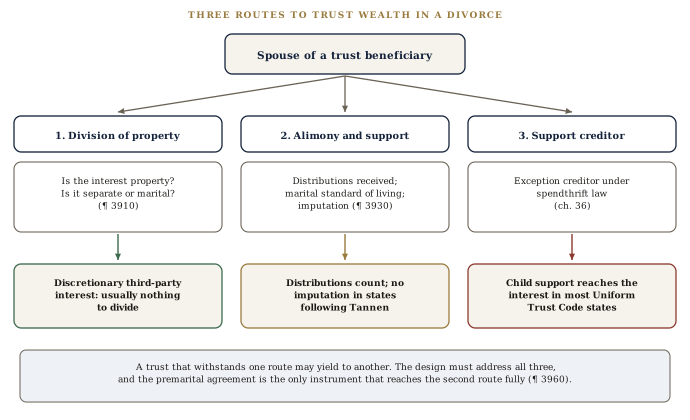
Three routes to trust wealth. A spouse can reach wealth held in trust by three routes, and each is governed by a different body of law. First, the spouse may claim that the trust, an interest in it or property held in it forms part of the marital or community estate that the divorce court divides. Second, the spouse may ask the court to treat the trust as a resource of the other spouse when it fixes alimony, maintenance or child support, even if the court cannot divide the trust itself. Third, a spouse or child who holds a support order may enforce it against the obligor's interest in the trust as an exception creditor under spendthrift law (see supra ch. 36). A trust that withstands one route may yield to another. A discretionary interest in a third-party trust is rarely property the court can divide, but the distributions it produces may enter the alimony calculation, and in many states a support creditor may reach them.
Legitimate and illegitimate objectives. Three objectives must be kept apart. Preserving family wealth for descendants against the claims of a descendant's future spouse is a settled and legitimate aim of trust design, and the law of most states gives effect to it. Arranging a couple's own affairs by agreement, with full disclosure, is legitimate and encouraged. Defeating a spouse's existing rights by transfers made during a failing marriage, or leaving a child's support unpaid, is not a legitimate objective, and a planner should decline it. The companion volume, Lighthouse on Asset Protection, examines family claimants from the creditor's side and the planner's duties in that setting (companion volume, ch. 9). This chapter takes the designer's view: what terms, structures and administrative habits make a trust behave predictably in a divorce.
How to read the chapter. Paragraph 3910 addresses whether a trust interest is property in the marital estate. Paragraph 3920 treats the growth, income and commingling questions that most often convert separate trust wealth into marital property. Paragraph 3930 examines trust wealth as a resource for alimony and support. Paragraph 3940 addresses self-settled trusts created during the marriage. Paragraph 3950 covers third-party trusts for married children and grandchildren, and ¶ 3960 premarital and marital agreements. Paragraph 3970 treats spousal lifetime access trusts and the income tax consequences of divorce for grantor trusts. Paragraph 3980 examines cross-border claims and offshore firewall statutes, and ¶ 3990 sets out model provisions and a drafting checklist.