

¶ 4901
Overview
Scope of the chapter. Bankruptcy touches the LLC in two settings. In the first, the LLC itself is the debtor. The questions are whether it may file, who may cause it to file, whether its lenders or members may prevent a filing by contract, how its affiliates are treated in a group case, and what the LLC can obtain from bankruptcy that it could not obtain under state law. In the second, a member is the debtor. The questions are what part of the member's interest passes to the bankruptcy estate, whether the trustee takes the member's governance rights or only the right to distributions, whether provisions of the operating agreement or of the LLC statute that strip a bankrupt member of rights can be enforced against the estate, and whether the trustee may reach assets the debtor placed in an LLC before filing. The two settings are governed by different provisions of the Bankruptcy Code and produce different planning concerns, and this chapter treats them in turn.
Federal and state law. The Bankruptcy Code supplies the framework, but it builds on state law at nearly every step. Whether an LLC has authority to file depends on the operating agreement and the statute under which the LLC was formed. Price v. Gurney, 324 U.S. 100, 106 (1945). What the debtor-member owns depends on the operating agreement and the LLC statute, and the Code then decides what part of that property comes into the estate and which restrictions on it the estate must honor. 11 U.S.C. §§ 365(c), (e), 541(a), (c)(1). Whether a transfer into an LLC can be avoided depends in part on state voidable-transactions law, which the trustee may invoke under 11 U.S.C. § 544(b). The answer to most of the questions in this chapter therefore requires reading federal and state law together.
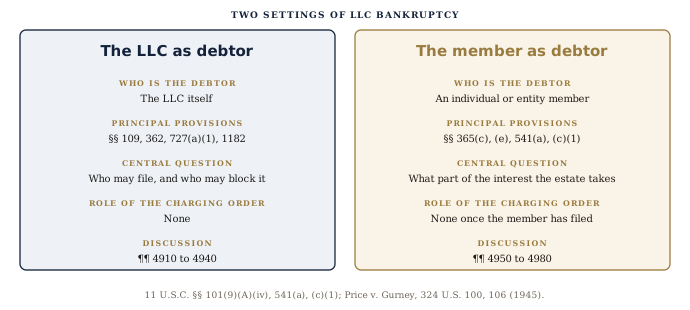
Relation to other chapters. Several subjects treated here are examined from other angles elsewhere in this treatise. The charging order and its exclusivity are examined in chapter 27, where ¶ 2760 explains why the charging order has no role once the debtor-member is in bankruptcy. Dissociation on bankruptcy under the LLC statutes is examined in ¶ 3160 of chapter 31, and the single-member LLC in ¶ 960 of chapter 9. Veil piercing, reverse piercing and substantive consolidation are examined in chapter 26, where ¶ 2680 previews the bankruptcy issues. Divisional mergers are examined in ¶ 3470 of chapter 34, and the use of LLCs to protect assets in chapter 55. This chapter refers to those discussions and does not repeat them.
Plan of the chapter. The chapter proceeds in nine parts:
- the LLC as debtor: eligibility, the choice of chapter and the consequences of filing (¶ 4910);
- authority to file a petition on the LLC's behalf (¶ 4920);
- blocking provisions, golden shares and independent managers (¶ 4930);
- LLC groups: substantive consolidation, insiders, fiduciary duties in insolvency and alter-ego claims (¶ 4940);
- the member's bankruptcy and the interest as property of the estate (¶ 4950);
- the operating agreement as an executory contract (¶ 4960);
- the single-member LLC and the trustee's control (¶ 4970);
- avoidance, denial of discharge, divisive mergers and tax (¶ 4980); and
- planning, drafting and a checklist (¶ 4990).
The principal tensions. Three tensions run through the cases. The first is between freedom of contract under state LLC law and the federal policy that an entity may not contract away its access to bankruptcy. LLC statutes, Delaware's above all, give effect to the members' agreement, and lenders have used that freedom to obtain consent rights over a filing. Bankruptcy courts have enforced some of those rights and refused to enforce others, and the line they have drawn depends on who holds the right and whether the holder owes any duty to the LLC (¶ 4930). The second is between the members' interest in choosing their co-members and the creditors' interest in the value of a bankrupt member's stake. LLC statutes protect the first interest by converting a bankrupt member into a transferee. The Code protects the second by bringing the debtor's interest into the estate notwithstanding provisions conditioned on bankruptcy. Courts reconcile the two through the executory-contract analysis of section 365, with divided results (¶¶ 4950 to 4960). The third is between the charging-order protection that state law gives a member's interest and the trustee's succession to that interest under federal law. The charging order protects against a judgment creditor. It gives no protection against a trustee who takes the interest itself (¶ 4970).
Terminology. The chapter uses "debtor" for the person in bankruptcy, "trustee" for a chapter 7 trustee or chapter 11 trustee and, where the context permits, for a chapter 11 debtor in possession, which has a trustee's rights and powers, and "estate" for the property that comes into the case under 11 U.S.C. § 541. A "blocking provision" is a provision of an operating agreement that requires the consent of a particular member, manager or class before the LLC may file a voluntary petition. A "special member" is a member admitted without an economic interest, usually at a lender's request, to hold such a consent right or to become the member automatically if the LLC would otherwise have none.