

¶ 3401
Overview
Scope of the chapter. This chapter examines the statutory transactions by which an LLC changes its legal identity, its form or its domicile, combines with another entity, or separates into two or more entities. The transactions are the merger and consolidation, the interest exchange, the conversion, the domestication and the division. The uniform acts call them "organic transactions" because each changes the organic law or the organic rules that govern the entity. Each is a creature of statute. Each moves property and liabilities by force of law, without deeds, assignments or assumption agreements, and each alters the rights of members who did not vote for it. The chapter examines the statutes that authorize these transactions, the votes they require and the extent to which the operating agreement may change those votes, the appraisal rights that are and are not available, the standards by which courts review a merger approved by those in control, the effect of each transaction on property, liabilities and contracts, the division statutes and the litigation they have produced, and an overview of the federal income tax treatment.
Why the form matters. Several of these transactions can reach the same economic result. Two LLCs can combine by merger, by an interest exchange followed by a distribution, or by a sale of assets followed by liquidation. A Delaware LLC can become a Texas corporation by conversion, by merger into a newly formed Texas corporation, or by a contribution of its assets to that corporation followed by dissolution. The statutes treat these routes differently. They require different votes, produce different filings, carry different appraisal consequences, and treat the company's contracts, licenses and permits in different ways. A transaction that is a "transfer" for the purposes of a lender's covenant or a licensor's anti-assignment clause in one form may not be a transfer in another. The choice of form is therefore a legal choice with consequences of its own, made after the business terms are settled.
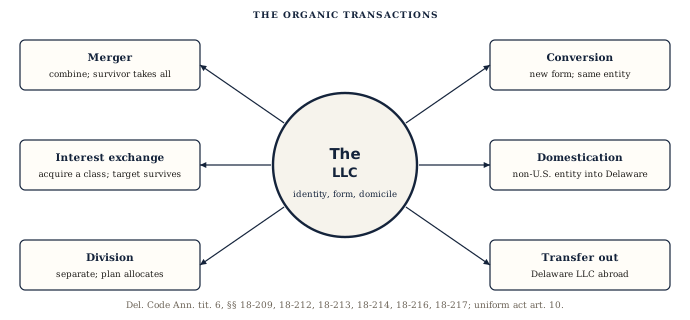
Organization. The chapter proceeds in nine parts:
- the statutory framework, including the Delaware act, Article 10 of the uniform act and the Florida and Texas codes (¶ 3410);
- mergers, consolidations and interest exchanges (¶ 3420);
- approval, operating-agreement overrides and appraisal rights (¶ 3430);
- fiduciary and contractual review of LLC mergers (¶ 3440);
- conversions, domestications and transfers out of the formation state (¶ 3450);
- the effects of these transactions on property, liabilities and contracts (¶ 3460);
- divisions (¶ 3470);
- an overview of the federal income tax treatment (¶ 3480); and
- choosing the form and a drafting checklist (¶ 3490).
Relation to other chapters. Transfers of interests by members, which do not change the entity, are examined supra ch. 29, and buy-sell, drag-along and tag-along provisions, which often operate through a merger, supra ch. 30. Dissolution and winding up, which a merger or conversion avoids, are examined infra ch. 33. The default fiduciary duties and their modification are examined supra chs. 21 and 22, exculpation and indemnification supra ch. 23, and conflicted transactions supra ch. 24. The choice of formation state, including the facts bearing on Delaware's Court of Chancery as a forum, is examined supra ch. 5, and the internal affairs doctrine supra ch. 12. Series LLCs are examined supra ch. 10, non-U.S. LLC statutes supra ch. 54, LLCs in bankruptcy infra ch. 49, and the partnership tax rules on contributions, distributions and transfers infra chs. 40 and 41.