

¶ 3801
Overview
Scope of the chapter. This chapter examines the remedies available in disputes among an LLC, its members and its managers. It begins with interim relief: temporary restraining orders, preliminary injunctions and the status quo orders that the Court of Chancery enters in contests for control. It then examines the summary proceeding under § 18-110 of the Delaware act, which determines who holds the office of manager and the result of a contested vote, and the broader jurisdictional grant in § 18-111. The chapter continues with specific performance of operating-agreement provisions; the appointment of receivers, custodians and liquidating trustees; rescission and rescissory damages; the measures of damages for breach of the operating agreement and breach of fiduciary duty; prejudgment interest; attorneys' fees; constructive trusts, equitable liens, accountings, reformation and declaratory judgments; and the enforcement of orders through contempt. It closes with a table matching remedies to the claims most often asserted in LLC litigation and a checklist for the lawyer preparing to seek or resist relief.
Relation to other chapters. The claims that these remedies serve are treated elsewhere. The default fiduciary duties and their modification are examined in Chapters 21 and 22, exculpation and indemnification in Chapter 23, conflicts of interest in Chapter 24, the distinction between direct and derivative claims in Chapter 35, inspection actions in Chapter 36, and the choice of forum and arbitration in Chapter 37. Judicial dissolution, which is itself a remedy for deadlock and oppression, is treated in Chapter 32 (see supra ¶¶ 3230, 3240), and the winding up that follows it in Chapter 33 (see supra ¶ 3340). The remedies of a member's judgment creditor, chiefly the charging order, are examined in Chapter 27 and are noted here only where a remedy against the LLC itself is sought in aid of them (see infra ¶ 3840.09).
The contractual setting. Remedies in LLC litigation differ from remedies in corporate litigation in one respect above all others. The operating agreement is a contract, and the Delaware act gives "maximum effect to the principle of freedom of contract and to the enforceability of limited liability company agreements." Del. Code Ann. tit. 6, § 18-1101(b). The parties may therefore shape the remedies available for breach of their own bargain. They may stipulate that a breach causes irreparable harm, agree that specific performance is available, waive or cap damages, shift attorneys' fees to the losing party, limit or eliminate liability for breach of contract and breach of fiduciary duty, and choose a forum or an arbitral tribunal. The statute limits that freedom at one point: the agreement "may not limit or eliminate liability for any act or omission that constitutes a bad faith violation of the implied contractual covenant of good faith and fair dealing." Id. § 18-1101(e). Most remedial questions in Delaware LLC litigation are therefore questions of contract interpretation first and questions of equity second.
The equitable setting. Where the agreement is silent, the general law supplies the remedy. The Delaware act provides that in any case not provided for in the chapter, "the rules of law and equity, including the rules of law and equity relating to fiduciary duties and the law merchant, shall govern." Del. Code Ann. tit. 6, § 18-1104. The Court of Chancery's equitable powers are broad. The Delaware Supreme Court has described them, in the context of fiduciary claims reviewed for entire fairness, as "very broad in fashioning equitable and monetary relief ... as may be appropriate, including rescissory damages." Int'l Telecharge, Inc. v. Bomarko, Inc., 766 A.2d 437 (Del. 2000). Those powers extend to members and managers of LLCs who owe default fiduciary duties under § 18-1104 or contractual duties under the agreement. See Gatz Props., LLC v. Auriga Capital Corp., 59 A.3d 1206 (Del. 2012).
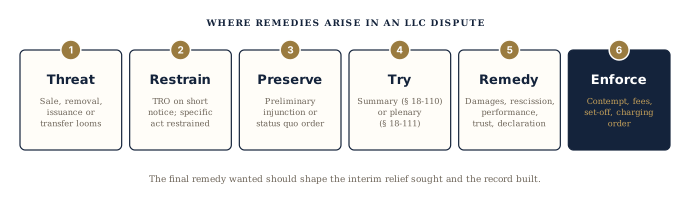
Timing. The remedial question arises at three points in a dispute. At the outset, the party seeking relief must decide whether interim relief is needed to prevent a change of control, a sale, a dilution or a removal that a later judgment could not undo. During the case, the parties litigate under any status quo order the court enters, and a violation of that order is itself a ground for sanctions. At judgment, the court chooses among final remedies: damages, rescission, specific performance, a declaration, a constructive trust, or the appointment of a receiver or liquidating trustee. A lawyer who identifies at the start the final remedy the client wants, and the facts needed to obtain it, is better placed to seek the right interim relief and to build the right record.
The forum. Most of the decisions discussed in this chapter come from the Delaware Court of Chancery, which has jurisdiction under §§ 18-110 and 18-111 over the principal categories of LLC dispute and decides them without a jury. Its procedures and the record of its recent decisions bear on the choice of forum, and that choice is examined in Chapters 5 and 37 (see supra ¶ 540; infra ¶ 3701). Courts in other states apply similar remedial principles under their own statutes, and the chapter notes the principal statutory variations where they matter.