

¶ 3301
Overview
Scope of the chapter. This chapter examines the end of an LLC's life: the events that dissolve it, the process of winding up its activities, the claims of its creditors during and after winding up, the distribution of what remains to its members, and the filing that ends its existence. It also examines the routes by which a dissolved or canceled LLC may be brought back: revocation of dissolution, revival or reinstatement after an administrative cancellation, and judicial nullification of a certificate of cancellation. Judicial dissolution on the ground of deadlock or oppression is treated in Chapter 32 and is noted here only where it bears on winding up (see supra ¶¶ 3230, 3240). Dissociation of individual members is treated in Chapter 31, the liability of members who receive distributions on dissolution in Chapter 28 (see supra ¶ 2880), and the choice between a state-law wind-down and a bankruptcy case in Chapter 49.
Three stages. Every LLC statute separates three events that lay readers tend to treat as one. Dissolution is the event that changes the company's purpose: from the moment of dissolution the company exists to wind up. Winding up is the process of finishing or selling the business, collecting the company's property, paying or providing for its liabilities and distributing the remainder. Termination, which Delaware accomplishes by the filing of a certificate of cancellation and the uniform act by a statement of termination, ends the company's existence as a legal person. The comment to the uniform act puts the first point directly: "Dissolution does not end a limited liability company's existence," and a dissolved company "continues after dissolution only for the purpose of winding up." Rev. Unif. Ltd. Liab. Co. Act § 701 cmt. (2013) (quoting § 702(a)). Delaware's statute reaches the same result through its structure: § 18-801 lists the events of dissolution, § 18-803 governs winding up, § 18-804 governs the application of assets, and § 18-203 permits the certificate of cancellation to be filed only "upon the dissolution and the completion of winding up." Del. Code Ann. tit. 6, §§ 18-203(a), 18-801, 18-803, 18-804.
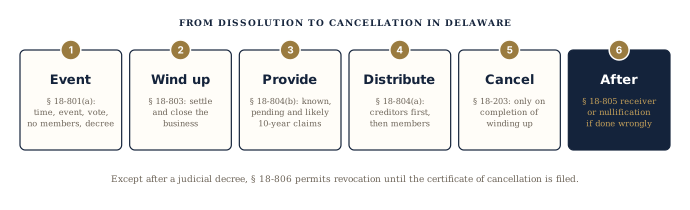
Why the stages matter. The separation of the three stages has practical consequences that recur throughout this chapter. The duties that § 18-804(b) imposes on a Delaware LLC to provide for known, pending and foreseeable claims arise only after dissolution; an LLC that has not dissolved may distribute its assets subject only to the general limits of § 18-607. PXP Producing Co. LLC v. MitEnergy Upstream LLC, C.A. No. 2024-0668-MTZ, slip op. at 21–22 (Del. Ch. June 26, 2025). The authority of the persons winding up to sue and defend in the company's name lasts until the certificate of cancellation is filed, after which the company cannot act, retain counsel or appear until a receiver is appointed or the cancellation is nullified. Del. Code Ann. tit. 6, § 18-803(b); In re Reinz Wis. Gasket, LLC, C.A. No. 2022-0859-MTZ, letter op. at 4, 11 (Del. Ch. May 8, 2023). A filing made out of order, such as a certificate of cancellation filed while assets or claims remain, exposes the filing to correction or nullification and exposes the members to claims they believed had ended. Del. Code Ann. tit. 6, § 18-203(b).
Vocabulary across the statutes. The statutes use different words for the same steps. Delaware speaks of a "certificate of cancellation" and of "cancellation" of the certificate of formation; New York of "articles of dissolution," whose filing cancels the articles of organization; Nevada of "articles of dissolution"; California of a "certificate of cancellation"; Texas of a "certificate of termination"; and the uniform act and Florida of a "statement of dissolution" and a "statement of termination." The statutes also differ on administrative action by the filing office. The uniform act, Florida and Wyoming provide for administrative dissolution or forfeiture followed by reinstatement; Delaware provides no administrative dissolution and instead cancels the certificate of formation after three years of unpaid annual tax or the loss of a registered agent, followed by revival. This chapter uses each statute's own term when discussing that statute and uses "termination" for the end of existence in general discussion.
The default rules and the agreement. Most of the rules in this chapter are default rules. Delaware permits the agreement to specify the time or events of dissolution, to change the vote required to dissolve, to designate who winds up and to alter the order in which members share in liquidating distributions. Del. Code Ann. tit. 6, §§ 18-801(a)(1)–(3), 18-803(a), 18-804(a)(2)–(3). The rules that protect creditors are not default rules: the agreement cannot relieve the company of the duty to pay or provide for creditors before members receive anything, because the agreement cannot bind persons who are not parties to it. Rev. Unif. Ltd. Liab. Co. Act § 707 cmt. (2013) (subsection (a) "is non-waivable as to creditors who are not members"). The drafting questions are therefore of two kinds: the terms on which the members want the company to end among themselves, and the steps that allow the members to keep what they receive.
Organization. ¶ 3310 examines the events of dissolution. ¶ 3320 examines judicial dissolution briefly and administrative dissolution, forfeiture and reinstatement in more detail. ¶ 3330 examines revocation of dissolution. ¶ 3340 examines winding up: who conducts it, with what powers and under what duties, and when a court will supervise it. ¶ 3350 examines Delaware's claims regime under § 18-804, and ¶ 3360 the notice-and-bar procedures of the uniform act and other states. ¶ 3370 examines the distribution of remaining assets, the liability of distributees and the tax consequences of liquidation. ¶ 3380 examines cancellation and termination, the capacity of a canceled LLC, nullification and the appointment of receivers. ¶ 3390 collects planning points, a state comparison and a wind-up checklist.