

¶ 3101
Overview
Scope of the chapter. This chapter examines the information-reporting regime that applies when a broker effects a sale of a digital asset for a customer. The regime rests on section 6045 of the Internal Revenue Code, as amended by section 80603 of the Infrastructure Investment and Jobs Act in 2021, and on the final regulations published as T.D. 10000 in July 2024. Its principal product is Form 1099-DA, Digital Asset Proceeds From Broker Transactions, which brokers began filing in 2026 for sales effected during 2025. The chapter covers the statutory amendments, the regulatory definition of a broker, the content and timing of reporting, the special rules for stablecoins, nonfungible tokens, payment processors and real estate closings, the rule for decentralized trading platforms that Congress nullified in 2025, the transition relief the Internal Revenue Service has granted, transfer statements, backup withholding, the cash-reporting rule of section 6050I, penalties, and the consequences of the regime for taxpayers who must reconcile their own records to the forms they receive. The substantive income tax treatment of digital assets is treated in ch. 30, and international reporting under the Crypto-Asset Reporting Framework and related regimes in ch. 32.
Why reporting matters. Information reporting is the mechanism by which the federal tax system learns of income that the taxpayer must report. For securities, Form 1099-B has for decades told the Service the gross proceeds of each sale and, since 2011, the adjusted basis of shares acquired after the applicable date. Digital assets lacked a comparable return. A customer of a trading platform could sell tokens at a gain and receive no form, and the Service learned of the transaction, if at all, through a John Doe summons, an examination or the taxpayer's own answer to the digital-asset question on Form 1040. The enforcement history is described in ch. 30. The 2021 amendments and the 2024 regulations close that gap for transactions effected by custodial intermediaries. They leave a gap for transactions a taxpayer effects personally through an unhosted wallet, because the regulation that would have reached decentralized trading platforms no longer has legal effect (¶ 3150).
The three layers of the regime. Three layers of authority govern. The first is the statute: section 6045 as amended, together with sections 6045A (transfer statements), 6050I (cash received in a trade or business) and the penalty provisions of sections 6721 and 6722. The second is the regulations, principally Treas. Reg. § 1.6045-1 as amended by T.D. 10000, together with § 1.1012-1(j) on basis identification, which ch. 30 discusses in detail. The third is administrative guidance, which in this area has been unusually important: Notices 2024-56, 2024-57 and 2025-33, Notice 2025-7, Revenue Procedure 2024-28, Announcements 2023-2 and 2024-4, and the annual Instructions for Form 1099-DA. A practitioner who reads only the regulation will misstate the law in force for any given year, because the notices suspend backup withholding, relieve penalties and excuse reporting for whole classes of transactions.
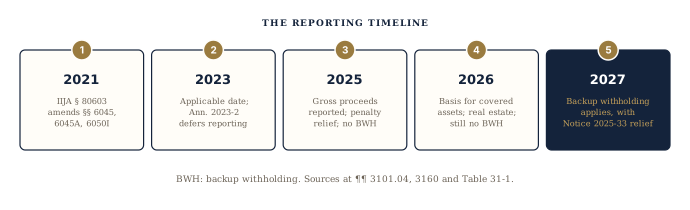
The timetable. The statutory amendments apply to returns required to be filed, and statements required to be furnished, after December 31, 2023. Pub. L. No. 117-58, div. H, tit. VI, § 80603(c), 135 Stat. 429, 1341 (2021). The Service announced in early 2023 that brokers need not report additional information about digital assets until final regulations issued. Announcement 2023-2. The final regulations require reporting of gross proceeds for sales of digital assets on or after January 1, 2025, and of adjusted basis for sales on or after January 1, 2026 of digital assets that are covered securities, which means digital assets acquired on or after January 1, 2026 in an account at a broker that provides custodial services. Treas. Reg. § 1.6045-1(a)(15)(i)(J), (q). Sales of digital assets for real property are reportable from January 1, 2026. Id. § 1.6045-1(q). Table 31-1 at ¶ 3130 sets out the timeline year by year.
Who is affected. The regime affects four groups. Brokers bear the filing and furnishing obligations and the backup-withholding obligation. Customers receive payee statements that the Service will match against their returns. Merchants, real estate closing agents and payment processors may be brokers for particular transactions without being in the business of trading digital assets. Fiduciaries and advisers must take account of the regime when they hold digital assets for others, because a trust, estate or entity that sells through a platform will receive a Form 1099-DA, and its return must reconcile to it. The fiduciary dimension is treated in chs. 14 and 23.
Terminology. This chapter follows the regulation's terms. A digital asset is any digital representation of value recorded on a cryptographically secured distributed ledger or similar technology. I.R.C. § 6045(g)(3)(D); Treas. Reg. § 1.6045-1(a)(19). A hosted wallet is a custodial service that electronically stores the private keys to digital assets held on behalf of others; an unhosted wallet is a non-custodial means of storing a user's private keys. Treas. Reg. § 1.6045-1(a)(25). A covered security is a specified security for which basis reporting is required. A digital asset middleman is a person who provides a facilitative service with respect to a sale of digital assets. Id. § 1.6045-1(a)(21). A PDAP is a processor of digital asset payments. Id. § 1.6045-1(a)(22). The general vocabulary of the book is set out in ch. 1 ¶ 180.
Organization. Section ¶ 3110 describes the statute. Section ¶ 3120 examines who is a broker. Section ¶ 3130 examines what a broker reports and when. Section ¶ 3140 covers the special rules for stablecoins, nonfungible tokens, payment processors and real estate. Section ¶ 3150 treats the decentralized-finance rule and its nullification. Section ¶ 3160 collects the transition relief. Section ¶ 3170 covers Form 1099-DA itself, transfer statements, backup withholding and foreign customers. Section ¶ 3180 addresses section 6050I, penalties and the interaction with international and state reporting. Section ¶ 3190 turns to the taxpayer's side and closes with checklists for brokers and taxpayers.