

¶ 101
Overview
Scope of the chapter. This chapter fixes the subject matter of the treatise. It examines how the principal legal regimes define a digital asset, sets out a working taxonomy of the assets that practitioners encounter, explains why the same asset is characterized differently for different legal purposes, and settles the terminology used in the remaining chapters. It closes with a roadmap of the treatise and a checklist for the first review of any matter involving digital assets.
The central difficulty. There is no single legal definition of a digital asset. The Uniform Commercial Code speaks of controllable electronic records. The Revised Uniform Fiduciary Access to Digital Assets Act uses "digital asset" to mean almost any electronic record in which an individual has an interest, including e-mail and photographs. The Internal Revenue Code uses the same two words to mean a representation of value recorded on a cryptographically secured distributed ledger. Federal stablecoin legislation, the European Union's Markets in Crypto-Assets Regulation, the Financial Action Task Force and the English statute of 2025 each adopt their own formulation. A lawyer who carries the definition from one regime into another will misstate the law. The first task in any matter is therefore to identify which regime asks the question and to apply that regime's terms.
Why the definitions diverge. Each regime defines its subject by reference to its own purpose. Commercial law asks who may transfer an asset free of competing claims and how a lender perfects a security interest; it therefore defines the asset by the possibility of control. Fiduciary-access law asks what a personal representative or trustee may see and manage after death or incapacity; it therefore defines the asset as broadly as the range of an individual's electronic records. Tax law asks what a broker must report and when gain is realized; it defines the asset by the ledger on which it is recorded. Financial regulation asks whether an activity requires a license, registration or reserve; it defines the asset by function, distinguishing payment instruments, investment instruments and other tokens. Anti-money-laundering standards ask which intermediaries must identify customers; they define the asset by its capacity to be traded or transferred and used for payment or investment. See infra ¶ 170.
Property first. Beneath the regulatory definitions lies the question of private law: whether a digital asset is property at all, and if so what kind. The answer governs whether the asset may be held in trust, whether it passes on death, whether a creditor may levy on it, whether it forms part of a bankruptcy estate, and whether a claimant may trace it into the hands of a third party. Courts in the United States, England and Wales, Singapore and New Zealand have answered that crypto-assets are property, and the Property (Digital Assets etc) Act 2025 confirms for England and Wales and Northern Ireland that a thing is not prevented from being the object of personal property rights merely because it is neither a thing in possession nor a thing in action. Property (Digital Assets etc) Act 2025, c. 29, s. 1. The characterization of digital assets in American property law is treated in ch. 3, and the comparative position in ch. 4.
Control as the organizing concept. The concept that recurs across the private-law regimes is control. The 2022 amendments to the Uniform Commercial Code define the controllable electronic record by reference to control under § 12-105, and the UNIDROIT Principles on Digital Assets and Private Law define a digital asset as an electronic record which is capable of being subject to control. UNIDROIT, Principles on Digital Assets and Private Law, Principle 2(2) (2023). Control in these instruments is a legal construct built on factual powers: the power to obtain substantially all the benefit of the asset, the exclusive power to prevent others from obtaining that benefit, and the exclusive power to transfer it. U.C.C. § 12-105(a)(1). Those powers are usually exercised through cryptographic keys. The relationship between a key, a wallet and legal control is therefore the technical foundation of the book, and ¶ 180 sets out the vocabulary used for it.
The audience and the approach. The treatise is written for lawyers, trustees, fiduciaries, compliance officers and policy makers who must apply existing bodies of law to digital assets. It assumes familiarity with trust, entity, commercial, tax and regulatory law and supplies the technical knowledge needed to apply that law. It does not argue for or against any asset, network or business model. Where the law is unsettled, the chapters identify the competing positions and the authorities for each, state the better view where one can be stated, and give planning guidance that holds under each position.
Organization of the chapter. Paragraph 110 compares the statutory and regulatory definitions. Paragraph 120 sets out the taxonomy used throughout the book. Paragraphs 130 through 160 examine each class in turn: native tokens, stablecoins and related payment instruments, tokenized securities and non-fungible tokens, and governance tokens. Paragraph 170 shows, through the leading cases, how one asset is characterized differently for different purposes. Paragraph 180 defines the terms used for keys, wallets, custody and control. Paragraph 190 gives the roadmap of the treatise and a first-review checklist.
Date of statement. The law is stated as of November 2026. The field moves faster than most areas of practice. Federal stablecoin legislation was enacted in July 2025, a Congressional Review Act resolution nullified a Treasury regulation in April 2025, and the English property statute received assent in December 2025. Readers should confirm the current text of any statute, regulation or guidance before relying on it.
¶ 110
The Term "Digital Asset" Across Legal Regimes
Method. This paragraph sets the principal definitions side by side. The point of the comparison is practical. An asset that is a "digital asset" under one statute may fall outside the same words in another, and an asset that is excluded from one regime may be swept into the next. Table 1-1 summarizes the definitions; the text that follows examines each.
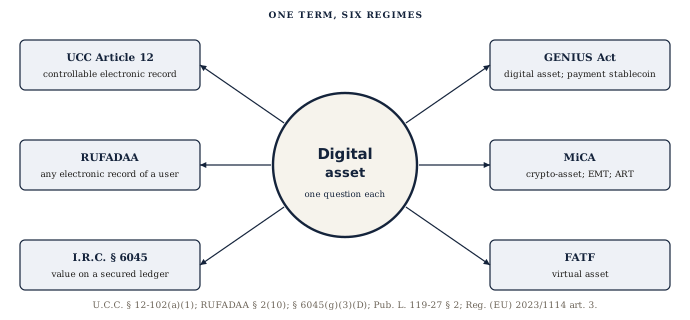
Uniform Commercial Code Article 12. The 2022 amendments to the Uniform Commercial Code added Article 12, which governs controllable electronic records, controllable accounts and controllable payment intangibles. A controllable electronic record is "a record stored in an electronic medium that can be subjected to control under Section 12-105." U.C.C. § 12-102(a)(1). The definition then excludes a list of records already governed elsewhere in the Code, including deposit accounts, electronic copies of records evidencing chattel paper, electronic documents of title, electronic money, investment property and transferable records. Id. The definition has two features. It is technology-neutral: a record qualifies whether it is recorded on a public blockchain, a permissioned ledger or another system, provided the system permits control. It is also defined by a legal capacity: the question is whether the record can be subjected to control as § 12-105 defines it, which requires that a person have the power to obtain substantially all the benefit of the record, the exclusive power to prevent others from obtaining it, the exclusive power to transfer control, and the ability readily to identify itself as having those powers. U.C.C. § 12-105(a). Article 12 is treated in ch. 6.
Money under the amended Code. The same amendments changed the definition of money. Money remains "a medium of exchange that is currently authorized or adopted by a domestic or foreign government," but the term now "does not include an electronic record that is a medium of exchange recorded and transferable in a system that existed and operated for the medium of exchange before the medium of exchange was authorized or adopted by the government." U.C.C. § 1-201(b)(24) (as amended 2022). The exclusion was drafted with a specific situation in view: a crypto-asset that a government later adopts as legal tender. Under the amended text such an asset remains a controllable electronic record for commercial-law purposes. An electronic medium of exchange created by a government, such as a central bank digital currency, is money and, in electronic form, electronic money.
Fiduciary access: RUFADAA. The Revised Uniform Fiduciary Access to Digital Assets Act (2015) defines a digital asset as "an electronic record in which an individual has a right or interest," and provides that the term "does not include an underlying asset or liability unless the asset or liability is itself an electronic record." Unif. Fiduciary Access to Digital Assets Act (Revised) § 2(10) (Unif. L. Comm'n 2015); e.g., Fla. Stat. § 740.002(9). The definition reaches e-mail, documents, photographs, social-media accounts and online financial records as well as crypto-assets. Its exclusion is significant: a bank account accessed online is an underlying asset governed by other law, while the electronic statement for that account is a digital asset. A crypto-asset is an electronic record and therefore falls within the definition itself. The Act governs the fiduciary's right of access as against a custodian, defined as a person that "carries, maintains, processes, receives, or stores a digital asset of a user." Fla. Stat. § 740.002(7). It does not determine whether the fiduciary may sign a transaction with a private key that the decedent held, a question governed by the law of property, trusts and estates. A few states enacted earlier statutes with different definitions. Delaware's 2014 Act, for example, lists data, text, e-mails, documents, software, usernames and passwords and other electronically stored material, and excludes an underlying asset or liability governed by other provisions of the title. Del. Code Ann. tit. 12, § 5002(7). Fiduciary access is treated in ch. 13.
Federal tax: Internal Revenue Code § 6045. The Infrastructure Investment and Jobs Act added a definition to the broker-reporting provisions: "Except as otherwise provided by the Secretary, the term 'digital asset' means any digital representation of value which is recorded on a cryptographically secured distributed ledger or any similar technology as specified by the Secretary." I.R.C. § 6045(g)(3)(D), added by Pub. L. No. 117-58, div. H, tit. VI, § 80603(b), 135 Stat. 429, 1339 (2021). The regulations extend the definition to a representation of value recorded on such a ledger "without regard to whether each individual transaction involving that digital asset is actually recorded on that ledger," and exclude cash. Treas. Reg. § 1.6045-1(a)(19)(i). The extension brings within the definition assets traded off-chain on the internal books of a custodial exchange. The regulations add that nothing in the definition implies that a digital asset is or is not a security, commodity or other instrument for any other purpose of the Code. Id. § 1.6045-1(a)(19)(ii). Tax and reporting are treated in chs. 30 to 32.
Federal stablecoin legislation. The Guiding and Establishing National Innovation for U.S. Stablecoins Act (the GENIUS Act) defines a digital asset as "any digital representation of value that is recorded on a cryptographically secured distributed ledger." Pub. L. No. 119-27, § 2(6) (2025) (codified at 12 U.S.C. § 5901(6)). The definition omits the tax statute's reference to "any similar technology." The Act then defines a payment stablecoin as a digital asset that is, or is designed to be, used as a means of payment or settlement, whose issuer is obligated to convert, redeem or repurchase it for a fixed amount of monetary value and represents that it will maintain a stable value relative to that amount. Id. § 2(22)(A). A national currency, a deposit (including a deposit recorded using distributed ledger technology) and a security are excluded. Id. § 2(22)(B). The stablecoin definition is examined at ¶ 140, and the regulatory regime in ch. 37.
The European Union: MiCA. The Markets in Crypto-Assets Regulation defines a crypto-asset as "a digital representation of a value or of a right that is able to be transferred and stored electronically using distributed ledger technology or similar technology." Regulation (EU) 2023/1114, art. 3(1)(5), 2023 O.J. (L 150) 40. It distinguishes two classes of stable-value token: the electronic money token, which "purports to maintain a stable value by referencing the value of one official currency," and the asset-referenced token, which purports to maintain a stable value by referencing another value or right or a combination, including one or more official currencies. Id. art. 3(1)(6)–(7). All other crypto-assets fall into a residual category. The Regulation excludes from its scope, among other things, crypto-assets that are financial instruments under existing EU legislation, deposits, and crypto-assets that are unique and not fungible with other crypto-assets. MiCA is treated in ch. 38.
The FATF standard. The Financial Action Task Force added the terms "virtual asset" and "virtual asset service provider" to its Recommendations in October 2018. A virtual asset is a digital representation of value that can be digitally traded, or transferred, and can be used for payment or investment purposes; the term does not include digital representations of fiat currencies, securities and other financial assets already covered elsewhere in the Recommendations. FATF, International Standards on Combating Money Laundering and the Financing of Terrorism & Proliferation, General Glossary. The definition is functional and deliberately broad. National anti-money-laundering laws implementing Recommendation 15 adopt it, often with local variation. See infra ch. 33.
England and Wales: the 2025 Act. The Property (Digital Assets etc) Act 2025 contains no definition of a digital asset. Section 1 provides that "[a] thing (including a thing that is digital or electronic in nature) is not prevented from being the object of personal property rights merely because it is neither (a) a thing in possession, nor (b) a thing in action." Property (Digital Assets etc) Act 2025, c. 29, s. 1. The Act extends to England and Wales and Northern Ireland and came into force on the day it was passed, 2 December 2025. Id. s. 2. It implements the Law Commission's recommendation that the courts be left to develop the boundaries of a third category of personal property. The comparative treatment is in ch. 4.
State digital-asset statutes. Several states have enacted their own classifications. Wyoming defines a digital asset as "a representation of economic, proprietary or access rights that is stored in a computer readable format," which is either a digital consumer asset, a digital security or virtual currency. Wyo. Stat. Ann. § 34-29-101(a)(i) (as amended by 2021 Wyo. Sess. Laws, Enrolled Act 61). Each class is intangible personal property, and for Article 9 purposes digital consumer assets are general intangibles, digital securities are securities and investment property, and virtual currency is treated as money. Id. § 34-29-102(a). The Wyoming statute also provides that "possession" of a digital asset for Article 9 purposes includes use of a private key, a multi-signature arrangement exclusive to the secured party or a smart contract. Id. § 34-29-103(e)(iv). These provisions interact with Article 12 in states that have adopted both, a subject taken up in ch. 6.
Table 1-1. The principal definitions compared
| Regime | Term | Core test | Notable exclusions |
|---|---|---|---|
| UCC Art. 12 (2022) | Controllable electronic record | Record in electronic medium capable of control under § 12-105 | Deposit accounts, electronic money, investment property, documents of title, transferable records |
| RUFADAA (2015) | Digital asset | Electronic record in which an individual has a right or interest | Underlying asset or liability unless itself an electronic record |
| I.R.C. § 6045(g)(3)(D) | Digital asset | Digital representation of value on a cryptographically secured distributed ledger or similar technology | Cash (by regulation) |
| GENIUS Act § 2(6), (22) | Digital asset; payment stablecoin | Digital representation of value on a cryptographically secured distributed ledger; stablecoin adds payment use and redemption obligation | National currency, deposits, securities (from payment stablecoin) |
| MiCA art. 3(1)(5) | Crypto-asset | Digital representation of value or right transferable and storable using DLT or similar technology | Financial instruments, deposits, unique non-fungible assets |
| FATF Glossary | Virtual asset | Digital representation of value that can be traded or transferred and used for payment or investment | Digital fiat, securities and financial assets covered elsewhere |
| Property (Digital Assets etc) Act 2025 | None | A thing may be the object of personal property rights although it is neither a thing in possession nor a thing in action | None |
¶ 120
A Working Taxonomy
Purpose of the taxonomy. No statute adopts the taxonomy used in this treatise. It is a working classification, built on the economic and legal function of each asset, designed to tell the practitioner which bodies of law are likely to apply. The categories overlap at the margins, and a single token may move between them as its network, issuer or use changes. The taxonomy is therefore a starting point for analysis and never a substitute for it.
The classifying questions. Four questions place an asset in the taxonomy. The first is whether the asset represents a claim against an identifiable person. A native token of a public network usually does not; a stablecoin, a tokenized bond and a tokenized deposit do. The second is whether the asset's value is designed to track a reference value, such as a national currency, a commodity or a security. The third is whether the asset confers rights of governance or participation in a protocol or organization. The fourth is whether the asset is unique or fungible. The answers place the asset in one or more of the six classes described in ¶ 120.03.
The six classes. The treatise uses six classes.
- Native tokens are the units of account of a public network, issued by the network's protocol and used to pay transaction fees or secure the network, such as bitcoin and ether. They embody no claim against an issuer. See infra ¶ 130.
- Stable-value tokens are designed to hold a value equal to a reference amount. They include fiat-backed stablecoins, asset-referenced tokens and tokens whose stability depends on an algorithm or over-collateralization. See infra ¶ 140.
- Tokenized deposits and central bank digital currencies are bank or central-bank liabilities recorded on a ledger. They are money or deposits for most legal purposes and are treated with stable-value tokens for convenience. See infra ¶¶ 140.08–140.10.
- Tokenized securities and real-world assets are tokens that represent, or are, a security, a fund interest, a commodity, real property or a receivable. See infra ¶ 150.
- Non-fungible tokens are unique tokens, usually linked to a digital or physical object or a right of access. See infra ¶¶ 150.08–150.12.
- Governance and protocol tokens confer voting rights over a protocol or a decentralized organization, and sometimes economic rights in its fees or treasury. See infra ¶ 160.
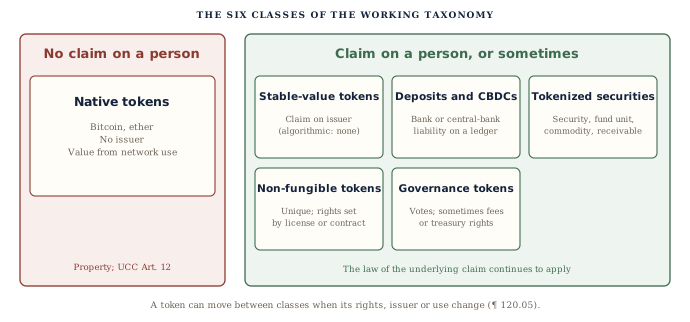
Claim-based and claimless assets. The most important distinction in private law is between assets that embody a claim against a person and assets that do not. A tokenized bond is a debt owed by the issuer; the token is the means by which the claim is held and transferred, and the law that governs the claim continues to apply. A native token embodies no claim. Its value depends on the willingness of others to accept it, and its existence depends on the continued operation of a network that no single person controls. The English Law Commission and the courts have relied on this distinction in concluding that crypto-tokens such as bitcoin are neither things in possession nor things in action and fall within a distinct category of personal property. See infra ch. 4. In the United States the distinction affects the characterization of tokens for Article 9 purposes, the treatment of custodial holdings in insolvency and the availability of remedies such as replevin and conversion. See infra chs. 3, 6 and 27.
Table 1-2. The six classes and the principal bodies of law
| Class | Claim against a person? | Principal private law | Principal regulatory regimes |
|---|---|---|---|
| Native tokens | No | Property; UCC Art. 12 | Commodities (CFTC); AML; tax |
| Stable-value tokens | Usually against issuer | Contract; UCC Art. 12 | GENIUS Act; state money transmission; MiCA (EMT, ART) |
| Tokenized deposits and CBDCs | Against bank or central bank | Deposit law; UCC Art. 4, 9 | Banking law |
| Tokenized securities and RWAs | Yes, or interest in underlying asset | UCC Art. 8; law of the underlying asset | Securities law; MiCA exclusion for financial instruments |
| Non-fungible tokens | Sometimes, by license or contract | Property; contract; intellectual property | Securities law (fact-specific); AML |
| Governance and protocol tokens | Sometimes, in organization | Property; partnership and association law | Securities law (fact-specific); AML |
Movement between classes. A token's class can change. A governance token may acquire a claim on protocol fees by a vote of its holders. A stablecoin whose issuer becomes insolvent may cease to hold its reference value and trade as a claim in the issuer's estate. A tokenized security may be redeemed and its token retired. A native token may become legal tender, as bitcoin did in El Salvador in 2021, without changing its status as a controllable electronic record under the amended Uniform Commercial Code. See supra ¶ 110.03. Planning documents should anticipate these changes. A trust that permits the trustee to hold "stablecoins" should state what the trustee must do if a stablecoin loses its peg.
Wrapped and bridged tokens. A wrapped token represents another asset held by a custodian or a smart contract; wrapped bitcoin on the Ethereum network is the common example. A bridged token represents an asset locked on one network and reissued on another. Each is a claim-based asset even though the underlying asset is claimless: the holder relies on the custodian or the bridge contract to redeem the token for the underlying asset. The taxonomy classifies a wrapped or bridged token according to the claim it represents and notes the additional counterparty or code risk. Losses from bridge exploits have been among the largest in the history of the field, and the legal consequences of those losses for holders are examined in chs. 12 and 16.

¶ 130
Native Tokens and Cryptocurrencies
Definition. A native token is the unit of value that a public blockchain's protocol creates and recognizes. Bitcoin on the Bitcoin network and ether on the Ethereum network are the principal examples. The protocol issues new units as a reward to those who validate transactions, records each unit's movement on the shared ledger, and requires that transaction fees be paid in the native unit. A native token has no issuer in the legal sense. No person promises to redeem it, and no person's insolvency causes it to cease to exist.
What the holder has. In technical terms, the holder of a native token does not hold an object. The ledger records that a quantity of units is associated with an address, and the protocol permits a transaction moving those units to be validated if it is signed with the private key corresponding to that address. What the holder has, then, is the practical ability, through knowledge of the key, to cause the network to record a transfer. The law has had to decide what legal interest corresponds to that ability. The prevailing answer in the common-law world is that the holder owns the token as personal property. See infra chs. 3 and 4. The 2022 amendments to the Uniform Commercial Code give the ability a legal form: the person with control under § 12-105 is treated as having the rights that Article 12 attaches to control, including in many cases the ability to take free of competing property claims. U.C.C. § 12-104(e). See infra ch. 6.
"Cryptocurrency" and "virtual currency." The terms "cryptocurrency" and "virtual currency" are often used for native tokens. This treatise avoids them except where a statute or authority uses them, because both imply a monetary character that the law does not generally recognize. The Internal Revenue Service has treated convertible virtual currency as property and not as currency for federal tax purposes since 2014. I.R.S. Notice 2014-21, 2014-16 I.R.B. 938. The amended Uniform Commercial Code excludes most native tokens from "money." See supra ¶ 110.03. Several statutes nonetheless use "virtual currency" as their defined term, including the New York regulation that licenses virtual-currency business activity and FinCEN's guidance on convertible virtual currency. See infra chs. 33 and 37. When a statute uses one of these terms, the statutory definition governs.
Proof-of-work and proof-of-stake. Native tokens differ according to the mechanism by which their networks reach agreement on the state of the ledger. In a proof-of-work network, such as Bitcoin, validators compete to solve a computational problem, and the winner proposes the next block and receives newly issued units. In a proof-of-stake network, such as Ethereum since September 2022, validators lock a quantity of the native token as stake, are selected to propose and attest to blocks, receive rewards, and may lose part of their stake for misconduct. The difference matters to lawyers in three ways. Staking rewards raise questions of income recognition, examined in ch. 30. Staking arrangements in which a custodian or service stakes on behalf of a holder raise questions of custody, title and disclosure, examined in ch. 12. And a trustee who holds a proof-of-stake asset must decide whether prudence requires staking, permits it, or forbids it. See infra ch. 14.
Forks and airdrops. A native token can multiply. A hard fork occurs when a network divides into two chains, each with its own native token; holders of the original token at the moment of the fork hold units on both chains. An airdrop distributes new tokens to the addresses of existing holders. Each event raises questions of ownership and income. As between a custodian and its customers, the custody agreement usually determines who is entitled to forked or airdropped units, and many agreements reserve to the custodian the decision whether to support a new chain. For federal tax purposes, a taxpayer who receives new units following a hard fork has gross income when the taxpayer obtains dominion and control over them. Rev. Rul. 2019-24, 2019-44 I.R.B. 1004. For trustees, the receipt of forked units raises the question of allocation between income and principal, examined in ch. 14.
Commodity status. The Commodity Futures Trading Commission has taken the position since 2015 that bitcoin and other virtual currencies are commodities under the Commodity Exchange Act. Federal courts have agreed. CFTC v. McDonnell, 287 F. Supp. 3d 213 (E.D.N.Y. 2018). Commodity status gives the Commission jurisdiction over derivatives on native tokens and anti-fraud and anti-manipulation authority over spot transactions in interstate commerce. It does not of itself make the spot market for native tokens a regulated market. See infra ch. 36.
Securities status. Whether a native token, or a particular offer or sale of it, is an investment contract under SEC v. W.J. Howey Co., 328 U.S. 293 (1946), depends on the facts of the transaction. The Securities and Exchange Commission's staff has long expressed the view that bitcoin, as currently offered and sold, is not a security, and the agency's posture toward other native tokens changed markedly in 2025. The case law distinguishes between a token and the transactions in which it is sold. In SEC v. Ripple Labs, Inc., 682 F. Supp. 3d 308 (S.D.N.Y. 2023), the court held that the issuer's direct sales of its token to institutional buyers under written contracts were investment contracts, while its programmatic sales on trading platforms to buyers who could not know the seller's identity were not. See infra ¶ 170.05 and ch. 35.
¶ 140
Stablecoins, Tokenized Deposits and Central Bank Digital Currencies
The common feature. The assets in this class are designed to hold a stable value measured in a national currency or another reference asset. They differ in who stands behind the value. A fiat-backed stablecoin depends on its issuer's reserves and its obligation to redeem. An asset-referenced token depends on a basket of reserve assets. A crypto-collateralized stablecoin depends on over-collateralization enforced by smart contracts. An algorithmic stablecoin depends on a mechanism that expands and contracts supply. A tokenized deposit depends on the issuing bank. A central bank digital currency depends on the central bank. The legal treatment follows the source of value.
Fiat-backed stablecoins. The most widely used stablecoins are issued by a company that holds reserves of cash and short-term government securities and promises to redeem tokens for dollars or another currency at par. The holder's rights against the issuer are contractual and are found in the issuer's terms. The holder of a token acquired on the secondary market may or may not have a direct right of redemption; many issuers redeem only for verified customers above a minimum amount, and other holders realize value by selling the token on a trading platform. The questions that matter most to a fiduciary or creditor are the quality and segregation of reserves, the identity of the obligor, the holder's priority if the issuer fails, and the issuer's power to freeze tokens.
The GENIUS Act definition. Under the GENIUS Act, a payment stablecoin is a digital asset "that is, or is designed to be, used as a means of payment or settlement," the issuer of which "is obligated to convert, redeem, or repurchase for a fixed amount of monetary value, not including a digital asset denominated in a fixed amount of monetary value," and "represents that such issuer will maintain, or create the reasonable expectation that it will maintain, a stable value relative to the value of a fixed amount of monetary value." Pub. L. No. 119-27, § 2(22)(A) (2025). Monetary value means a national currency or a deposit denominated in a national currency. Id. § 2(17). The definition excludes a digital asset that is a national currency, a deposit "including a deposit recorded using distributed ledger technology," or a security under the federal securities statutes. Id. § 2(22)(B). A proviso adds that no bond, note, evidence of indebtedness or investment contract issued by a permitted payment stablecoin issuer qualifies as a security solely because it satisfies the payment-stablecoin conditions. Id. § 2(22)(B)(iii).
Consequences of the definition. Three consequences follow. First, a token redeemable for a fixed amount of another stablecoin falls outside the definition, because monetary value excludes a digital asset denominated in a fixed amount of monetary value. Second, a token that maintains its value only by algorithm, with no issuer obligated to redeem, falls outside the definition, because the definition requires an issuer's obligation and representation. Third, the exclusion of deposits draws a line between stablecoins and tokenized deposits, which remain within banking law. The Act's licensing, reserve, disclosure and insolvency provisions, and the treatment of holders in an issuer's insolvency, are examined in chs. 27 and 37.
MiCA's two classes. The European regime divides stable-value tokens into e-money tokens, referencing one official currency, and asset-referenced tokens, referencing another value or right or a combination, including several currencies. Regulation (EU) 2023/1114, art. 3(1)(6)–(7). An e-money token issuer must be a credit institution or an electronic money institution, and holders have a right of redemption at par at any time. The distinction between the two classes, and the significant-token regime applicable to the largest issuers, are examined in ch. 38.
Crypto-collateralized and algorithmic tokens. Some stable-value tokens are created by a smart contract when a user deposits other crypto-assets worth more than the tokens issued, and are destroyed when the user repays them and withdraws the collateral. Others rely on an algorithm that adjusts supply, often paired with a second token that absorbs volatility. The collapse of a prominent algorithmic stablecoin and its paired token in May 2022 eliminated tens of billions of dollars of nominal value within days and prompted enforcement actions, private litigation and legislative attention. A holder of a token of this kind has no issuer obligated to redeem it at par. For fiduciaries, this distinction is decisive. A trustee who treats every token described as a "stablecoin" as a cash equivalent may be unable to defend that treatment if a token without a redemption obligation fails. See infra ch. 14.
Freezing and blacklisting. Most fiat-backed stablecoins are issued through smart contracts that permit the issuer to freeze tokens held at a particular address and, in some cases, to destroy and reissue them. Issuers use these powers to comply with sanctions, court orders and law-enforcement requests. The powers affect several bodies of law. A creditor seeking to levy on stablecoins may be able to obtain an order directed at the issuer. See infra ch. 24. A victim of theft may obtain a freezing order effective against tokens at a thief's address. See infra ch. 25. And a holder's property rights in a token are subject to the issuer's contractual and technical power to freeze it. See infra ch. 3.
Tokenized deposits. A tokenized deposit is a deposit liability of a bank, recorded on a distributed ledger. The token is a record of the depositor's claim against the bank, and the claim is a deposit for purposes of banking law, deposit insurance and Article 4 and Article 9 of the Uniform Commercial Code. The GENIUS Act's exclusion of deposits "recorded using distributed ledger technology" from the definition of payment stablecoin confirms that tokenization does not change the character of the liability. Pub. L. No. 119-27, § 2(22)(B)(ii). The commercial-law consequence is that a security interest in a tokenized deposit is perfected by control under Article 9's deposit-account rules, and a tokenized deposit is not a controllable electronic record. U.C.C. § 12-102(a)(1).
Central bank digital currencies. A central bank digital currency is a liability of a central bank in digital form, available to the public or to financial institutions. Several central banks have launched retail or wholesale versions, and others are in pilot. In the United States, Executive Order 14178 of January 23, 2025, prohibits federal agencies, except as required by law, from undertaking any action to establish, issue or promote a central bank digital currency, and terminated plans then under way. Exec. Order No. 14178, § 5, 90 Fed. Reg. 8647 (Jan. 31, 2025). A foreign central bank digital currency held by a United States person is money for purposes of the Uniform Commercial Code, being a medium of exchange authorized by a foreign government. U.C.C. § 1-201(b)(24).
Comparison. The legal differences among the assets in this class are greatest in insolvency. A holder of a central bank digital currency faces no meaningful insolvency risk. A holder of a tokenized deposit has the protection of deposit insurance to the statutory limit and the priority of a depositor. A holder of a payment stablecoin has the priority that the GENIUS Act gives to holders in the issuer's insolvency, examined in ch. 27. A holder of an algorithmic or crypto-collateralized token has whatever rights the protocol's code and any surviving entity provide. Table 1-3 summarizes the comparison.
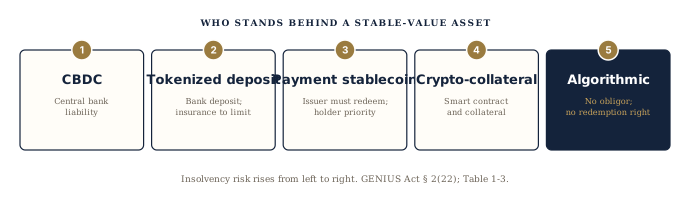
Table 1-3. Stable-value assets compared
| Asset | Obligor | Redemption right | Treatment in insolvency |
|---|---|---|---|
| Central bank digital currency | Central bank | Legal tender | No ordinary insolvency risk |
| Tokenized deposit | Bank | Depositor's withdrawal right | Deposit insurance and depositor priority |
| Payment stablecoin (GENIUS Act) | Permitted issuer | Statutory and contractual redemption at par | Statutory priority for holders (see ch. 27) |
| E-money token (MiCA) | Credit or e-money institution | Redemption at par at any time | Reserve protection under MiCA (see ch. 38) |
| Crypto-collateralized token | Smart contract; sometimes a foundation | Redemption against collateral by code | Depends on code and any entity |
| Algorithmic token | None | None | No obligor |

¶ 150
Tokenized Securities, Real-World Assets and Non-Fungible Tokens
Tokenization defined. Tokenization is the representation of an asset or a right on a distributed ledger by means of a token. The asset represented may be a security, a fund interest, a deposit, a commodity, a receivable, an interest in real property or a work of art. Tokenization changes the method of recording and transferring the asset. Whether it also changes the legal nature of the asset depends on how the token is linked to the underlying right, and on the law that governs that right.
Two models. Two models of tokenization are in use. In the first, the token is the asset: the issuer creates a security in tokenized form, and the ledger is the issuer's register or an official record of ownership. In the second, the token represents an asset held elsewhere: a custodian holds a bond, a fund unit or a bar of gold, and issues tokens that entitle the holder to the custodian's interest or to delivery of the asset. The first model raises questions of corporate and securities law about whether a ledger can serve as a register of members or holders. The second raises the questions of custody, intermediation and insolvency examined in chs. 8 to 11.
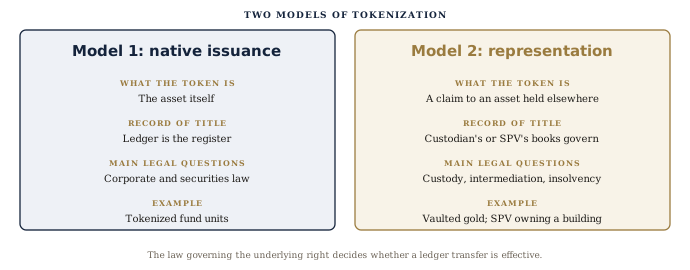
Tokenized securities. A security does not cease to be a security because it is issued or recorded as a token. The federal securities laws apply to tokenized stocks, bonds, notes and fund interests as they apply to their conventional counterparts, and the questions of registration, exemption, broker-dealer status, transfer-agent status and custody remain. See infra ch. 35. Under the Uniform Commercial Code a tokenized security may be a security under Article 8 or, if held through an intermediary, a financial asset credited to a securities account. Article 12 expressly excludes investment property from the definition of a controllable electronic record. U.C.C. § 12-102(a)(1). The interaction between Article 8 and Article 12, which determines how a tokenized security is transferred and how a lender perfects a security interest in it, is examined in ch. 8.
Tokenized funds. The most widely adopted tokenized securities are units of money market funds and short-term government bond funds, whose shares are recorded on a public or permissioned ledger and transferable among approved holders. They are used as collateral, as treasury holdings for digital-asset businesses and as reserves. A trustee or fiduciary who holds tokenized fund units holds an interest in an investment company; the token is the record of that interest. Due diligence extends to the fund, its adviser and its transfer agent, and to the ledger on which ownership is recorded.
Real-world assets. "Real-world assets" is the industry term for tokens representing assets that exist off the ledger, such as real estate, private credit, commodities and receivables. The phrase has no legal content. The critical question is how the token holder's right to the off-ledger asset is secured. In most structures a special-purpose entity owns the asset and the tokens represent equity or debt interests in that entity; in others, a custodian holds the asset for token holders under a trust or custody agreement. The holder's position depends on the entity's or custodian's documents, on the law governing the asset, and on whether a court asked to enforce the holder's rights will recognize the ledger as authoritative. A token that purports to convey title to land, for example, conveys nothing unless the land-records law of the place where the land lies recognizes the transfer.
Tokenized commodities. Tokens representing precious metals or other commodities are usually issued by a custodian that holds the commodity in a vault and promises to deliver it, or its value, on redemption. The holder's position resembles that of the holder of a warehouse receipt or a bailment claim. If the token is a document of title under Article 7 of the Uniform Commercial Code, Article 12 does not apply to it. U.C.C. § 12-102(a)(1). If it is not, it may be a controllable electronic record whose holder also has a contractual claim against the custodian. A trustee should determine whether the commodity is allocated to holders or held as a pool, and whether the custodian's creditors can reach it.
Tokenized receivables and controllable payment intangibles. Article 12 also governs controllable accounts and controllable payment intangibles: rights to payment evidenced by a controllable electronic record that provides that the obligor undertakes to pay the person with control. U.C.C. § 12-102(a)(2)–(3). A tokenized receivable structured in this way allows the account debtor to discharge its obligation by paying the person with control of the record, and allows a purchaser for value to take free of competing claims. See infra ch. 6.
Non-fungible tokens defined. A non-fungible token is a token that is unique and is not interchangeable with other tokens. Each carries an identifier recorded on the ledger. Most non-fungible tokens are linked to a digital image, a piece of music or another work, to a ticket or membership, or to a physical object. The link is usually a pointer to a file stored elsewhere. The token itself usually contains no copy of the work.
What the holder owns. The holder of a non-fungible token owns the token. Whether the holder also owns or has rights in the linked work depends on the license or terms of sale published by the creator or the platform. In most cases the holder acquires a limited license to display the work and no copyright interest. Buyers are often surprised by this. For lawyers, the point to remember is that a non-fungible token is a controllable electronic record whose commercial value depends on contractual and intellectual-property rights that exist outside the ledger.
Exclusion from MiCA. MiCA excludes from its scope crypto-assets that are unique and not fungible with other crypto-assets. Regulation (EU) 2023/1114, art. 2(3). The exclusion is applied by substance. A collection of tokens issued in a large series, or fractional interests in a single non-fungible token, may be treated as fungible and brought within the Regulation. See infra ch. 38.
Securities status. Uniqueness does not place a non-fungible token outside the securities laws. In Friel v. Dapper Labs, Inc., No. 21-cv-5837, 2023 WL 2162747 (S.D.N.Y. Feb. 22, 2023), the court denied a motion to dismiss claims that tokens representing basketball video highlights were investment contracts. The court relied on allegations that the tokens could be traded only on the issuer's marketplace, which ran on the issuer's own blockchain, so that the value of the tokens depended on the issuer's efforts to maintain and promote both. The decision was at the pleading stage and turned on the specific structure alleged. See infra ch. 35.
Non-fungible tokens linked to physical assets. Some non-fungible tokens are issued to represent title to, or a right to delivery of, a physical object held by a custodian, such as a watch, a bottle of wine or a work of art. The holder's rights against the custodian are contractual, and the custodian's insolvency, the law governing transfer of the object, and any requirement of physical delivery for a valid transfer under the law of the place where the object is located all affect the holder's position. The analysis follows the second model of tokenization. See supra ¶ 150.02.
¶ 160
Governance Tokens and Protocol Interests
Definition. A governance token is a token that confers on its holder the power to vote on proposals affecting a protocol or a decentralized autonomous organization, usually in proportion to the number of tokens held. Proposals may change the protocol's parameters, upgrade its smart contracts, allocate funds from a treasury controlled by the protocol, or set the fees the protocol charges. Some governance tokens also carry, or can be voted to carry, economic rights such as a share of fees or of the treasury.
The decentralized autonomous organization. A decentralized autonomous organization, usually called a DAO, is a group of persons who coordinate through smart contracts and a governance token to manage a protocol, a treasury or a common project. Most DAOs have no legal entity. Their participants may be numerous, anonymous and located in many countries. The legal question that follows is what kind of association the law will find among them, and whether that association exposes token holders to personal liability. See infra ch. 19.
Partnership exposure. A general partnership is formed whenever two or more persons associate to carry on as co-owners a business for profit, whether or not they intend to form a partnership. Rev. Unif. P'ship Act § 202(a) (1997). Each partner is jointly and severally liable for the partnership's obligations. Id. § 306(a). Courts have held that allegations about a DAO's structure and activities can plead the existence of a general partnership among its token holders or some of them.
Regulatory treatment of DAOs. In CFTC v. Ooki DAO, No. 3:22-cv-05416-WHO (N.D. Cal. June 8, 2023), the court entered a default judgment against a DAO, holding that it was an unincorporated association that could be sued as a person under the Commodity Exchange Act, and that it had operated an illegal trading platform. The court had earlier permitted service by posting on the DAO's online forum and help-chat function. The case shows that a regulator can obtain judgment against a DAO as such and, through the theory of association, against those who voted its tokens. See infra chs. 19 and 36.
Legal wrappers. In response to these risks, several jurisdictions provide entity forms designed for DAOs. Wyoming's decentralized autonomous organization supplement permits a limited liability company to be organized as a DAO whose management is vested in its members or in its members and smart contracts. Wyo. Stat. Ann. §§ 17-31-101 to -116. The Republic of the Marshall Islands enacted a Decentralized Autonomous Organization Act in 2022, and Utah enacted a DAO statute in 2023, effective in 2024. Foundations and purpose trusts in offshore jurisdictions are also used to hold a DAO's treasury and contract on its behalf. See infra chs. 18 and 20. Under the Wyoming statute, the articles of organization must identify any smart contract used to manage the company, and a change to that smart contract requires an amendment to the articles. Id. § 17-31-107(a)(iii). The statutory treatment, including the consequences of upgrading the code, is examined in ch. 20 and in Lighthouse on Limited Liability Companies.
Securities status. Governance tokens may be investment contracts. The Securities and Exchange Commission's 2017 report on The DAO found that tokens sold to fund a venture whose profits would be shared among holders were securities, notwithstanding the voting rights the tokens carried, because the holders' voting power was too limited and dispersed to give them meaningful control. Report of Investigation Pursuant to Section 21(a) of the Securities Exchange Act of 1934: The DAO, Exchange Act Release No. 81207 (July 25, 2017). The analysis depends on the facts of each offering and on the extent of decentralization at the time of sale. See infra ch. 35.
Protocol tokens with economic rights. A token that entitles its holder to a share of fees, to buy-backs funded by protocol revenue or to a distribution of the treasury has an economic character that affects its treatment under securities law, tax law and partnership law. A vote to switch on a fee distribution may change the token's legal profile. Holders who are fiduciaries should watch governance proposals with this possibility in mind.

¶ 170
Characterization Depends on Purpose
The principle. The same asset may be property for one purpose, money for another, a commodity for a third and, in some transactions, a security. These characterizations do not conflict, because each answers the question posed by a particular statute or body of law. A court asked whether bitcoin is "money" under a money-transmission statute construes that statute; its answer does not determine whether bitcoin is money for the Uniform Commercial Code or for federal tax purposes. The cases in this paragraph illustrate the principle and introduce authorities examined at length later in the book.
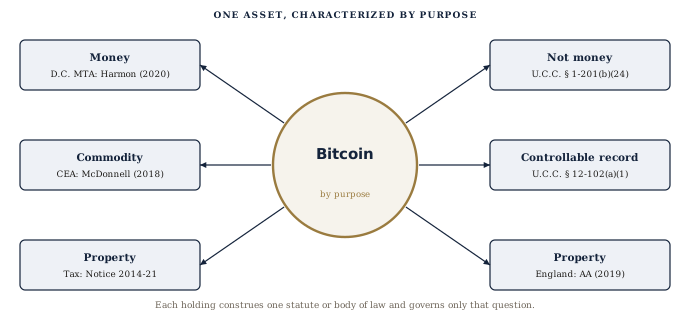
Money for one statute, property for another. The Internal Revenue Service treats convertible virtual currency as property. I.R.S. Notice 2014-21, 2014-16 I.R.B. 938. The amended Uniform Commercial Code excludes most native tokens from money. U.C.C. § 1-201(b)(24). A federal court has nonetheless held that bitcoin is money for purposes of a local money-transmission statute.
A commodity for the Commodity Exchange Act. In CFTC v. McDonnell, 287 F. Supp. 3d 213 (E.D.N.Y. 2018), the court held that virtual currencies are commodities within the Commodity Exchange Act, so that the Commission could pursue fraud in spot transactions in them. The holding gives the Commission enforcement authority. It does not make native tokens commodities for the purposes of Article 2 of the Uniform Commercial Code, which governs transactions in goods, or for tax purposes, where the commodity characterization raises separate questions under the Internal Revenue Code. See infra chs. 30 and 36.
Property in insolvency: the terms decide. Whether a customer of a custodial platform owns the assets credited to the customer's account, or holds only a contractual claim against the platform, is the most consequential characterization question in practice. The answer turns on the terms of service and the law governing them.
A security in some transactions only. The investment-contract test of SEC v. W.J. Howey Co., 328 U.S. 293 (1946), is applied to the transaction in which a token is offered or sold.
Not property for one statute. A smart contract that no person can alter or control may fall outside a statute's concept of property even when tokens that pass through it are property.
Property in English law. The English courts reached the property question first in an interim injunction case.
Ruscoe v Cryptopia. The High Court of New Zealand reached the same conclusion in the liquidation of an exchange, holding that the crypto-assets the exchange held were property and that they were held on trust for its account holders. Ruscoe v Cryptopia Ltd (in liq) [2020] NZHC 728. The trust finding turned on the exchange's records and conduct. See infra chs. 4 and 28.
¶ 180
Terminology Used in This Treatise
Why a fixed vocabulary. Industry usage of the terms "wallet," "custody" and "control" is loose, and the same word is used in different senses by engineers, regulators and courts. A treatise that applies law to these arrangements must use each term in one sense. This paragraph fixes those senses. Where a statute uses a term differently, the text says so. The technology is explained more fully in ch. 2, and a glossary appears in App. A.
Ledger, address and transaction. A ledger is the record maintained by a network of the quantities of each token associated with each address. A public ledger can be read and written to by anyone who follows the protocol; a permissioned ledger restricts those functions to approved participants. An address is an identifier, derived from a public key or from a smart contract, to which tokens can be sent. A transaction is an instruction, broadcast to the network and signed as the protocol requires, that moves tokens from one address to another or calls a function of a smart contract. A transaction is final when the network's consensus rules make reversal impracticable.
Keys and seed phrases. A private key is a secret number that permits the holder to sign transactions from the corresponding address. A public key is derived from the private key and allows others to verify the signature. A seed phrase, also called a recovery phrase or mnemonic, is a sequence of words from which a wallet's private keys are generated; anyone who knows the seed phrase can regenerate all the keys and move all the tokens. The treatise uses key material to refer to private keys, seed phrases and key shares collectively. Key material is information. Its loss or disclosure has legal consequences that the law of tangible property does not anticipate, because a copy is as effective as the original and the original may survive the copying unaltered.
Wallet. The treatise uses wallet to mean software or hardware that stores key material and uses it to sign transactions. A wallet does not hold tokens; tokens remain recorded on the ledger. A hardware wallet stores key material on a dedicated device. A software wallet stores it on a general-purpose computer or phone. A hosted or custodial wallet is one in which a service provider holds the key material for the user. An unhosted or self-custodied wallet is one in which the user holds it. Regulatory texts sometimes use "unhosted wallet" to mean an address not associated with a regulated provider. See infra ch. 34.
Multi-signature and threshold arrangements. In a multi-signature arrangement, a smart contract or script requires signatures from a stated number of distinct keys, such as two of three, before a transaction is valid. In a threshold-signature or multi-party computation arrangement, a single key is never assembled in one place; parties holding key shares cooperate to produce a signature, and the network sees an ordinary transaction. Both arrangements distribute the power to transfer. Whether any single participant has control under § 12-105, which requires exclusive powers subject to stated exceptions for shared control, is a question examined in chs. 6 and 9. A recovery arrangement is a set of procedures and key material held by persons other than the owner, such as a trusted contact, a custodian or a time-locked contract, that permits access to be restored if the owner's key material is lost or the owner dies. See infra ch. 22.
Custody. The treatise uses custody in its commercial sense: the holding of key material, or of the power to transfer tokens, by one person for the benefit of another. A custodian is the person who does so. Custody may be third-party custody, by a bank, trust company or other service provider, or self-custody, by the owner. Whether a custodian holds tokens as bailee, trustee, securities intermediary or debtor depends on the agreement and the governing law, and the consequences are greatest in insolvency. See infra chs. 10 and 27. Two statutory uses differ from the commercial sense. RUFADAA uses custodian for any person that carries, maintains, processes, receives or stores a digital asset of a user, including an e-mail provider. See supra ¶ 110.04. The Investment Advisers Act custody rule uses custody to mean holding client funds or securities, directly or indirectly, or having authority to obtain possession of them. See infra ch. 11.
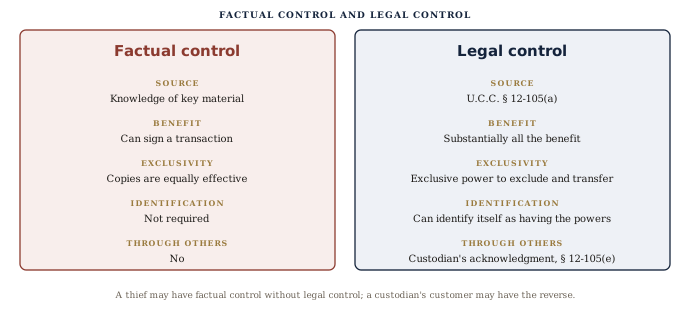
Control. The treatise uses control in the sense of Article 12 unless the text indicates otherwise. A person has control of a controllable electronic record if the record, a record attached to or logically associated with it, or the system in which it is recorded gives the person the power to avail itself of substantially all the benefit from the record, the exclusive power to prevent others from doing so, and the exclusive power to transfer control, and enables the person readily to identify itself as having those powers. U.C.C. § 12-105(a). Control may be had through another person who acknowledges that it has control on the first person's behalf. Id. § 12-105(e). Control is a legal relation. It may differ from factual control, the treatise's term for the practical ability to sign a transaction. A thief who copies a seed phrase has factual control but may lack the exclusive power the statute requires; an owner whose key material is held by a custodian lacks factual control but may have legal control through the custodian.
Smart contract. A smart contract is a program deployed to a ledger that executes according to its code when called by a transaction. The term does not imply a contract in the legal sense. A smart contract may implement the terms of a legal agreement, may be the subject of one, or may operate with no agreement at all. Whether a smart contract that cannot be altered is property was the question in Van Loon. See supra ¶ 170.06. Wyoming's DAO statute uses its own definition. Wyo. Stat. Ann. § 17-31-102(a). See infra ch. 20.
Exchange, platform and broker. The treatise uses trading platform for a system that matches orders for digital assets and exchange where that term is customary, without implying registration as a national securities exchange. A custodial platform is a trading platform or lending service that holds customer assets. A broker is used in the sense of the statute under discussion; for tax-reporting purposes it means a person that, for consideration, is responsible for regularly providing any service effectuating transfers of digital assets on behalf of another person. I.R.C. § 6045(c)(1)(D).
Virtual asset service provider. Following the FATF Recommendations, the treatise uses virtual asset service provider, or VASP, for a person that as a business conducts for or on behalf of another exchange, transfer, safekeeping or administration of virtual assets, or participates in financial services related to an issuer's offer or sale. National laws use variant terms, including crypto-asset service provider under MiCA and money services business under the Bank Secrecy Act. See infra chs. 33, 38 and 40.
Table 1-4. Core terms
| Term | Meaning in this treatise | Statutory variants |
|---|---|---|
| Key material | Private keys, seed phrases and key shares | Wyoming "private key" (§ 34-29-103(e)) |
| Wallet | Software or hardware that stores key material and signs transactions | "Unhosted wallet" in AML texts |
| Custody | Holding key material or transfer power for another | RUFADAA "custodian"; Advisers Act "custody" |
| Control | Article 12 control under § 12-105 | UNIDROIT Principle 6; Wyoming "possession" and "control" |
| Factual control | Practical ability to sign a transaction | None |
| Smart contract | Program on a ledger that executes when called | Wyo. Stat. § 17-31-102(a) |
| VASP | Business providing exchange, transfer or safekeeping of virtual assets | MiCA CASP; BSA money services business |

¶ 190
Roadmap and First-Review Checklist
Organization of the treatise. The treatise has forty chapters in eleven parts, followed by seven appendices and the finding lists. The order follows the questions a practitioner meets in practice: what the asset is, how it is held and transferred, who may manage it for others, how it is structured and passed on, what creditors and insolvency administrators may do with it, and which tax and regulatory regimes apply to it.
Part I: Foundations. Chapter 1 fixes scope and terminology. Chapter 2 explains the technology that a lawyer needs to understand, including consensus, keys, wallets and smart contracts. Chapter 3 examines the characterization of digital assets as property in the United States, including conversion, replevin and the effect of issuer controls. Chapter 4 surveys England and Wales and the common-law world, including the 2025 Act and the decisions of courts in Singapore, Hong Kong and New Zealand. Chapter 5 addresses conflict of laws: the situs of an asset recorded on a ledger, the choice-of-law rules of § 12-107 and the UNIDROIT Principles.
Part II: Commercial law. Chapter 6 treats Article 12 and the 2022 amendments, including control, the qualifying purchaser and the take-free rule. Chapter 7 treats security interests in digital assets. Chapter 8 addresses tokenized securities and the boundary between Articles 8 and 12.
Part III: Custody and control. Chapter 9 compares custody models as legal arrangements. Chapter 10 examines the custodial relationship and the characterization of customer holdings. Chapter 11 addresses qualified custodians, trust companies and chartered institutions. Chapter 12 treats staking, lending, rehypothecation and yield products.
Part IV: Fiduciaries. Chapter 13 covers fiduciary access to digital assets under RUFADAA. Chapter 14 addresses the duties of trustees who hold digital assets. Chapter 15 covers directed trusts and the drafting of trust provisions for digital assets. Chapter 16 treats fiduciary liability, exculpation and loss of keys.
Part V: Entities, foundations and DAOs. Chapter 17 examines limited liability companies as holding vehicles. Chapter 18 treats foundations and purpose trusts. Chapter 19 addresses the unincorporated DAO and member liability. Chapter 20 examines DAO limited liability companies in Wyoming and the Marshall Islands and other legal wrappers.
Part VI: Estates and succession. Chapter 21 covers estate planning for digital assets. Chapter 22 addresses key succession and recovery arrangements. Chapter 23 treats estate administration, valuation and transfer taxes.
Part VII: Creditors, enforcement and recovery. Chapter 24 covers creditor remedies against digital assets. Chapter 25 addresses tracing, freezing orders and cross-border recovery. Chapter 26 treats voidable transfers and asset protection.
Part VIII: Insolvency. Chapter 27 examines digital assets as property of the estate and customer claims in bankruptcy. Chapter 28 studies the major exchange and lender failures. Chapter 29 treats valuation dates, distributions in kind and avoidance actions.
Parts IX to XI: Tax, AML and regulation. Chapters 30 to 32 address federal income tax, broker reporting and international reporting. Chapters 33 and 34 cover anti-money-laundering obligations, the travel rule and sanctions. Chapters 35 to 40 treat securities regulation, commodities and market-structure legislation, stablecoins and state regulation, the European Union, the Gulf and the offshore financial centers, and the Asia-Pacific region, including the Philippines.
Appendices and finding lists. Appendix A is a glossary. Appendix B reproduces selected statutory texts. Appendices C and D give model provisions for trusts and entities. Appendix E contains custody due-diligence and negotiation checklists. Appendix F gives inventory and succession memorandum forms. Appendix G collects comparative tables. The Table of Cases, Table of Statutes and Regulations and Index follow.
First-review checklist. At the outset of any matter involving digital assets, the practitioner should work through the checklist in Table 1-5. Each item refers to the chapter in which it is examined.
Table 1-5. First-review checklist
| Step | Question | Chapter |
|---|---|---|
| 1 | What assets are involved, and in which class of the taxonomy does each fall? | 1 |
| 2 | On which network is each asset recorded, and who is the issuer, if any? | 1, 2 |
| 3 | Who holds the key material, in what form, and under what arrangement? | 2, 9 |
| 4 | Is any asset held by a custodian, and what does the custody agreement say about title, use and insolvency? | 10, 11 |
| 5 | Which jurisdiction's law governs the asset, the custody relationship and any transfer? | 5 |
| 6 | Has the relevant state enacted Article 12, and does any person have control? | 6 |
| 7 | Is any asset subject to a security interest? How is it perfected? | 7 |
| 8 | Is any asset a security, a commodity, a payment stablecoin or another regulated instrument? | 8, 35 to 37 |
| 9 | Is the asset held by a fiduciary, and do the governing instrument and statute authorize it? | 13 to 16 |
| 10 | Is the asset held through an entity, a foundation or a DAO, and who bears liability? | 17 to 20 |
| 11 | What happens to the asset on the owner's death or incapacity? | 21 to 23 |
| 12 | Is the asset exposed to creditors, claims of theft or forfeiture? | 24 to 26 |
| 13 | What are the consequences if the custodian or issuer becomes insolvent? | 27 to 29 |
| 14 | What tax and information-reporting obligations apply? | 30 to 32 |
| 15 | Are AML, travel-rule and sanctions obligations engaged? | 33, 34 |
| 16 | Does the activity require a license or registration in any jurisdiction? | 35 to 40 |
Citation and cross-reference conventions. The treatise cites by paragraph. Statutes are cited to their official codifications where they exist and to the session law otherwise. Uniform acts are cited to the official text of the Uniform Law Commission and, where it matters, to a state enactment. Regulations of the European Union are cited to the Official Journal. Cross-references to later chapters use see infra and to earlier paragraphs see supra. Companion volumes in the same library are cited by title.