

¶ 3001
Overview
Scope of the chapter. This chapter states the federal income tax treatment of digital assets held by individuals, fiduciaries and entities. It begins with the rule that digital assets are property for federal tax purposes and with the hierarchy of authority that supports the rule. It then takes up character and holding period, basis and the identification of units, the realization of gain or loss on exchanges and other dispositions, income from mining, staking, forks and airdrops, losses, compensation and gifts, the treatment of entities, trusts and estates that hold digital assets, foreign aspects, the digital-asset question on the individual return and the government's means of enforcement. It closes with planning points and a checklist. Information reporting by brokers on Form 1099-DA is the subject of ch. 31, and international reporting regimes, including the Crypto-Asset Reporting Framework and the reporting of foreign accounts, are the subject of ch. 32.
The governing rule. The Internal Revenue Code contains no general provision on the income taxation of digital assets. The governing rule comes from administrative guidance. In Notice 2014-21 the Service stated that "[f]or federal tax purposes, virtual currency is treated as property" and that "[g]eneral tax principles applicable to property transactions apply to transactions using virtual currency." Notice 2014-21, 2014-16 I.R.B. 938, § 4, Q&A-1. Every later ruling and regulation builds on that premise. The consequences follow from the premise: an exchange of a digital asset for cash, other property or services is a realization event; gain or loss is measured against basis; character depends on whether the asset is a capital asset in the holder's hands; and receipts of digital assets as compensation or reward are income measured by fair market value.
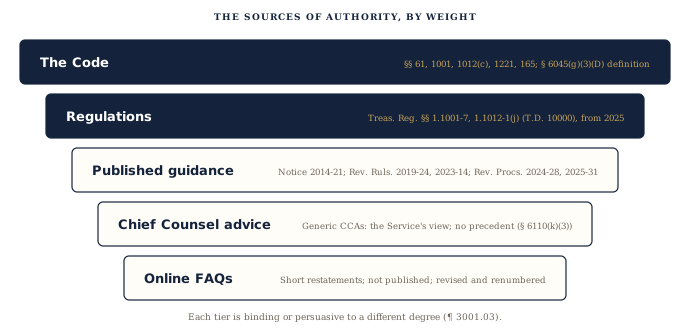
The sources of authority. The authorities fall into five tiers, and their weight differs.
- The Code. The Infrastructure Investment and Jobs Act added a definition of "digital asset" to the broker-reporting provisions of I.R.C. § 6045(g)(3)(D) and made digital assets "specified securities" for basis reporting and for the account-by-account basis rule of § 1012(c). See supra ch. 1 ¶ 110.05. The Code otherwise applies to digital assets through its general provisions: §§ 61, 451, 1001, 1011, 1012, 1221, 1222 and 165.
- Regulations. T.D. 10000 (July 9, 2024) adopted Treas. Reg. § 1.1001-7, on the computation of gain or loss and the allocation of transaction costs, and Treas. Reg. § 1.1012-1(j), on the identification of units sold. Both apply to dispositions on or after January 1, 2025. ¶¶ 3030, 3040.
- Published guidance. Revenue rulings, revenue procedures and notices published in the Internal Revenue Bulletin bind the Service and may be relied on by taxpayers whose facts match. The principal items are Notice 2014-21, as modified by Notice 2023-34; Rev. Rul. 2019-24 (forks and airdrops); Rev. Rul. 2023-14 (staking); Notice 2023-27 (NFTs as collectibles); Rev. Proc. 2024-28 (transition to wallet-by-wallet basis); Notice 2025-7 (temporary relief on identification); and Rev. Proc. 2025-31 (staking by investment trusts).
- Chief Counsel advice. Generic legal advice memoranda issued by the Office of Chief Counsel, such as CCA 202114020, CCA 202124008, CCA 202302011, CCA 202302012, CCA 202316008 and CCA 202511015, state the Service's litigating views. Each states on its face that it may not be used or cited as precedent. I.R.C. § 6110(k)(3). This chapter cites them as evidence of the Service's position.
- Frequently asked questions. The Service's online FAQs on virtual currency restate its positions in short form. They are not published in the Bulletin and do not bind the Service, and Rev. Proc. 2024-28 records that they have been revised and renumbered since 2019. They are cited here by the numbering of the current version.
What the guidance does not decide. Much of the law in this field rests on general principles applied by analogy. No statute or regulation addresses the timing of income from staking rewards for a taxpayer who contests Rev. Rul. 2023-14, the character of a token that is a security for one purpose and a commodity for another, the application of § 1058 to token loans, or the treatment of most transactions in decentralized finance. Where this chapter states a position on such a question without authority, it says so.
Terminology. This chapter uses "digital asset" in the sense of § 6045(g)(3)(D): "any digital representation of value which is recorded on a cryptographically secured distributed ledger or any similar technology as specified by the Secretary." The older guidance speaks of "virtual currency" and "convertible virtual currency"; Rev. Rul. 2019-24 defines virtual currency as "a digital representation of value that functions as a medium of exchange, a unit of account, and a store of value other than a representation of the United States dollar or a foreign currency." The later CCAs treat the older terms as included in the statutory one. E.g., CCA 202316008, at 2. "Unit" means one unit of a fungible token, and "wallet" and "account" carry the meanings given in Treas. Reg. § 1.6045-1(a)(25). See ch. 1 ¶ 180 for the general vocabulary of the book.
The law stated. The law is stated as of November 2026. The rates and thresholds that matter to digital-asset transactions, including the capital gain rates of § 1(h) and the threshold amounts of the net investment income tax under § 1411, are general rules of the income tax and are not restated here.