

¶ 2401
Overview
Scope of the chapter. This chapter examines how a creditor who holds a money judgment in the United States reaches a debtor's digital assets. It begins with discovery, because a creditor cannot levy on an asset it cannot find, and with the evidence that blockchain analysis supplies. It then considers the traditional writs of execution and garnishment, the position of exchanges and custodians as garnishees, and the turnover order, which is the principal remedy against assets the debtor holds in its own wallets. It examines the defenses a debtor raises to a turnover order, including inability to comply and the privilege against self-incrimination, and the courts' answers to them. It then treats receivers, prejudgment remedies, charging orders against interests in entities that hold tokens, exemptions, the enforcement of family support obligations, and the federal tax lien and levy. It closes with a sequence for enforcement and a checklist.
The enforcement problem. The law of judgment enforcement was built around two kinds of property. Tangible property could be seized by an officer who took it into custody. Intangible property, such as a bank deposit or a debt, could be reached by serving process on the third party who owed the debt or held the deposit, and that third party then paid the officer. A digital asset held in self-custody fits neither pattern. Nothing tangible can be seized, because the asset consists of entries on a ledger that no officer can enter. No third party owes the debtor anything, because the debtor's control rests on knowledge of a private key. See ch. 2 ¶¶ 230–240. The creditor must therefore act on the person of the debtor, by an order compelling the debtor to transfer the asset, enforced by contempt. Where the debtor holds its assets through an exchange or custodian, by contrast, the familiar garnishment model applies with modest adjustments, because the platform owes the customer a contractual or proprietary obligation that a levy can reach. See ch. 10.
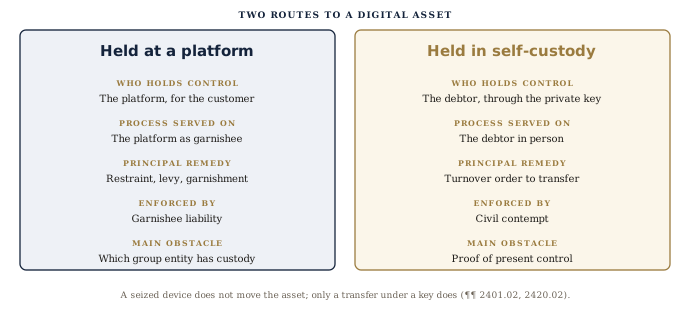
Characterization comes first. Every enforcement remedy depends on a prior question: what interest the debtor holds and under what law. A judgment creditor reaches "property" of the debtor, and whether a token, an exchange balance or an interest in an entity that holds tokens is property of the debtor, and of what kind, is answered by the law discussed in ch. 3 (characterization in the United States), ch. 5 (situs and governing law), ch. 6 (controllable electronic records and control under U.C.C. § 12-105) and ch. 10 (the customer's relationship with a custodian). The enforcement statutes are generally broad enough to reach any assignable interest. New York, for example, allows a money judgment to be enforced "against any property which could be assigned or transferred, whether it consists of a present or future right or interest and whether or not it is vested." N.Y. C.P.L.R. 5201(b). The difficulty lies in the mechanics of reaching the asset.
The sources of law. Judgment enforcement is governed principally by state law. In federal court, Rule 69(a)(1) of the Federal Rules of Civil Procedure provides that a money judgment "is enforced by a writ of execution, unless the court directs otherwise," and that the procedure on execution and in proceedings supplementary to and in aid of judgment "must accord with the procedure of the state where the court is located, but a federal statute governs to the extent it applies." Fed. R. Civ. P. 69(a)(1). Prejudgment remedies are likewise borrowed from state law. Fed. R. Civ. P. 64(a). The federal tax lien and levy are governed by the Internal Revenue Code. 26 U.S.C. §§ 6321, 6331–6334. Receiverships in federal court are governed by Rule 66, 28 U.S.C. § 754 and the historical practice of equity. The chapter uses New York, California and Texas as principal examples of state enforcement law because each has a developed turnover procedure and because judgment creditors often choose to enforce there.
Relation to other chapters. Remedies against assets that a debtor has moved beyond the creditor's reach, including worldwide freezing orders and recovery from persons unknown, are discussed in ch. 25. Transfers by a debtor to defeat creditors, and structures such as offshore trusts that hold digital assets, are discussed in ch. 26. The treatment of digital assets in the debtor's bankruptcy is discussed in chs. 27 to 29. The charging order against an interest in a limited liability company is summarized here and examined in ch. 17 ¶ 1770 and, more fully, in Lighthouse on Limited Liability Companies. The asset protection planning that a creditor's remedies are designed to overcome is examined in Lighthouse on Asset Protection.
Plan of the chapter. ¶ 2410 treats discovery and tracing. ¶ 2420 treats execution and levy. ¶ 2430 treats exchanges and custodians as garnishees. ¶ 2440 treats turnover orders against self-custodied assets. ¶ 2450 treats contempt, impossibility and the Fifth Amendment. ¶ 2460 treats receivers. ¶ 2470 treats prejudgment attachment and freezing orders. ¶ 2480 treats charging orders, exemptions, family support and federal tax collection. ¶ 2490 sets out a sequence for enforcement and a checklist.