

¶ 1701
Overview
Scope of the chapter. This chapter examines the limited liability company as a vehicle for holding digital assets. It explains why owners place tokens in an LLC, how the choice of formation state and of a series structure affects the result, how tokens are contributed and recorded, how the operating agreement allocates authority over private keys and signing, how members' statutory information rights interact with the need to keep key material secret, what duties a manager owes when the company's assets are volatile, and what a member's creditor may and may not reach. It closes with tax classification, beneficial-ownership reporting, financial-statement accounting, the LLC held under a trust, model operating-agreement provisions and a checklist.
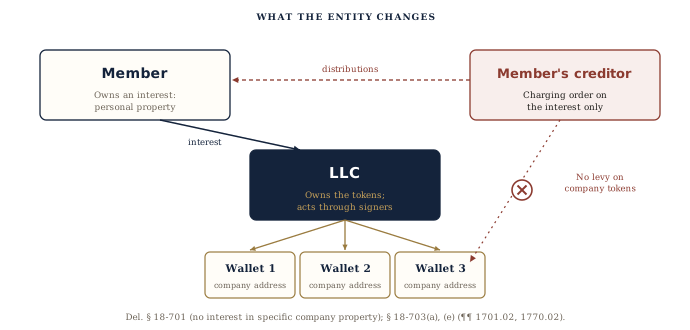
The central point. A token held directly is controlled by whoever holds the key, and the law that governs it is the law of personal property and, where adopted, Article 12 of the Uniform Commercial Code. See ch. 3; ch. 6. A token held by an LLC belongs to the company. The member owns an interest in the company, and that interest is personal property in which the member "has no interest in specific limited liability company property." Del. Code Ann. tit. 6, § 18-701. The interposition of the entity changes four things at once: who may lawfully use the key, what a member may transfer, what a member's creditor may reach and what records the law requires. Each of those changes is a function of the statute and of the operating agreement, and each can be lost if the owner treats the company's wallets as personal wallets.
The statutes examined. The chapter uses the Delaware Limited Liability Company Act, Del. Code Ann. tit. 6, ch. 18, the Wyoming Limited Liability Company Act, Wyo. Stat. Ann. §§ 17-29-101 to -1105, and the Nevada statute, Nev. Rev. Stat. ch. 86, as its principal examples. Those three states are the formation states most often chosen for holding companies that are not tied to an operating business in a particular state. The fuller treatment of LLC law generally, including formation, governance, fiduciary duty, charging orders and single-member LLCs, appears in Lighthouse on Limited Liability Companies, and this chapter does not repeat it. The Wyoming decentralized autonomous organization LLC, which has its own supplement and its own rules on algorithmic management, is treated in ch. 20.
What the LLC does not do. An LLC does not change the technology of the asset. A key that is lost is lost whether the wallet belongs to a person or to a company, and a key that is copied can be used by the copier whatever the operating agreement says. The entity changes the legal consequences of control. Who can sign is still decided by the key arrangement. For that reason most of the drafting in this chapter is directed at aligning the legal authority stated in the operating agreement with the technical control that the key arrangement gives each person. Where the two diverge, the law will usually follow the agreement in allocating rights among the members, and the ledger will follow the key in recording what happened. See ch. 9 (custody models); ch. 6 ¶ 630 (control under U.C.C. § 12-105).
Terminology. This chapter uses "key arrangement" for the combination of keys, devices, shares and approval rules that together determine who can authorize a transfer from a wallet. It uses "company wallet" for an address or account whose assets belong to the LLC, and "signer" for a person who holds a key or key share for a company wallet. A "manager" is a manager as the statute uses the term, and in a member-managed company the members exercise the management powers. The terms are defined further in ch. 1 ¶ 180.
Organization. Paragraph 1710 states the reasons for using an LLC. Paragraph 1720 compares Delaware, Wyoming and Nevada and the series form. Paragraph 1730 treats contribution, title and records. Paragraphs 1740 and 1750 treat authority over keys and information rights. Paragraph 1760 treats the manager's duties. Paragraph 1770 treats creditors of members, the single-member problem, veil piercing and the question of keys in enforcement. Paragraph 1780 treats tax, reporting, accounting and the LLC held by a trust, and ¶ 1790 collects model provisions and a checklist.