

¶ B01
Overview
Purpose of the appendix. This appendix sets out two forms of operating agreement for a limited liability company organised under the Limited Liability Companies Act 2008 (No. 7) (Cook Is.), as amended by the Limited Liability Companies Amendment Act 2013 (No. 16). Form 1 (¶ B10) is a single-member agreement for a manager-managed company whose sole member is the trustee of an international trust registered under the International Trusts Act 1984 or a foundation established under the Foundations Act 2012. Form 2 (¶ B20) is a multi-member agreement for a manager-managed company with several members, such as a family investment company held by two trusts or a joint venture between unrelated investors. The commentary at ¶ B30 explains the clauses and refers to the paragraph of the volume in which the rule each clause applies is examined. The schedules at ¶ B40 complete both forms. In this appendix a section cited without the name of an Act is a section of the Limited Liability Companies Act 2008 as amended.
How the forms were built. Each form collects the model provisions set out in chapters 12 to 17 and fits them into a complete agreement (see supra ¶¶ 1290.03, 1390.04–1390.06, 1480.10, 1590.02–1590.05, 1790.05). Where a chapter supplied a model provision, the form uses its text, adjusted only so that defined terms and cross-references agree. Where no chapter supplied one, the clause is drafted from the text of the Act itself. The commentary identifies the source of each clause. A reader who wants the reasoning behind a clause should read the paragraph cited for it, because the commentary states conclusions without repeating the analysis. No reported Cook Islands decision construes the Act (see supra ¶¶ 1301.05, 1601.05), so each form rests on the statutory text and on the analysis in the chapters.
The operating agreement under the Act. The Act defines the operating agreement as any valid agreement of all of the members, whether or not in writing, including amendments made by all the members or in the manner a written agreement provides. § 2; see supra ¶ 1310.01. The agreement may contain any provision for the affairs of the company and the conduct of its business that is consistent with law. It governs the rights, duties, limitations, qualifications and relations among the managers, the members, the members' assignees and transferees and the company. § 8(1). Its provisions prevail over any contrary provision of the Act, except the matters listed in section 8(2). Id. Unless contained in a written operating agreement, or in another writing approved in accordance with one, no provision of an operating agreement may vary a requirement of the Act that a particular action or provision be in writing. § 8(3). Both forms are therefore written, both are signed by the company as well as by the members and the manager, and both state their own amendment procedure (see supra ¶¶ 1310.04–1310.08).
Why the agreement must be in writing. Several of the Act's defaults can be displaced only by a writing. Management vests in the members in proportion to their capital contributions "unless otherwise provided in writing in the operating agreement." § 26(1). A member may resign at any time unless a written operating agreement prohibits it. § 37. An assignee may be given the right to become a member only by a power granted in a written operating agreement. § 43(b). Events of dissolution must be "specified in writing." § 49(1)(b). An oral understanding that a trustee company will manage the company, or that a member may not resign, has no effect against these sections (see supra ¶¶ 1340.02, 1630.01). The first step in using either form is to confirm that it is executed in full and that the articles of organisation agree with it.
The articles of organisation. The articles state the company's name, the name and address of its registered agent and the period of its duration, which may be perpetual. § 12; see supra ¶ 1240.06. Both forms assume articles that state a perpetual duration, so that the events of dissolution can be placed in the operating agreement, which may be amended without a public filing (see supra ¶ 1640.03). The registered agent must be a trustee company licensed under the Trustee Companies Act 2014. § 18(1); see supra ¶ 1260.01. The articles are lodged through a trustee company acting on behalf of persons who do not reside in the Cook Islands. §§ 5, 11(1); see supra ¶¶ 1240.01–1240.02.
Choices in brackets. Words in square brackets are choices or blanks. A bracket containing a description, such as [name] or [number], is to be completed. A bracket containing alternatives separated by "or" requires a choice, and the alternative not chosen is to be deleted. A bracket that begins "Optional:" contains a provision that the drafter may delete. No bracket should remain in an executed agreement.
The defaults the forms displace. The Act contains several default rules that do not suit a company held for asset protection or succession, and both forms displace them expressly. The most important are the following:
- management by the members in proportion to their capital contributions (§ 26(1)), which the forms replace by management vested in writing in a licensed trustee company (see supra ¶¶ 1340.01–1340.03);
- the allocation of profits, losses and distributions by the value of contributions (§ 35), which the forms replace with discretionary distributions by the manager and, in Form 2, with percentage interests (see supra ¶¶ 1370.03–1370.04, 1590.02);
- the right of a member to resign at any time (§ 37), which both forms prohibit (see supra ¶ 1630.01);
- the rule that an assignor ceases to be a member on assigning any of its membership rights (§ 44), which both forms modify so that a member ceases to be a member only on assigning its entire interest with the consents the agreement requires (see supra ¶¶ 1330.05, 1610.03);
- the treatment of a member's death, incompetency, dissolution or termination as an assignment of its interest (§ 46(3)), which both forms supplement by naming a successor who is admitted without further consent (see supra ¶¶ 1590.04, 1620.01–1620.06); and
- the dissolution of the company by the unanimous written agreement of all the members and managers (§ 49(1)(a)), which both forms supplement with written events of dissolution under section 49(1)(b) (see supra ¶¶ 1360.03, 1640.02–1640.03).
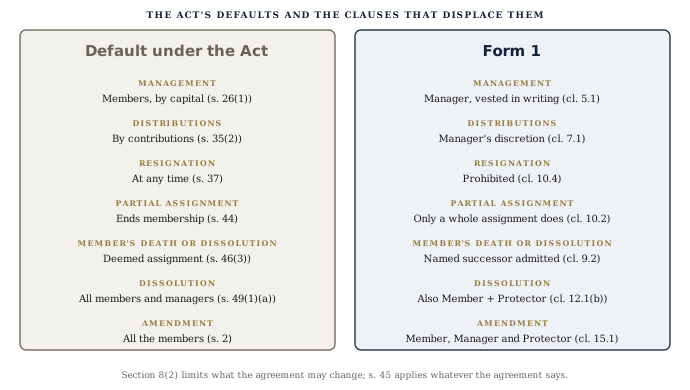
Rules the forms cannot change. Some rules apply whatever the agreement says. Section 8(2) provides that an operating agreement may not unreasonably restrict a member's access to books and records under sections 32 and 48; reduce the duty of care under section 27(1); amend the obligation to perform duties in good faith under section 27(1), although the members may agree on standards by which that obligation is measured if they are not manifestly unreasonable; vary any filing requirement; restrict the rights of, or impose duties on, persons other than the members, their assignees and transferees and the company without their consent; alter the managers' obligations to keep accounts under section 31A; affect the application of section 34(2); or be altered in any manner that affects the application of section 45. § 8(2) (as amended by 2013 Act § 4); see supra ¶¶ 1320.03–1320.10. Each form is drafted to stay within that list. The standards clause in article 6 of each form measures good faith but does not reduce care (see supra ¶¶ 1440.03, 1450.07), and the charging-order article restates section 45 without altering it.
The pending proposal. A committee proposal to revise the Act was submitted on April 1, 2026 and is pending before Parliament. It has not been enacted (see supra ¶¶ 1750.01–1750.05). Neither form relies on it. Where a clause anticipates a change the proposal would make, the commentary says so and labels the proposed provision as a proposal. If the proposal is enacted, both forms should be reviewed against the enacted text before they are used.
United States tax. Both forms contain a classification clause and an information clause drawn from chapter 17 (see supra ¶ 1790.05). A Cook Islands LLC is not on the list of foreign entities that are always classified as corporations, and because no member has unlimited liability for its debts (§ 47), its default classification for federal tax purposes is an association taxable as a corporation (see supra ¶¶ 1740.02–1740.03). Form 1 therefore provides for an election to be disregarded, and Form 2 for an election to be classified as a partnership, each to be made only after the owners' tax position has been reviewed (see supra ¶¶ 1740.04–1740.06; infra ch. 29). Under the present Act a payment by the company of a member's tax is a distribution, and both forms treat it as one (see supra ¶¶ 1370.10, 1560.08).