

¶ 2401
Overview
Scope of the chapter. This chapter examines how a claim concerning a Cook Islands international trust, limited liability company or foundation is litigated in the High Court of the Cook Islands. It covers the commencement of proceedings, service, interim injunctions and Mareva (freezing) orders, the statutory limits on interim relief against the three structures, the rules that keep the proceedings private, disclosure and privilege, security for costs and costs, and the hearing and appeal. The substantive rules that a creditor must satisfy are examined elsewhere: section 13B in chapter 21, the bars to suit in chapter 22 and the rule against recognition of foreign judgments in chapter 23 (see supra chs. 21–23). This chapter is concerned with the procedure through which those rules are applied.
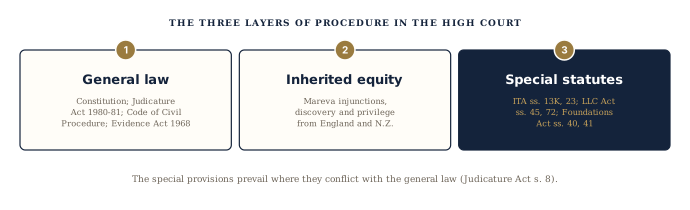
Three layers of law. Procedure in the High Court comes from three layers. The first is the general law of the court: the Constitution, the Judicature Act 1980-81, the Code of Civil Procedure of the High Court and the Evidence Act 1968. The second is the equitable and common law inherited through New Zealand and England, including the law of Mareva injunctions, discovery and legal professional privilege (see supra ch. 2). The third is a set of special provisions in the three statutes that govern the structures: sections 13K and 23 of the International Trusts Act 1984, sections 45 and 72 of the Limited Liability Companies Act 2008 and sections 40 and 41 of the Foundations Act 2012. The special provisions prevail over the general law where they conflict. They are the reason that litigation against a Cook Islands structure differs from ordinary commercial litigation in the same court.
The general rule of procedure. The Judicature Act gives the High Court a wide discretion over its own procedure. Section 8 provides that, subject to the Act, the Code of Civil Procedure and any other enactment, "the practice and procedure of the High Court in the exercise of its civil and criminal jurisdiction shall be such as the Court thinks in each case to be the most consistent with natural justice and convenience." Judicature Act 1980-81, § 8 (Cook Is.). The Code is modeled on the former Code of Civil Procedure of New Zealand, and counsel and judges in the Cook Islands refer to New Zealand practice under that Code. Gun Bo LLC v. Asia Trust Ltd, [2011] CKHC 6, [7], [29]–[30] (Cook Is. High Ct. Dec. 10, 2010) (Grice J.).
Who litigates in the Cook Islands. Most litigation about Cook Islands international trusts has been brought by foreign creditors of a settlor. In the reported cases the creditor held, or was pursuing, a judgment from an American court and sued in Rarotonga under section 13B because the foreign judgment could not be enforced there. 515 South Orange Grove Owners Ass'n v. Orange Grove Partners, [1995] CKHC 1 (Cook Is. Ct. App. Nov. 6, 1995); A v. B, [2002] CKHC 6, [2004] 4 ITELR 877 (Cook Is. High Ct. Apr. 4, 2002); Gun Bo, [2011] CKHC 6, [1]–[4]. The defendants are usually the trustee company in Rarotonga and the settlors, who live abroad. Counsel are commonly members of the New Zealand bar who appear with local practitioners. The court sits in Rarotonga, the Court of Appeal may sit in New Zealand, and hearings by telephone and video link are part of the practice (see infra ¶ 2480).
The creditor's problem. A creditor who sues a Cook Islands trustee faces four procedural obstacles before reaching the merits. It must commence proceedings within the periods of sections 13B and 13K. It must file an affidavit under section 13K(4) and, before any order is made, satisfy the court beyond reasonable doubt of the matters in section 13K(3), including its ability to prove a claim under section 13B(1). It must pay security for the defendants' costs, because it lives abroad. And it must conduct the proceedings in private, under a statute that makes disclosure of trust information an offence. The cases show that each obstacle can be met, but none can be ignored.
Plan of the chapter. The chapter proceeds as follows:
- commencement of proceedings in the High Court and the section 13K affidavit (¶ 2410);
- service on the structures and on parties abroad (¶ 2420);
- interim injunctions and Mareva orders, with a case discussion of Orange Grove (¶ 2430);
- the statutory limits on interim relief against international trusts, LLCs and foundations (¶ 2440);
- hearing in private, publication of decisions and the confidentiality offences (¶ 2450);
- discovery, privilege and the fraud exception, with case discussions of A v. B and E v. A, and disclosure by third parties (¶ 2460);
- security for costs and costs, with a case discussion of Gun Bo (¶ 2470);
- hearings, evidence from abroad, contempt and appeals (¶ 2480);
- a typical sequence and checklists for each side (¶ 2490).
Absence of decided cases on some points. The reported Cook Islands decisions on international trusts are few, and PacLII's search facility could not be used for this chapter. No reported decision was located on a freezing order against an LLC, on any application under the Foundations Act, or on a Norwich Pharmacal order. Where the chapter states how the court is likely to approach such a question, it says so and gives the reasons.