

¶ 101
Overview
Scope of the chapter. The Cook Islands is a group of fifteen islands in the South Pacific with a population of about fifteen thousand. It has governed itself since August 4, 1965, under a constitution enacted by the Parliament of New Zealand. It remains in free association with New Zealand, whose citizenship Cook Islanders hold. For more than four decades it has also been a center for international trusts, and later for limited liability companies and foundations, formed for settlors and owners who live elsewhere. This chapter explains how a small self-governing state came to legislate for that business, what its Constitution permits its Parliament to do, which institutions administer and adjudicate the law, and what follows for a planner who chooses Cook Islands law. The later chapters examine each statute in detail. This chapter supplies the constitutional and institutional frame within which every one of them operates.
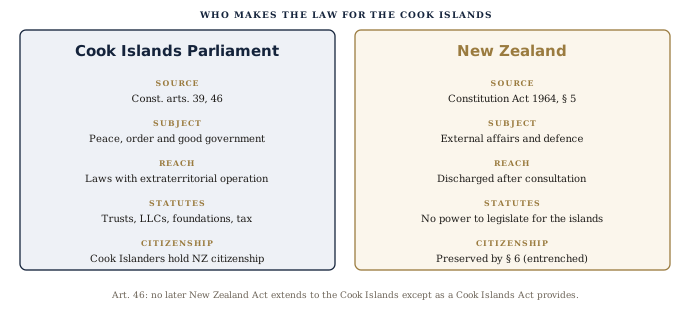
The constitutional basis of the statutes. The statutes on which this treatise is built are Acts of the Parliament of the Cook Islands. The Cook Islands Constitution Act 1964 (N.Z.) declares that "[t]he Cook Islands shall be self-governing" and that the Constitution set out in its Schedule "shall be the supreme law of the Cook Islands." Cook Islands Constitution Act 1964, §§ 3–4 (N.Z.). Article 39 of the Constitution empowers Parliament to make laws "for the peace, order, and good government of the Cook Islands," including laws "having extraterritorial operation." Const. of the Cook Islands art. 39(1)–(2). Article 46 provides that no later Act of the New Zealand Parliament extends to the Cook Islands except as an Act of the Cook Islands Parliament provides. Id. art. 46. The International Trusts Act 1984, the Limited Liability Companies Act 2008 and the Foundations Act 2012 are therefore the product of a legislature with plenary power over the internal affairs of the islands, subject only to the Constitution and to New Zealand's responsibility for external affairs and defence (see infra ¶ 120).
Five statutes, one registry. Five Acts carry most of the international business conducted in the Cook Islands:
- the International Trusts Act 1984 (No. 14), enacted on December 27, 1984, and amended in 1985, twice in 1989, and in 1991, 1995–96, 1999, 2004 and 2013;
- the International Companies Act 1981–82, the first of the international-sector statutes, whose tax exemption was removed in 2019;
- the Limited Liability Companies Act 2008 (No. 7), assented to on June 25, 2008, and amended in 2013;
- the Foundations Act 2012 (No. 11), amended in 2013; and
- the Trustee Companies Act 2014 (No. 4), which licenses the trustee companies through which every international trust, LLC and foundation is formed and administered.
International trusts, LLCs, foundations, international companies and international partnerships are registered in a registry operated by the Financial Supervisory Commission, which also licenses and supervises the trustee companies (see infra ¶ 150). The growth of each statute is traced at ¶ 140.
Why the frame matters. A trust deed, operating agreement or foundation instrument that chooses Cook Islands law draws its strength from three sources. The first is the text of the statute. The second is the courts that will apply it: the High Court of the Cook Islands, the Court of Appeal of the Cook Islands, and, with leave, the Judicial Committee of the Privy Council. The third is the constitutional and political arrangement that keeps the statute in force and allows Parliament to amend it. Practitioners study the first closely and tend to take the other two for granted. The second is examined in chapter 3 (see infra ch. 3). The third is the subject of this chapter. It explains why the Cook Islands statutes can be amended by a small Parliament acting on its own authority, why New Zealand cannot legislate them away, why the Court of Appeal is staffed largely by New Zealand judges, and why the relationship with New Zealand is a recurring subject of planning questions from clients.
A legislature that responds. The feature of the Cook Islands that most distinguishes it from other trust jurisdictions is the record of its legislature. The International Trusts Act has been amended eight times since 1984. Several of the amendments followed decisions of the Cook Islands courts that went against the trusts, and the most important of them, the International Trusts Amendment Act 1995–96, rewrote the limitation rules within months of a Court of Appeal decision that had allowed creditors' claims to proceed (see infra ¶ 140.05). That record is a source of confidence for settlors and of caution for planners. It shows that Parliament will act to restore the protection the statute was designed to give. It also shows that a planner must read every decision against the text of the Act in force when the decision was made, and must check the current text before relying on any provision.
A note on sources. No official consolidation of the International Trusts Act or of the other international-sector statutes was located for this edition. The Financial Supervisory Commission publishes each principal Act and each amending Act separately, and the provisions described in this treatise are drawn from those texts and from the sessional legislation published by the Pacific Islands Legal Information Institute. The Constitution is cited from the consolidated text that the Institute publishes. Where a provision has been amended, the citation states the amending Act. A reader who relies on a provision should obtain a current consolidation from Cook Islands counsel or the Crown Law Office.
The plan of the chapter. The chapter proceeds in order. It describes the path from New Zealand administration to self-government in free association (see infra ¶ 110); the Constitution and its amendment (see infra ¶ 120); how Cook Islands law is made, brought into force and given extraterritorial effect (see infra ¶ 130); the growth of the international statutes (see infra ¶ 140); the institutions that administer and adjudicate them (see infra ¶ 150); the Cook Islands in comparison with Nevis and Belize (see infra ¶ 160); international standards and information exchange (see infra ¶ 170); the considerations that bear on a decision to use the Cook Islands (see infra ¶ 180); and the plan of the treatise (see infra ¶ 190).
¶ 110
From New Zealand Administration to Free Association
The islands. The Constitution defines the Cook Islands as all the islands in the South Pacific Ocean lying between the 8th and 23rd degrees of south latitude and the 156th and 167th degrees of longitude west of Greenwich, each island including the smaller islands within ten miles of its coast. Const. of the Cook Islands art. 1(1). The fifteen islands fall into a southern group, which includes Rarotonga, the seat of government, and a northern group of atolls. The constituencies named in the Constitution give a sense of the dispersion: Aitutaki, Atiu, Mangaia, Manihiki, Mauke, Mitiaro, Penrhyn, Pukapuka and Nassau, Rakahanga, and Rarotonga with Palmerston. Id. art. 27(2). The international business conducted under the statutes examined in this treatise is administered almost entirely from Rarotonga, where the trustee companies, the Financial Supervisory Commission and the High Court registry are located.
New Zealand administration. Before 1965 the Cook Islands was administered by New Zealand under the Cook Islands Act 1915 (N.Z.), an Act of the New Zealand Parliament that established, among other things, the High Court of the Cook Islands and the Native Land Court. The Constitution confirms the continuity of both: the High Court established by the Constitution "is hereby declared to be the same Court as the High Court of the Cook Islands established by the Cook Islands Act 1915," and the Land Court is declared to be the same court as the Native Land Court established by that Act. Const. of the Cook Islands arts. 82(1), 83(1). Local legislative bodies were created in stages. A Legislative Council made Ordinances under section 2 of the Cook Islands Amendment Act 1946, and a Legislative Assembly made Ordinances under section 38 of the Cook Islands Amendment Act 1957. Both sets of Ordinances, so far as in force on Constitution Day, were continued in force by the Constitution. Id. art. 81. The New Zealand Parliament continued to amend the Cook Islands Act 1915 after self-government, for example by repealing provisions that Cook Islands enactments had displaced. Cook Islands Amendment Act 1970, § 2 (N.Z.).
The Constitution Act 1964. The Cook Islands Constitution Act 1964 (N.Z.) was assented to on November 17, 1964. Its long title describes it as "[a]n Act to make provision for self government by the people of the Cook Islands (other than Niue) and to provide a constitution for those islands." Cook Islands Constitution Act 1964, long title (N.Z.). The Act was not to come into force until after the first meeting of a Legislative Assembly elected after its passage, so that the people of the islands, through their elected representatives, would take up self-government. Id. § 1(2). It was brought into force at 10:30 p.m. on August 4, 1965, by the Cook Islands Constitution Act Commencement Order 1965 (S.R. 1965/128). The date is the Cook Islands' Constitution Day, the reference point for the transitional provisions of the Constitution. Const. of the Cook Islands art. 1(1) (definition of "Constitution Day").
The four operative sections. The Act itself is short. Its operative core is four sections:
- section 3: "The Cook Islands shall be self-governing."
- section 4: the Constitution set out in the Schedule "shall be the Constitution of the Cook Islands, and shall be the supreme law of the Cook Islands."
- section 5: "Nothing in this Act or in the Constitution shall affect the responsibilities of Her Majesty the Queen in right of New Zealand for the external affairs and defence of the Cook Islands, those responsibilities to be discharged after consultation by the Prime Minister of New Zealand with the Premier of the Cook Islands."
- section 6: nothing in the Act or the Constitution "shall affect the status of any person as a British subject or New Zealand citizen by virtue of the British Nationality and New Zealand Citizenship Act 1948."
Cook Islands Constitution Act 1964, §§ 3–6 (N.Z.). The office of Premier has since become that of Prime Minister. Const. of the Cook Islands art. 1(1) (definition of "Prime Minister"). These four sections are entrenched: a bill amending them may be presented for assent only after it has passed Parliament by the special majorities required for constitutional amendments and has been approved by two-thirds of the valid votes cast in a poll of the electors. Id. art. 41(2) (see infra ¶ 120.06).
Free association. The term "free association" does not appear in the Constitution Act. It describes the relationship that the Act created and that the two governments have since developed by agreement. A declaration signed by the two governments in Rarotonga on April 1, 2026 recites that the relationship was "established in 1965, under which the Cook Islands is self-governing in free association with New Zealand," and that it "has evolved through the Kirk-Henry Exchange of Letters 1973, the Letters Patent of 1983 and the Joint Centenary Declaration 2001." Declaration on Defence and Security between the Government of the Cook Islands and the Government of New Zealand, recitals & para. 4 (Apr. 1, 2026). The same declaration states that "the Cook Islands has control over its internal affairs and an international legal personality, under which it pursues its own foreign policy and diplomatic relationships, subject to the constitutional limits of free association." Id. para. 5. It describes the relationship as "a voluntary relationship of mutual consent" underpinned by "the shared Sovereign in right of New Zealand" and by the extension of New Zealand citizenship to the people of the Cook Islands. Id. paras. 1–2.
What free association means for the statutes. For a planner the relationship has three practical consequences. First, legislative power over the international sector lies with the Cook Islands Parliament alone. New Zealand cannot amend the International Trusts Act, because no Act of the New Zealand Parliament passed after the relevant date extends to the Cook Islands except as a Cook Islands Act provides. Const. of the Cook Islands art. 46 (see infra ¶ 130.05). Second, the external dimension of the statutes, which includes tax information exchange agreements, mutual legal assistance and international standards, is conducted by the Cook Islands government in its own name, within the limits of the relationship (see infra ¶ 170). Third, Cook Islanders hold New Zealand citizenship, and the relationship with New Zealand is a matter of continuing political attention in both countries. A client who asks whether the relationship could change, and with what effect on a trust, deserves an accurate answer (see infra ¶ 180.04).
Changes in the institutions since 1965. The Constitution has been amended many times. By 1997 the consolidated text listed twenty-two amending Acts, beginning with the Cook Islands Constitution Amendment Act 1965 (N.Z.) and continuing with Acts of the Cook Islands legislature from 1968–69 onward. Two amendments of the early 1980s changed the names of the institutions. The Constitution Amendment (No. 9) Act 1980–81 renamed the Legislative Assembly the Parliament of the Cook Islands, and the Constitution Amendment (No. 10) Act 1981–82 replaced the High Commissioner, who had represented the Crown, with the Queen's Representative. Const. of the Cook Islands arts. 3, 41 (notes to consolidated text). Older cases and commentary use the former names, and a reader should translate them accordingly.
¶ 120
The Constitution: Head of State, Executive, Parliament and Amendment
Structure of the Constitution. The Constitution is organized in seven Parts: the government of the Cook Islands, including the Head of State, the Queen's Representative and the House of Arikis (Part I); the executive government (Part II); Parliament (Part III); the judiciary (Part IV); fundamental human rights and freedoms (Part IVA); public revenues (Part V); the public service (Part VI), with miscellaneous provisions in Part VIA; and transitional provisions (Part VII). A preamble recognizes "the heritage of Christian principles, Cook Islands custom, and the rule of law." Const. of the Cook Islands pmbl. Only Parts III and IV, and the human-rights provisions of Part IVA, bear directly on the statutes examined in this treatise. They are examined here and in chapters 2 and 3 (see infra chs. 2–3).
The Head of State and the Queen's Representative. The Head of State of the Cook Islands is the Sovereign in right of New Zealand. Const. of the Cook Islands art. 2. The executive authority of the Cook Islands is vested in the Sovereign and may be exercised on the Sovereign's behalf by the Queen's Representative, directly or through subordinate officers. Id. arts. 3, 12(1)–(2). The Queen's Representative acts, in most matters, on the advice of Cabinet, the Prime Minister or the appropriate Minister. For the international statutes the Representative's most important function is assent to bills, examined at ¶ 130.02. The Constitution uses the title "Queen's Representative" throughout, and the office has continued under that title.
Cabinet and the Executive Council. Executive government is directed by a Cabinet consisting of the Prime Minister, who presides, and not fewer than six nor more than eight other Ministers. Cabinet has "the general direction and control of the executive government of the Cook Islands," and is "collectively responsible to Parliament." Const. of the Cook Islands art. 13(1). The Queen's Representative appoints as Prime Minister the member of Parliament who commands, or is likely to command, the confidence of a majority of members. Id. art. 13(2). An Executive Council, which also considers Cabinet decisions, gives formal effect to many executive acts. Id. arts. 22–25. Statutes in the international sector frequently provide that a provision comes into force, or that regulations are made, by Order in Executive Council. The Financial Supervisory Commission Act 2003, for example, came into force on a date fixed by the Queen's Representative by Order in Executive Council. Financial Supervisory Commission Act 2003, § 1(2) (Cook Is.).
The House of Arikis. The House of Arikis consists of hereditary chiefs (Ariki) representing the islands. Const. of the Cook Islands art. 8. It considers matters relating to the welfare of the people that Parliament submits to it, and expresses its opinion and makes recommendations to Parliament. Id. art. 9. It has no power over legislation and plays no part in the making or amendment of the international statutes. It is mentioned here because clients sometimes ask whether customary authorities could affect trust property. They cannot. The international statutes deal with property held for non-residents, and the land-tenure rules administered by the Land Division of the High Court apply to Cook Islands land, which international structures do not ordinarily hold.
Parliament. Article 27 establishes "a sovereign Parliament for the Cook Islands, to be called the Parliament of the Cook Islands," elected by secret ballot under universal suffrage from constituencies on the islands. Const. of the Cook Islands art. 27(1)–(2). The number of members and the constituencies have been changed by amendment more than once, and the current figures should be taken from the latest consolidation. Parliament's legislative power, its procedure for bills and the rules on assent and commencement are examined at ¶ 130.
Amendment of the Constitution. Article 41 provides two levels of protection.
- Ordinary constitutional amendments. A bill repealing, amending, modifying or extending any provision of the Constitution, or making any provision inconsistent with it, is not passed unless it receives the affirmative votes of not less than two-thirds of the total membership of Parliament, including vacancies, at both the final vote and the vote preceding it, with an interval of not less than ninety days between those two votes. The bill must be accompanied by the Speaker's certificate when presented for assent. Const. of the Cook Islands art. 41(1).
- Entrenched provisions. A bill affecting sections 2 to 6 of the Constitution Act 1964, Article 2 of the Constitution (the Head of State) or Article 41 itself must, in addition, be submitted to a poll of the electors and supported by not less than two-thirds of the valid votes cast. Id. art. 41(2).
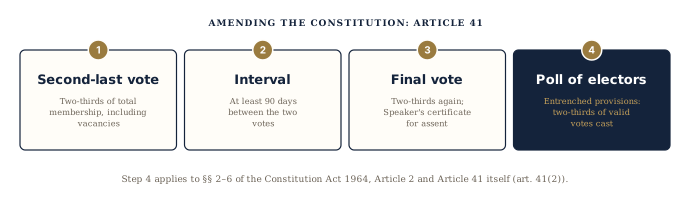
The second level protects the self-governing status of the islands, the supremacy of the Constitution, New Zealand's responsibility for external affairs and defence, the New Zealand citizenship provision and the Head of State. A change to the relationship with New Zealand that touched any of those provisions would therefore require a two-thirds popular vote in the Cook Islands as well as special majorities in Parliament.
Fundamental rights and the protective statutes. Part IVA recognizes, among other rights, "[t]he right of the individual to own property and the right not to be deprived thereof except in accordance with law," and "the right to a fair hearing, in accordance with the principles of fundamental justice." Const. of the Cook Islands arts. 64(1)(c), 65(1)(d). These rights are subject to limitations imposed by any enactment for protecting the rights and freedoms of others or in the interests of public order and the general welfare. Id. art. 64(2). Article 40, which requires compensation for compulsory acquisition of property, expressly does not affect general laws relating to trusts and trustees, to the limitation of actions, to the execution of judgments or orders of courts, or to the property of bankrupts. Id. art. 40(2)(d), (e), (g), (h). A creditor who argues that the short limitation periods of the International Trusts Act deprive it of property without compensation therefore faces an express constitutional answer: the Act is a general law relating to trusts and to the limitation of actions.
Supremacy of the Constitution. Because the Constitution is "the supreme law of the Cook Islands," an Act inconsistent with it is invalid to the extent of the inconsistency unless it has been passed with the majorities Article 41 requires. Cook Islands Constitution Act 1964, § 4 (N.Z.); Const. of the Cook Islands arts. 39(4), 41(1). Conversely, no Act is invalid merely because it is inconsistent with some other law in force. Id. art. 39(4). The second rule matters to the international statutes, which depart deliberately from the general law of trusts, companies and limitation that otherwise applies in the islands. A provision of the International Trusts Act that displaces a received rule of English equity, or a provision of the Limited Liability Companies Act that displaces the general law of execution, prevails over that general law without any need for special majorities.

¶ 130
Making Cook Islands Law: Acts, Assent, Commencement, Extraterritorial Reach and Existing Law
The power to make laws. Article 39 is the source of every statute examined in this treatise. Subject to the Constitution, Parliament "may make laws (to be known as Acts) for the peace, order, and good government of the Cook Islands." Const. of the Cook Islands art. 39(1). The power includes "the repeal or revocation or amendment or modification or extension, in relation to the Cook Islands, of any law in force in the Cook Islands." Id. art. 39(3). The words "peace, order, and good government" are the formula used in the constitutions of Commonwealth legislatures to confer plenary power within the legislature's territory, and the courts of the Commonwealth have long read them as conferring the widest legislative power, subject only to express constitutional limits. Within the islands the Cook Islands Parliament is as free to legislate on trusts, companies and the remedies of creditors as the Parliament of New Zealand is within New Zealand.
Bills and assent. Any member may introduce a bill, subject to the Constitution and the Standing Orders of Parliament. Const. of the Cook Islands art. 42. Bills that impose or alter taxation, or charge public money, require the recommendation of the Queen's Representative. Id. art. 43. No bill becomes law until it has been passed by Parliament and assented to by the Queen's Representative. Id. art. 44(1). The Representative assents or refuses assent acting on the advice of the Prime Minister. The Representative may, however, acting in the Representative's discretion, summon the Executive Council within fourteen days after a bill is presented to consider amendments the Representative proposes or whether assent should be refused. If the Council decides that the bill should be returned, it goes back to Parliament with the proposed amendments or for reconsideration. If Parliament passes it again with the proposed amendments, or in its original form, the Representative must assent. Id. art. 44(2)–(6). A bill assented to "shall be known as an Act of Parliament." Id. art. 44(8). The international statutes carry on their face the Representative's certificate of assent and the date, and the Clerk's certificate that the text was examined. E.g., Limited Liability Companies Act 2008 (Cook Is.) (assented to June 25, 2008).
Commencement. Every Act comes into operation on the day of assent or on any other date the Act specifies, "whether earlier or later than the date on which it is assented to," and different provisions may commence on different dates. Const. of the Cook Islands art. 45. Most of the recent international-sector Acts come into force on the day after assent. Trustee Companies Act 2014, § 2 (Cook Is.); Foundations Act 2012, § 2 (Cook Is.); International Companies (Removal of Tax Exemption) Amendment Act 2019, § 2 (Cook Is.). Others commence by Order in Executive Council. Financial Supervisory Commission Act 2003, § 1(2) (Cook Is.). Article 45 expressly permits retrospective commencement, and the amending Acts to the International Trusts Act have used transitional provisions to define which dispositions and which pending proceedings each amendment governs. The International Trusts Amendment Act 1995–96, for example, did not apply to proceedings already pending when it came into force (see infra ¶ 140.05).
Extraterritorial operation. "The powers of Parliament shall extend to the making of laws having extraterritorial operation." Const. of the Cook Islands art. 39(2). The clause matters to the international statutes in two ways. First, it removes any doubt that Parliament may legislate about persons, property and transactions outside the islands: the beneficiaries of international trusts must be non-residents, their settlors and creditors are usually abroad, and the trust property is usually held in banks in other countries. A Cook Islands court will apply the Act's rules on the validity of a disposition, the standard of proof of fraud and the limitation of creditors' claims to property in Zurich or Singapore held by a Cook Islands trustee. Second, extraterritorial operation in Cook Islands law is distinct from recognition abroad. A court in another country is not bound by Article 39(2), and will decide for itself whether to give effect to a Cook Islands statute under its own conflict-of-laws rules. The statutes are drafted with that limit in mind: they rely on the location of the trustee, the registered office and the litigation in Rarotonga, and on the refusal of the Cook Islands courts to recognize foreign judgments (see infra ch. 23).
New Zealand legislation. Article 46 provides that, except as provided by Act of the Parliament of the Cook Islands, no Act of the Parliament of New Zealand passed after the commencement of the Article, and no provision of such an Act, "shall extend or be deemed to extend to the Cook Islands as part of the law of the Cook Islands." Const. of the Cook Islands art. 46. Article 39(5), added in 1981–82, declares for the avoidance of doubt that the Cook Islands legislature always had power to make laws notwithstanding the original Article 46, under which New Zealand Acts could be extended to the islands. Id. art. 39(5). New Zealand Acts that were in force in the Cook Islands before the change continue until repealed or amended by the Cook Islands Parliament, and some remain part of Cook Islands law. The detailed rules, including the reception of English law through New Zealand-era legislation, are examined in chapter 2 (see infra ch. 2).
Existing law. "The existing law shall, until repealed, and subject to any amendment thereof, continue in force on and after Constitution Day," and rights, obligations and liabilities arising under it continue. Const. of the Cook Islands art. 77. "Existing law" means any law in force in the Cook Islands immediately before Constitution Day. Id. art. 1(1). The rule gives the Cook Islands a layered body of law: English common law and equity, New Zealand statutes in force before 1965, Ordinances of the former Legislative Council and Legislative Assembly, and Acts of the Cook Islands Parliament. The international statutes sit at the top of that structure, and where they speak they prevail. Where they are silent, the earlier layers supply the rule. See International Trusts Act 1984, § 3 (Cook Is.) (saving of existing laws that apply to international trusts).
Publication and citation. Cook Islands Acts are numbered within the year or session in which they are passed, and a session that spans two calendar years is cited by both, as in the International Companies Act 1981–82 and the International Trusts Amendment Act 1995–96. This treatise cites Acts by short title and year, adding the number where two Acts of the same name were passed in one year, as with the two International Trusts Amendment Acts of 1989 (Nos. 23 and 31). Section numbers are cited with §. Where a provision has been substituted or inserted, the citation identifies the amending Act. Articles of the Constitution are cited as "Const. of the Cook Islands art. __."
¶ 140
The Growth of the International Statutes, 1981–2026
The first package: 1981–82. The international sector began with a group of statutes passed in the 1981 and 1981–82 sessions. The International Companies Act 1981–82 provided for the incorporation of international companies owned by non-residents. It refers to two companion statutes passed at the same time: an international company may not carry on banking unless licensed under the Off-Shore Banking Act 1981, or insurance unless licensed under the Off-Shore Insurance Act 1981–82. International Companies Act 1981–82, § 7 (Cook Is.). The International Companies Act was amended many times, and a private consolidation published in 2005 lists eleven amending Acts between 1986–87 and 2006. Further amendments followed in 2007, 2013 and 2015. For two decades the international company was the standard vehicle for holding assets beneath Cook Islands trusts.
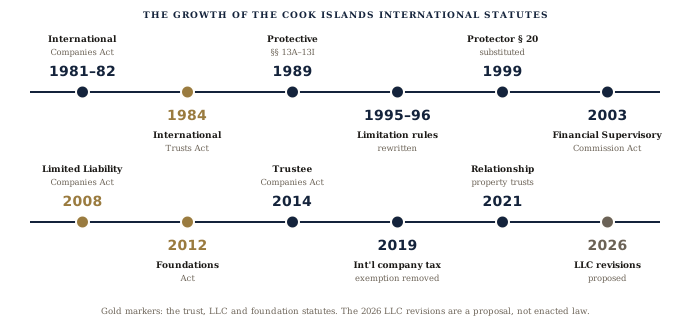
The International Trusts Act 1984. The International Trusts Act 1984 (No. 14), described in its long title as "[a]n Act to provide for International Trusts," was enacted on December 27, 1984. International Trusts Act 1984, long title (Cook Is.). As first enacted it was a modest statute. Its Part II codified the law applicable to international trusts by permitting a specified perpetuity period, adopting the wait-and-see rule, abolishing the rule against double possibilities and the rule against accumulations, modifying the rule in Saunders v. Vautier, creating a presumption against avoidance of trusts, and providing for charitable and purpose trusts and for investments. Part III provided for registration, Part IV applied other Acts to international trusts, and Part V dealt with resident beneficiaries, secrecy and penalties. Id. pts. II–V. The original Act did not contain the provisions on fraudulent dispositions, foreign judgments and settlor powers for which the Cook Islands is now known.
The 1989 amendments. The International Trusts Amendment Act 1989 (No. 23) inserted sections 13A to 13I: rules on bankruptcy, fraudulent dispositions, settlor powers, foreign judgments, heirship, spendthrift provisions and governing law, together with a definition of the protector. International Trusts Amendment Act 1989 (No. 23) (Cook Is.). These sections made the Act the first statute designed to protect a settlor's trust assets against foreign creditors. The International Trusts Amendment (No. 2) Act 1989 (No. 31) amended the limitation rules in section 13B. Later amendments refined both sets of provisions. Other jurisdictions followed with statutes of their own, including Belize in 1992 and Nevis in 1994 (see infra ¶ 160).
Amendments from 1991 to 2013. The protective provisions were developed by five further amending Acts. Table 1-1 lists every amendment since 1984.
Table 1-1. The International Trusts Act 1984 and its amendments
| Amending Act | Principal changes |
|---|---|
| 1985 (No. 7) | Defined international trust for the purposes of Part IV |
| 1989 (No. 23) | Inserted §§ 13A–13I: bankruptcy, fraudulent dispositions, settlor powers, foreign judgments, heirship, spendthrift provisions, governing law; defined protector |
| 1989 (No. 2) (No. 31) | Amended the § 13B limitation rules |
| 1991 | Added § 13B(8)–(10) (accrual of the cause of action; exclusive remedy), § 13J (community property) and § 13K (proceedings in the High Court within two years) |
| 1995–96 (No. 25) | Substituted § 13D and the protector definition; amended §§ 13B and 13K; added rules on change of governing law; substituted the registration provisions; new Parts on trustees and protectors |
| 1999 (No. 3) | Excluded punitive and multiplied damages; substituted § 20 on protectors; applied the protective sections to migrated trusts; added § 27C on trust records |
| 2004 (No. 7) | Substituted § 23 on confidentiality; amended registration renewal and deregistration |
| 2013 (No. 15) | Inserted § 27C(1A)–(1C) on trust records |
The 1999 substitution of section 20 is an example of the detail a planner must check. The 1995–96 text gave a protector, unless the instrument provided otherwise, the power to remove any trustee and appoint a new one, and provided that while no protector was appointed the statutory powers of a protector were deemed conferred on the court. International Trusts Amendment Act 1995–96, § 23 (Cook Is.) (enacting § 20(2)(a), (8)). The 1999 substitution omitted both rules, leaving the protector's powers to the trust instrument. International Trusts Amendment Act 1999, § 9 (Cook Is.). A trust drafted on the assumption that the statute supplies a default power of removal, or a court-held fallback, should be reviewed (see infra ch. 9).
The Orange Grove case and the legislative response. The leading example of the relationship between the courts and Parliament is the Orange Grove litigation.
An earlier High Court decision had shown the limitation rules working as designed. In Pacific Heritage Bank v. Radke, [1994] CKHC 9 (Cook Is. High Ct. Dec. 6, 1994), a California bank's Mareva injunction was discharged because the bank had not brought proceedings within one year of the October 15, 1992 transfer, as section 13B(3)(b) required, and the court refused to run the year from the bank's later discovery of the trust. The fraudulent-disposition rules are examined in chapter 21 (see infra ch. 21).
The Financial Supervisory Commission Act 2003. The Financial Supervisory Commission Act 2003 (No. 11) established the Financial Supervisory Commission as the single supervisor of the financial sector, with a Board, a Commissioner and powers of licensing, inspection and disclosure. Financial Supervisory Commission Act 2003, pts. 1–3 (Cook Is.). It was amended in the same year and again by the Financial Legislation Amendment Act 2012. The Act was passed as the Cook Islands was working to leave the Financial Action Task Force's list of non-cooperative countries and territories (see infra ¶ 170.02). It is the foundation of the regulatory structure examined in chapter 4 (see infra ch. 4).
The Limited Liability Companies Act 2008. The Limited Liability Companies Act 2008 (No. 7) was assented to on June 25, 2008. Limited Liability Companies Act 2008 (Cook Is.). It provides for the formation of LLCs by articles of organisation filed with the Registrar, management by members or managers under an operating agreement, and a charging-order regime for members' creditors that is among the strongest in any jurisdiction. Id. §§ 11–12, 26–28, 45. It was amended in 2013. The LLC has largely replaced the international company as the holding vehicle beneath Cook Islands trusts, particularly since the removal of the international company's tax exemption in 2019 (see infra ¶ 140.10). The Act is examined in Part III (see infra chs. 12–17).
The Foundations Act 2012. The Foundations Act 2012 (No. 11) provides for the establishment of foundations with their own legal personality. A foundation has a foundation instrument, which states its name, objects and registered agent, and foundation rules, which deal with its objects, its council, its registered agent, an enforcer, the endowment and dedication of assets, and revocation. Foundations Act 2012, pt. 2 (Cook Is.). The Act came into force on the day after assent and was amended in 2013. Id. § 2. It carries protective provisions that mirror those of the International Trusts Act (see infra chs. 18–20).
The Trustee Companies Act 2014. The Trustee Companies Act 2014 (No. 4) repealed the Trustee Companies Act 1981–82 and introduced a modern licensing regime, with defined trustee company business, fit-and-proper requirements for directors and controllers, compliance officers and grounds for intervention by the Commission. Trustee Companies Act 2014, §§ 4–11, 122 (Cook Is.). It came into force on the day after assent. Id. § 2. Every international trust, LLC and foundation is formed and administered through a licensed trustee company, so this Act governs the service providers on whom clients depend (see infra ch. 4).
Removal of the international company tax exemption, 2019. The International Companies (Removal of Tax Exemption) Amendment Act 2019 (No. 12) repealed the provision exempting non-resident recipients of income from international companies, replaced section 249 so that specified Acts, including the Income Tax Act 1997, the Financial Intelligence Unit Act 2015 and the Financial Transactions Reporting Act 2017, apply to international companies, and made transitional provision. International Companies (Removal of Tax Exemption) Amendment Act 2019, §§ 4–7 (Cook Is.). Companies already incorporated kept the exemption until the close of December 31, 2021. The amendment responded to international standards on harmful tax practices (see infra ¶ 170) and completed the shift from the international company to the LLC.
International relationship property trusts, 2021. The International Relationship Property Trusts Act 2021 (No. 14), with regulations made in 2022, created a separate class of registered trust to hold a couple's relationship property and to govern its division if the relationship ends. International Relationship Property Trusts Act 2021, pts. 1–3 (Cook Is.). The Act is outside the scope of the Parts on trusts, but it is noted in chapter 20 for its use alongside foundations and international trusts (see infra ch. 20).
Proposed revisions to the LLC Act. A committee of practitioners prepared a set of amendments to the Limited Liability Companies Act 2008, which was submitted to the Cook Islands government on April 1, 2026 and is pending. None of the amendments has been enacted, and until a bill is passed a Cook Islands LLC is governed by the 2008 Act as amended in 2013. The proposal would, among other things, define assignees and assignments, permit certificated interests, add a fraudulent-transfer rule for LLCs and clarify that certain tax payments are not distributions. The proposals are described in chapter 17 and are identified as proposals wherever they are mentioned (see infra ch. 17).

¶ 150
The Institutions
Four functions. The bodies that matter to the international sector can be grouped by function. Parliament and the Queen's Representative make and amend the statutes (see supra ¶¶ 120–130). The Financial Supervisory Commission licenses the trustee companies and keeps the registers. The trustee companies form and administer every international trust, LLC and foundation. And the High Court, the Court of Appeal and the Privy Council decide disputes. Two further bodies, the Financial Intelligence Unit and the tax administration, carry the jurisdiction's anti-money-laundering and tax-information obligations (see infra ¶ 170). Figure 1.4 shows the relationships.
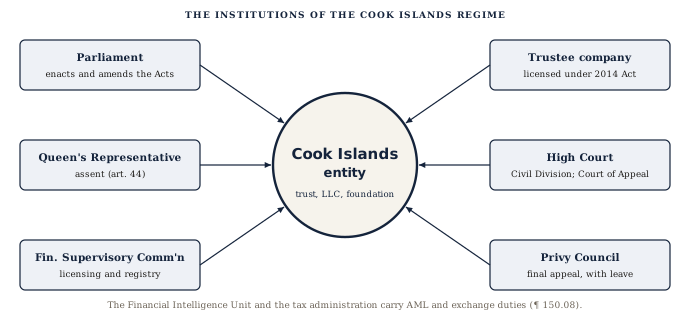
The Financial Supervisory Commission. The Financial Supervisory Commission was established by the Financial Supervisory Commission Act 2003. It licenses banks, insurers (including captive insurers), money-changing and remittance businesses and trustee companies. It also operates the registry for international and foreign companies, limited liability companies, international trusts, international partnerships and foundations. The Registrar of International Companies and International Trusts is part of the Commission. Fin. Supervisory Comm'n (Cook Is.), Home Page (visited Nov. 5, 2026). The Commission publishes the principal Acts and amending Acts it administers, which is the most convenient official source of the statutes cited in this treatise. Its structure, powers and supervisory practice are examined in chapter 4 (see infra ch. 4).
The registry. Each international entity is registered by filing with the Registrar through a trustee company. An international trust becomes an international trust by registration; its registration must be renewed, and a trust that is deregistered loses the protection of the Act, including the protection of sections 13A and 13B for dispositions made before deregistration. International Trusts Act 1984, §§ 14–16 (as substituted 1995–96 and amended 1999 and 2004) (Cook Is.). An LLC is formed by filing articles of organisation, receives a certificate of organisation for a term that must be renewed, and must maintain a registered agent. Limited Liability Companies Act 2008, §§ 11–18 (Cook Is.). A foundation is established on application through its registered agent. Foundations Act 2012, pt. 2 (Cook Is.). The International Trusts Act provides no public inspection of its register, and makes unauthorized disclosure of a trust's affairs an offence. International Trusts Act 1984, § 23 (as substituted 2004) (Cook Is.).
The trustee companies. Trustee companies are licensed under the Trustee Companies Act 2014. Only a licensed trustee company may carry on trustee company business, which it must do in accordance with the conditions of its licence. Trustee Companies Act 2014, pts. 2–3 (Cook Is.). In practice the trustee of every international trust is a licensed trustee company or its subsidiary, and the same companies act as registered agents of LLCs and foundations. They are reporting entities under the anti-money-laundering laws and carry out the due diligence on which the integrity of the sector depends. The sector is small, and the selection of a trustee company is among the most important decisions a planner makes for a client (see infra ch. 7).
The High Court. The High Court of the Cook Islands is a court of record "for the administration of justice throughout those islands," with all the civil and criminal jurisdiction necessary to administer the law in force. It has three Divisions: Civil, Criminal and Land. Const. of the Cook Islands art. 47(1)–(3). It is the same court as the High Court established by the Cook Islands Act 1915. Id. art. 82(1). Proceedings under the International Trusts Act, the Limited Liability Companies Act and the Foundations Act are brought in its Civil Division. The Act directs that civil proceedings concerning international trusts be heard in camera unless the court orders otherwise. International Trusts Act 1984, § 23(3) (Cook Is.).
The Court of Appeal. The Court of Appeal of the Cook Islands is a superior court of record. Its judges are the Chief Justice and the other judges of the High Court, and other persons qualified for appointment to the High Court who are appointed by the Queen's Representative on the recommendation of the Executive Council, made on the advice of the Chief Justice and the Attorney General. Const. of the Cook Islands art. 56(1)–(3). One of the appointed judges is made President of the Court; the Chief Justice, if present, presides, and otherwise the President or, in the President's absence, the senior judge. Const. of the Cook Islands art. 56(4)–(5). Any three judges may exercise the Court's powers, and no judge may sit on an appeal from the judge's own decision. Id. arts. 57–58. The Court may sit within or outside the Cook Islands, on dates and at times fixed by the President after consultation with the Chief Justice. Const. of the Cook Islands art. 59(1). It hears appeals from judgments of the High Court, and causes removed from the High Court, as prescribed by Act, and may at any time grant special leave to appeal from any judgment of the High Court. Id. art. 60(1)–(2). The determination of the Court of Appeal is final, subject only to the appeal to the Privy Council. Id. art. 59(2). Articles 56 to 61 in this form were substituted by the Constitution Amendment (No. 28) Act 2009, s. 7. Earlier consolidations print the pre-2009 text, under which the President was a New Zealand judge, an appeal lay as of right where the matter in dispute was worth $400 or more, and the finality provision expressly barred appeals to the New Zealand courts.
The Privy Council. "There shall be a right of appeal to Her Majesty the Queen in Council, with the leave of the Court of Appeal, or, if such leave is refused, with the leave of Her Majesty the Queen in Council, from judgments of the Court of Appeal in such cases and subject to such conditions as are prescribed by Act." Const. of the Cook Islands art. 59(3); Utanga v. R [2025] CKCA 1, [7] (quoting the provision as art. 59(3); consolidations prepared before the Constitution Amendment (No. 28) Act 2009 substituted Articles 56 to 61 number it art. 59(2)). The Judicial Committee of the Privy Council is therefore the final court for the Cook Islands, although few Cook Islands appeals reach it. New Zealand ended appeals to the Privy Council from decisions of its own courts made after December 31, 2003, when the Supreme Court Act 2003 (N.Z.) came into force on January 1, 2004, and the continued link between the Cook Islands and the Privy Council is a point of difference that chapter 3 examines (see infra ch. 3).
The Financial Intelligence Unit and the tax administration. The Financial Intelligence Unit operates under the Financial Intelligence Unit Act 2015, and the Financial Transactions Reporting Act 2017 imposes customer due diligence, record-keeping and suspicious-transaction reporting obligations on reporting institutions, including trustee companies. Both Acts are among those that apply to international companies notwithstanding the general exemption from Cook Islands regulation. International Companies Act 1981–82, § 249(2) (as replaced 2019) (Cook Is.). Tax information exchange, including the Common Reporting Standard, is administered under the Income Tax Act 1997 as amended in 2016. These regimes are examined in chapters 27 and 28 (see infra chs. 27–28).
¶ 160
The Cook Islands in Comparative Perspective
The peer jurisdictions. Among the jurisdictions whose statutes were written for owners who live elsewhere, three are most often compared: the Cook Islands, Nevis and Belize. Each has a trust statute, an LLC statute and a foundation statute, and each is the subject of a volume in this series. The volumes share one structure, so that chapter 21 of this volume and chapter 21 of Lighthouse on Nevis: Trusts, LLCs, and Multiform Foundations both treat fraudulent dispositions, and chapter 15 of each treats the charging order. The fuller comparative treatment of the trust statutes appears in Lighthouse on Asset Protection, and of the LLC statutes in Lighthouse on Limited Liability Companies (see also infra app. E).
Political status. The three differ first in their constitutional position. The Cook Islands is self-governing in free association with New Zealand (see supra ¶ 110). Nevis is one island of the independent Federation of Saint Christopher and Nevis, with its own legislature for business law under the federal Constitution of 1983. Belize, formerly British Honduras, has been an independent state since 1981 with a single national legislature. Only the Cook Islands shares a Head of State, a citizenship and a responsibility for external affairs with a larger state, and only the Cook Islands Constitution entrenches those links by requiring a two-thirds referendum to change them (see supra ¶ 120.06).
The trust statutes. The Cook Islands International Trusts Act 1984, with its protective provisions inserted from 1989 onward, created the modern asset-protection trust. Nevis followed in 1994 with the Nevis International Exempt Trust Ordinance. Both require a creditor to prove beyond reasonable doubt that the transfer was made with principal intent to defraud that creditor and rendered the settlor insolvent, both refuse to enforce foreign judgments, and both impose short limitation periods. Nevis departs from the Cook Islands model in three respects: a creditor must post a bond of EC$270,000 before suing; a transfer made more than one year after the creditor's cause of action accrued is protected, where the Cook Islands period is two years; and the Nevis foreign-judgments provision applies notwithstanding any treaty. Belize took a different approach. Its Trusts Act of 1992 contains no fraudulent-disposition code of the Cook Islands or Nevis kind. Section 7(6) directs the Belize court not to set aside a Belize trust or recognize any claim against its property under foreign law or a foreign court order relating to marriage, succession or "the claims of creditors in an insolvency." Trusts Act, Cap. 202, § 7(6) (rev. ed. 2020) (Belize). Insolvency is a financial condition, distinct from the formal proceeding of bankruptcy, and the provision reaches the fraudulent-transfer claims of creditors of an insolvent settlor.
Table 1-2. The Cook Islands, Nevis and Belize compared
| Feature | Cook Islands | Nevis | Belize |
|---|---|---|---|
| Constitutional status | Self-governing in free association with New Zealand (1965) | Island of a federation with its own legislature for business law (1983) | Independent state (1981) |
| Trust statute | International Trusts Act 1984, as amended | Nevis International Exempt Trust Ordinance, Cap. 7.03(N) (in force 1994) | Trusts Act, Cap. 202 (1992) |
| Creditor's fraud claim | Principal intent to defraud and insolvency, beyond reasonable doubt (§ 13B) | Same elements and standard | No fraud code; § 7(6) bars foreign insolvency claims |
| Transfer after accrual protected | After 2 years, or if no suit within 1 year of the transfer (§ 13B(3)) | After 1 year | Not applicable |
| Bond before suit | None by statute | EC$270,000 | None by statute |
| Foreign judgments | Not enforced (§ 13D) | Not enforced, notwithstanding treaties | Not recognized as to matters in § 7(6) |
| LLC statute | Limited Liability Companies Act 2008 | Nevis Limited Liability Company Ordinance, Cap. 7.04(N) (2017) | Limited Liability Companies Act, Cap. 270:01 (as amended 2023) |
| Foundation statute | Foundations Act 2012 | Multiform Foundations Ordinance, Cap. 7.08(N) (2004) | International Foundations Act 2010 |
| Final appeal | Privy Council, with leave (Const. art. 59(3)) | Privy Council | Caribbean Court of Justice (since 2010) |
Sources: International Trusts Act 1984 (Cook Is.), as amended; Const. of the Cook Islands art. 59; Nevis Int'l Exempt Trust Ordinance, Cap. 7.03(N) (rev. ed. 2017); Trusts Act, Cap. 202 (rev. ed. 2020) (Belize); Lighthouse on Asset Protection chs. 22–24; Lighthouse on Limited Liability Companies ch. 54.
The LLC statutes. All three jurisdictions have LLC statutes that make the charging order a member's creditor's principal or exclusive remedy. The Cook Islands statute provides that a member's interest cannot be seized and does not pass to a trustee in bankruptcy, that the charging order is the sole and exclusive remedy for single-member and multi-member companies alike, that the order is not a lien and gives the creditor no rights of membership, and that no interlocutory order may be made against the LLC except an interim order without notice lasting no more than thirty days unless extended on notice. Limited Liability Companies Act 2008, § 45 (Cook Is.). The Nevis statute limits the life of a charging order to three years without renewal and permits the company to pay its members' income taxes directly to the taxing authority without treating the payment as a distribution. The Belize statute was renamed and substantially amended in 2023. The Cook Islands statute contains no fraudulent-transfer provision of its own, so a challenge to a transfer into a Cook Islands LLC is governed by the general law; the pending proposal would add one (see supra ¶ 140.12; see infra ch. 15).
The foundation statutes. The Cook Islands Foundations Act 2012 creates a civil-law style foundation with its own legal personality, governed by a council, with an enforcer and a registered agent, and with protective provisions that mirror those of the International Trusts Act, including the beyond-reasonable-doubt standard and the two-year and one-year limitation rules. Foundations Act 2012, §§ 37(7), 38–40 (Cook Is.). The Nevis Multiform Foundations Ordinance permits a foundation to elect the form in which it will be treated, as a trust, company, partnership or foundation. The Belize International Foundations Act 2010 provides for non-recognition of foreign judgments, a reduced limitation period and security for costs. The foundation statutes are compared in chapter 18 (see infra ch. 18).
The courts. The Cook Islands and Nevis both retain the Privy Council as their final court. Belize replaced the Privy Council with the Caribbean Court of Justice in 2010. The Cook Islands has the longest record of reported litigation on its trust statute of the three, with decisions of the High Court and the Court of Appeal from the early 1990s onward (see supra ¶ 140.05). The Nevis courts are part of the Eastern Caribbean Supreme Court, which serves several states. No reported Belize decision applying section 7(6) to a foreign creditor has been identified.

¶ 170
International Standards and Information Exchange
Why standards matter to the planner. A Cook Islands structure is used by clients who bank, invest and pay tax elsewhere. Its usefulness therefore depends on how banks, auditors, tax authorities and counterparties in other countries regard the jurisdiction. Those views are shaped by three international processes: the anti-money-laundering standards of the Financial Action Task Force, applied in the Pacific through the Asia/Pacific Group on Money Laundering; the tax-transparency standards of the Organisation for Economic Co-operation and Development and its Global Forum on Transparency and Exchange of Information for Tax Purposes; and the European Union's list of non-cooperative jurisdictions for tax purposes. The Cook Islands' record in each has changed markedly since 2000.
The FATF list, 2000–2005. In June 2000 the Financial Action Task Force identified the Cook Islands as a non-cooperative country or territory in the fight against money laundering. A year later the Task Force noted "with particular satisfaction" that the Cook Islands, with Israel, Lebanon and the Marshall Islands, had "enacted most, if not all legislation needed to remedy the deficiencies identified in June 2000," and asked those jurisdictions to submit implementation plans, while keeping them on the list. Fin. Action Task Force, Review to Identify Non-Cooperative Countries or Territories (June 22, 2001), as enclosed in Comm'n de Surveillance du Secteur Financier, Circular 01/31 (Lux.). At its plenary meeting in Paris on February 9–11, 2005, the Task Force removed the Cook Islands, Indonesia and the Philippines from the list. Gov't of H.K. Special Admin. Region, FATF Removes Three from Non-Cooperative List (Feb. 14, 2005). The Financial Supervisory Commission Act 2003 and the licensing and due-diligence regime that followed were part of the response (see supra ¶ 140.06).
The 2018 mutual evaluation. The Cook Islands is a member of the Asia/Pacific Group on Money Laundering. Its mutual evaluation report, adopted at the Group's annual meeting in September 2018, rated it compliant or largely compliant on 38 of the 40 FATF Recommendations, and assessed its effectiveness as substantial on five, moderate on four and low on two of the eleven immediate outcomes, with the jurisdiction placed in regular follow-up. Fin. Supervisory Comm'n (Cook Is.), Media Release on the AML/CFT Mutual Evaluation (2018). A planner should consult the Group's current follow-up reports for re-ratings. The obligations of trustee companies as reporting institutions are examined in chapter 28 (see infra ch. 28).
The OECD and harmful tax practices. The OECD's June 2000 report to its Ministerial Council identified a group of jurisdictions as meeting its technical criteria for tax havens, and the Cook Islands was among them. On March 27, 2002, the OECD announced that the Cook Islands had committed to improve the transparency of its tax system and to "a full exchange of information on tax matters with OECD countries by the year 2005." Inland Revenue Dep't (N.Z.), Policy & Strategy, Cook Islands to Co-operate with OECD Tax Haven Work (Mar. 28, 2002) (quoting OECD announcement). The international company's tax exemption, which had allowed non-residents to receive income from Cook Islands international companies free of Cook Islands tax, was removed in 2019 with effect for existing companies from the end of 2021 (see supra ¶ 140.10).
Automatic exchange and the Global Forum. The Cook Islands implemented the Common Reporting Standard through the Income Tax (Automatic Exchange of Financial Account Information and Other Matters) Amendment Act 2016, in force on its assent on September 26, 2016, and the Income Tax (Automatic Exchange of Financial Account Information) Regulations 2017. The same 2016 Act added the relevant Part of the Income Tax Act 1997 to the Schedule of Acts that apply to international trusts. The Global Forum's second-round review of the Cook Islands' exchange of information on request, published on July 29, 2026, rated the jurisdiction largely compliant overall, and found that legal and beneficial ownership information is available to the authorities under the anti-money-laundering framework and company law. Global Forum on Transparency & Exch. of Info. for Tax Purposes, Press Release (July 29, 2026). The Cook Islands was not on either annex of the European Union's list of non-cooperative jurisdictions for tax purposes following the Council's revision of October 9, 2026. Council Conclusions on the Revised EU List of Non-Cooperative Jurisdictions for Tax Purposes, Council Doc. 13854/26 (Oct. 9, 2026).
Confidentiality and transparency together. The International Trusts Act continues to make unauthorized disclosure of a trust's affairs an offence and to require trust proceedings to be heard in camera unless the court orders otherwise. International Trusts Act 1984, § 23 (as substituted 2004) (Cook Is.). Those provisions protect trusts from public disclosure and from fishing inquiries by private litigants. They do not prevent disclosure made in discharging a duty or function under any Act, which includes the reporting and exchange obligations of the tax and anti-money-laundering legislation, or disclosure that a court requires or authorizes, or that is made under a search warrant. Id. § 23(2). A Cook Islands trust is therefore private and transparent at once: private as against the world, and transparent to the authorities entitled to information.
¶ 180
Choosing the Cook Islands: Practitioner Considerations and Risks
What the jurisdiction offers. The Cook Islands offers a client five things that together explain its position as the benchmark offshore trust jurisdiction for American and other clients:
- a trust statute whose protective provisions are precise, tested in litigation and revised by Parliament when a decision exposed a gap (see supra ¶ 140);
- an LLC statute with one of the strongest charging-order provisions in any jurisdiction, which can be combined with the trust (see supra ¶ 160.04);
- a foundation statute with protective provisions of the same kind, for clients who prefer a civil-law entity (see supra ¶ 140.08);
- a court system staffed by experienced judges, including senior New Zealand judges in the Court of Appeal, with a final appeal to the Privy Council (see supra ¶¶ 150.05–150.07); and
- a regulatory record that has moved from the FATF list in 2000 to a largely compliant Global Forum rating and absence from the EU list in 2026 (see supra ¶ 170).
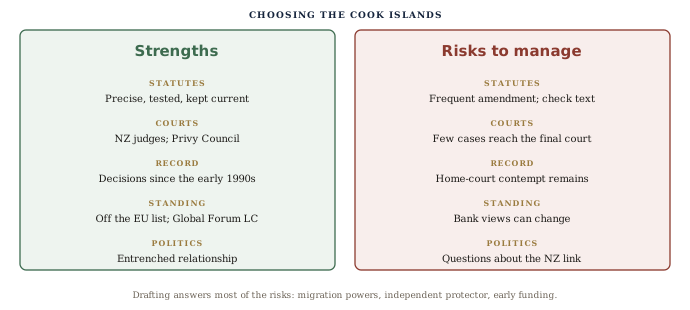
The test of the record. The jurisdiction's statute has been tested by American creditors, by the United States government and by a settlor's contempt in an American court. The trust in FTC v. Affordable Media was a Cook Islands trust. While the settlors were held in contempt in the United States for failing to repatriate the trust assets, the United States, on behalf of the Federal Trade Commission, sued the trustee in the Cook Islands in September 1999. The proceedings were settled in 2002, and the trustee turned over $1.2 million from the trust under a settlement approved by the Commission. Press Release, Fed. Trade Comm'n, Announced Actions for December 13, 2002 (Dec. 13, 2002). The episode shows both sides of the jurisdiction: the trustee did not repatriate under the American order, and the government recovered part of the assets only by litigating in Rarotonga and settling. It also shows the cost to the settlor, who bears the consequences in the home court (see infra ch. 25).
Practical disadvantages. The disadvantages are practical. The islands are remote from American and European clients, and the time difference from Europe and Asia can complicate urgent instructions. The trustee industry is small, so that the client's choice of provider is limited and the reputation of a few firms matters greatly. The domestic banking sector is small, and the assets of most international trusts are held in banks in other countries, through LLCs or directly by the trustee. Costs are significant, because the structure requires a licensed trustee, registration and renewal fees, and local counsel for any litigation. The Act contains no statutory duress provision of the kind found in some later statutes, so that a trustee's response to a foreign court order depends on the trust instrument and on the trustee's own judgment, supported by the court's power to give directions (see infra ch. 9).
Constitutional and political risk. Clients increasingly ask whether changes in the relationship between the Cook Islands and New Zealand could affect a trust. Three points answer most such questions.
- Entrenchment. The provisions of the Constitution Act that establish self-government, the supremacy of the Constitution, New Zealand's responsibility for external affairs and defence and the preservation of New Zealand citizenship can be changed only with a two-thirds vote of Parliament on two readings ninety days apart and a two-thirds vote of the electors in a poll. Const. of the Cook Islands art. 41(2).
- Continuity of law. A change in the constitutional relationship would not by itself repeal the International Trusts Act, the Limited Liability Companies Act or the Foundations Act, which remain in force until Parliament repeals or amends them. The Constitution of 1965 itself continued the existing law on Constitution Day, and any successor arrangement would be expected to do the same. Id. art. 77.
- Mobility of the trust. The International Trusts Act permits a trust's governing law to be changed to or from Cook Islands law under a power in the instrument, without breaking the continuity of the trust. International Trusts Act 1984, § 13G (as amended 1995–96) (Cook Is.). A trust drafted with a power to change its governing law and to replace the trustee can move if the client's assessment of the jurisdiction changes (see infra ch. 11).
The defence and security declaration of April 2026 reaffirmed the relationship of free association and New Zealand's constitutional responsibility for defence and security, while acknowledging the Cook Islands' international legal personality and its own foreign policy. Declaration on Defence and Security, supra ¶ 110.05, paras. 1–6. A planner should record the advice given on these questions and review it periodically.
When the Cook Islands is the wrong choice. The Cook Islands is a poor choice for a client who is already facing claims and hopes to protect assets by a late transfer. The Cook Islands court may protect the assets under the limitation rules, but the client will face repatriation orders and possible contempt in the home court. It is unsuitable for a client whose assets are mostly illiquid or must remain in the client's home country, for a client who needs regular access to the assets, and for a client who wants to keep practical control. It may be unsuitable for a client whose banks will not accept a Cook Islands structure. The suitability analysis should precede the choice of jurisdiction and should be recorded in the file (see infra ch. 30).

¶ 190
Plan of the Treatise and How to Use It
Seven Parts. The treatise is organized in seven Parts, each of which carries the same chapter numbers as the corresponding Part of the other jurisdiction volumes in the series.
- Part I, The Cook Islands and Its Legal System (chapters 1–4), describes the constitutional frame (this chapter), the sources of law (chapter 2), the courts (chapter 3) and the Financial Supervisory Commission, the trustee companies and the Registrar (chapter 4).
- Part II, International Trusts (chapters 5–11), examines the International Trusts Act 1984: its scope, history and registration rules (chapter 5); the creation of a trust (chapter 6); trustees (chapter 7); beneficiaries (chapter 8); protectors, reserved powers and settlor benefit (chapter 9); purpose and charitable trusts (chapter 10); and variation, migration and termination (chapter 11).
- Part III, Limited Liability Companies (chapters 12–17), examines the Limited Liability Companies Act 2008: formation (chapter 12); members, managers and the operating agreement (chapter 13); fiduciary duties (chapter 14); members' creditors and the charging order (chapter 15); transfers, dissolution and reorganizations (chapter 16); and international structures, U.S. classification and the proposed revisions to the Act (chapter 17).
- Part IV, Foundations (chapters 18–20), examines the Foundations Act 2012: formation (chapter 18), governance (chapter 19) and planning uses (chapter 20).
- Part V, Creditor Protection and Litigation (chapters 21–25), examines fraudulent dispositions under section 13B (chapter 21), the other bars to suit (chapter 22), foreign judgments under section 13D (chapter 23), litigation in the Cook Islands (chapter 24) and Cook Islands structures before foreign courts (chapter 25).
- Part VI, Tax, Reporting and AML (chapters 26–29), examines Cook Islands taxation (chapter 26), information exchange (chapter 27), anti-money laundering and beneficial ownership (chapter 28) and U.S. tax and reporting (chapter 29).
- Part VII, Planning and Forms (chapter 30), draws the Parts together in a guide to designing and drafting a Cook Islands structure.
Appendices A to E contain forms of trust deed, LLC operating agreement and foundation instrument and foundation rules, registration and compliance checklists, and a comparative table of the Cook Islands, Nevis and Belize. Tables of Cases and of Statutes and Regulations and an Index complete the volume.
Paragraph numbering. The treatise is cited by paragraph. Each chapter begins with an overview at ¶ N01, followed by sections numbered in tens (¶ N10, ¶ N20 and so on), divided into numbered paragraphs (¶ N10.01). The numbering leaves room for later editions to insert material without renumbering, and the same scheme is used in the companion volumes, so that a reference such as ¶ 2110.03 identifies a paragraph in chapter 21 of whichever volume is cited.
Cross-references across the series. Because the jurisdiction volumes share one structure, a reader who wishes to compare the Cook Islands rule on a subject with the Nevis or Belize rule can turn to the chapter with the same number in the other volume. Where a comparison is important to the Cook Islands analysis, the text gives it directly. Where the fuller discussion of a general subject appears in Lighthouse on Asset Protection or Lighthouse on Limited Liability Companies, the text cites that volume by title.
Examples, Planning Notes, Comments and case discussions. Each chapter contains numbered Examples, which apply the law to facts; Planning Notes, which draw practical conclusions for the drafter or adviser; and Comments, which explain the reasons for a rule or the limits of what is known about it. Case discussions set out the facts, proceedings, holding and lessons of the leading decisions. The Examples are illustrations. They describe the result the law would produce on the stated facts, and a reader should not assume that the same result will follow on different facts.
Statements of law and proposals. The law is stated as of November 2026. Where a provision has been amended, the text identifies the amending Act and, where it matters, the transitional rule. Proposals for legislative change, including the pending proposal to revise the Limited Liability Companies Act 2008, are described as proposals wherever they appear, and nothing in the treatise should be read as stating that a proposal has been enacted until it has been passed by Parliament, assented to and brought into force.
The readers. The treatise is written for lawyers, trustees, family-office advisers and compliance officers who establish, administer or advise on Cook Islands trusts, LLCs and foundations, and for lawyers and judges in other countries who must understand them. It assumes familiarity with the general law of trusts and companies and explains the Cook Islands rules against that background. Nothing in it is legal advice to any reader or client, and a reader who intends to rely on a provision should confirm the current text with Cook Islands counsel.