

¶ 2101
Overview
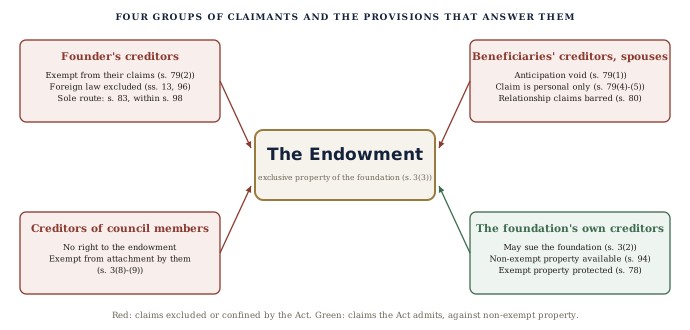
Scope of the chapter. This chapter examines the property of a Belize foundation and the protection the International Foundations Act gives it against claims made by persons outside the foundation. It covers four groups of claimants: creditors of the founder, creditors and spouses of beneficiaries, creditors of members of the foundation council, and creditors of the foundation itself. It sets out the statutory provisions on which each group's position depends, examines their text, and explains how they fit together. Chapter 19 examined the foundation as a legal form and its formation, and chapter 20 examines the founder, the foundation council, the protector and the beneficiaries (see supra ch. 19; see supra ch. 20). Chapter 22 compares the foundation with the trust and the LLC as planning vehicles (see infra ch. 22).
The statute. The Act was enacted as Act No. 2 of 2010 and appears in the 2020 revised edition as Chapter 24:02, consolidating the amendments made by Act No. 17 of 2013. International Foundations Act, Cap. 24:02 (rev. ed. 2020) (Belize) ("Foundations Act"). The International Foundations (Amendment) Act 2023, No. 49 of 2023, substituted "foundation" for "international foundation" throughout, placed the administration of the Act with the Financial Services Commission and added record-keeping and beneficial-ownership duties. It did not amend any of the protective provisions examined in this chapter: sections 3, 13, 14, 49, 53 and 75 to 83 and Part X stand as they were in the revised edition (see supra ¶¶ 1901.04, 1990.01).
A protective statute. The Belize Act belongs to the group of foundation statutes written for asset protection. It does not leave the foundation to the general law of creditors' remedies. It contains its own code. The code has eight elements: the endowment ceases irrevocably to be the founder's property on transfer; interests of founders and beneficiaries cannot be anticipated or alienated, and the endowment is exempt from the claims of their creditors; foreign law and foreign judgments are excluded on questions of validity and on claims based on family relationships, foreign fiscal law and pre-conviction forfeiture; a foundation is not void or voidable by reason of the founder's bankruptcy; a disposition may be set aside as fraudulent only under the Act's own section, on proof beyond a reasonable doubt; a short limitation period runs from the execution of the charter; a plaintiff outside the foundation must deposit security for costs and may not retain counsel on a contingent fee; and the court may not disregard the foundation as a separate entity. Foundations Act ss. 3(3), 13, 79–83, 96–102.
Belize law, Belize court. Every protection in the code operates in the Belize court. The governing law of a foundation registered under the Act "shall be the law of Belize," and the foundation is "subject to the exclusive and continuing jurisdiction of the Court, which shall be the exclusive forum for the adjudication of all disputes relating to the foundation." Id. s. 10. Part X repeats the rule: the Court "shall have exclusive and continuing jurisdiction over all matters, actions and proceedings arising under, or relating to, this Act, or any foundation established or registered under this Act." Id. s. 92. "Court" means the Supreme Court of Belize, now styled the High Court (see supra ¶ 1930.06). A foreign court will apply its own law to persons and assets within its reach. The Act's answer is to keep the endowment, the council and the litigation in Belize, and to direct the council not to act on foreign process without a Belize order (see infra ¶ 2170).
The definitions matter. Three definitions in section 2 govern the reading of the creditor provisions, and each is narrower than the ordinary meaning of the word. "Creditor" means "a person who has obtained a judgment for specified monetary damages issued by the Court, or an assignee of said judgment." "Judgment" means "an enforceable judgment issued by the Court." "Insolvency" means "the filing of a petition in bankruptcy or otherwise for winding up in a court having jurisdiction over the debtor." Id. s. 2(1). The first two definitions confine the Act's creditor remedies to holders of Belize judgments. The third gives the word "insolvency" a procedural meaning in this Act, which differs from the meaning of the same word in section 7(6)(c) of the Trusts Act. Paragraph 2140 examines the consequences (see infra ¶ 2140).
The trust and the foundation compared. The Trusts Act protects a Belize trust chiefly through section 7(6), which directs the court not to vary or set aside a Belize trust, or recognise a claim against its property, under foreign law or a foreign order relating to marriage, succession or "the claims of creditors in an insolvency" (see supra ch. 11). On the correct reading, insolvency in that provision is a financial condition, and paragraph (c) reaches fraudulent-transfer claims by ordinary creditors as well as claims in a bankruptcy (see supra ¶¶ 1150.02–1150.08). The Foundations Act reaches a comparable result by a different route. It excludes foreign law generally on the validity of the foundation and of dispositions to it, makes the endowment exempt from the claims of the founder's creditors, and then allows a single Belize-law claim, under section 83, on terms that few creditors can meet. The two statutes are drafted separately, and each is read by its own words and definitions. The Foundations Act definition of insolvency has no bearing on the meaning of section 7 of the Trusts Act (see supra ¶ 1920.09).
Sources. The chapter relies on the text of the Act in the 2020 revised edition, published by the Financial Services Commission, and on the text of Act No. 49 of 2023. No reported Belize decision applying sections 13, 79 to 83 or 96 to 102 has been located. Proceedings relating to a foundation are heard in camera unless the court orders otherwise, and decisions may be published only in redacted form approved by the parties. Foundations Act s. 106. The analysis that follows is therefore an analysis of the statute's text, with comparison to the parallel provisions of the Trusts Act and the Limited Liability Companies Act, which Belize courts will read in the same statutory setting.