
¶ 101
Overview
The subject of this book. This book examines the law of Belize governing three vehicles used in private wealth planning: the trust, the limited liability company and the foundation. Each is governed by its own statute. The Trusts Act, Cap. 202, governs domestic and international trusts. The Limited Liability Companies Act, Cap. 270:01, enacted in 2011 as the International Limited Liability Companies Act and renamed and reformed in 2023, governs the Belize LLC. The International Foundations Act, Cap. 24:02, enacted in 2010 and amended in 2023, governs the Belize foundation. The book treats each statute in its own Part and then examines the law that cuts across all three: the protection of the vehicle and its property against foreign claims, litigation in Belize and abroad, taxation, beneficial-ownership reporting, anti-money-laundering obligations and the American tax and reporting rules that apply when the settlor, member or founder is a United States person.
The jurisdiction. Belize lies on the Caribbean coast of Central America, between Mexico and Guatemala. It was the colony of British Honduras until 1973, when the colony took the name Belize, and became independent on September 21, 1981, as a constitutional monarchy within the Commonwealth. Its population is about four hundred thousand. Its legal system is founded on English common law and equity, received during the colonial period and continued by the Constitution, and its statute book follows English models in most fields of private law. Its official language is English. For the practitioner from the United States, the United Kingdom or another common-law country, the vocabulary of Belize trust and company law is familiar, and much of its case law draws on English and Commonwealth authority.
Three vehicles, one design. The three statutes were enacted at different times, for different markets. They differ in many details. They share a design. Each requires the vehicle to be registered with a Belize registrar through a licensed Belize agent; each confines the registry's public information to a minimum while giving Belize regulators and law-enforcement authorities access to the records; and each contains provisions directing the Belize court to disregard foreign law and foreign judgments in defined cases. In the Trusts Act, the central provision is section 7(6), which bars the Belize court from varying or setting aside a Belize trust, or recognizing a claim against its property, under foreign law or a foreign order relating to marriage, succession or "the claims of creditors in an insolvency." Trusts Act, Cap. 202, s. 7(6) (rev. ed. 2020). In the LLC Act, the central provisions are the bar on veil piercing, the rule that the LLC's property is not available to satisfy a member's debts and the exclusive charging order. Limited Liability Companies Act, Cap. 270:01, ss. 34–36 (rev. ed. 2020, as amended 2023). In the Foundations Act, they are the provisions disregarding foreign law concerning the validity of a foundation or of a disposition to it, the restraint on alienation of the endowment and the rules on limitation and security for costs (see infra ch. 21).
The international trust. Most of the trusts with which this book is concerned are international trusts within the meaning of the Trusts Act. As amended in 2023, an international trust is one at least one of whose trustees is a company incorporated under the Belize Companies Act or a licensed trust company doing business in Belize, whose settlor is not resident in Belize, none of whose beneficiaries is resident in Belize and whose property includes no land in Belize. Trusts Act s. 64(1) (as amended by Trusts (Amendment) Act 2023, No. 40 of 2023, s. 6). An international trust must be registered with the Registrar within ninety days of its creation, and section 7 applies to it only while it is registered. Id. ss. 65A–65B. The registration requirement runs through the whole of Part II of this book (see infra ch. 6), because a trust that is not registered loses the protection on which most international trusts are built.
The reader. The book is written for lawyers, trustees, trust officers, accountants and other professionals who design, administer, litigate or report on Belize structures. Most readers will advise clients outside Belize. Some will be Belize practitioners who wish to see how their statutes are read and tested in foreign courts. The book assumes familiarity with the general law of trusts, companies and conflict of laws, and explains Belize law against that background. Where a rule of Belize law depends on English authority, the English authority is identified. Where a question has been considered by an American court, that decision is examined, because American courts have produced most of the reported decisions on Belize trusts (see infra ch. 26).
The approach of this chapter. This chapter introduces the jurisdiction and the book. It traces the history of Belize as a financial centre (see infra ¶ 110), describes the three statutes (see infra ¶ 120), places Belize among the leading trust jurisdictions (see infra ¶ 130), introduces its courts and its regulator (see infra ¶ 140), summarizes the reforms of 2017 to 2025 (see infra ¶ 150), previews section 7 of the Trusts Act and the meaning of "insolvency" in section 7(6)(c) (see infra ¶ 160), describes the clients who use Belize structures (see infra ¶ 170), explains the sources and method of the book (see infra ¶ 180) and sets out its organization (see infra ¶ 190).
A summary of the position. Belize offers a trust statute whose protective core is categorical in form: it declines to recognize, under foreign law or foreign orders, the marital, succession and insolvency claims against a Belize trust that most often threaten family wealth. It offers an LLC statute with an exclusive charging order and a statutory bar on veil piercing, and a foundation statute with its own non-recognition provisions. Its legal system is familiar to common-law practitioners. Against those strengths the planner must weigh a thinner body of reported local decisions than that of some competing jurisdictions, a final court of appeal, the Caribbean Court of Justice, that has not yet considered the protective provisions of the Trusts Act, and a history of listing by international bodies that has made some banks cautious. Each of those factors is examined in this book, and none of them is a reason to misstate the statute. The most common misstatement, that section 7(6)(c) protects a Belize trust only against a trustee in bankruptcy, is examined in ¶ 160 and in chapter 23.
¶ 110
Belize as a Financial Centre: A History
The legal inheritance. Belize received English common law and equity as a British colony, and its courts continue to treat English decisions as highly persuasive. Its property legislation is modelled on the English property statutes, and its Law of Property Act, Cap. 190, contains the fraud-on-creditors provision, section 149, that descends from the Statute of Elizabeth (see infra ¶ 160.05 and ch. 23). Its domestic company law, until 2022, was contained in the Companies Act, Cap. 250, and its trust law, before 1992, was the English law of trusts applied by a colonial court. The modern financial-services statutes were built on that foundation, and each of them relies on the general law for the matters it does not address.
The International Business Companies Act 1990. Belize's offshore sector began with the International Business Companies Act, Act No. 9 of 1990, which came into force on May 1, 1990. International Business Companies Act, Cap. 270 (rev. ed. 2020) (enactment note). The Act provided a company for non-residents, exempt from Belize taxes on income earned outside Belize, with minimal public filings, nominee directors and, until 2017, bearer shares. It was amended in 1995 and twice in 1999. Id. (Acts No. 14 of 1995, No. 15 of 1999 and No. 25 of 1999). The Belize international business company, or IBC, became for more than two decades one of the most widely used offshore companies in the world, and a common holding vehicle beneath trusts formed in Belize and elsewhere. The IBC regime was transformed between 2017 and 2019 and repealed in 2022 (see infra ¶ 150 and ch. 18).
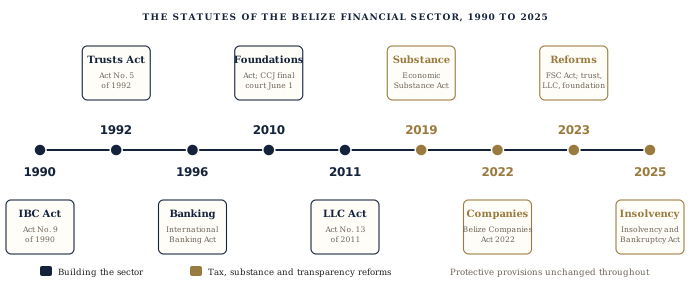
The Trusts Act 1992. The Trusts Act was enacted as Act No. 5 of 1992 and came into force on April 23, 1992. Trusts Act s. 69. It replaced the uncodified English law of trusts with a comprehensive statute that governs the creation, validity, administration, variation and termination of trusts, the powers and duties of trustees and the rights of beneficiaries, and that contains the special provisions for international trusts examined in Part II of this book. Its protective provisions in section 7 date from the original Act. The Act was a deliberate addition to the IBC regime: an IBC owned by a Belize trust could hold assets for a family under a single Belize structure, with the trust supplying succession planning and the IBC supplying a corporate vehicle for investment.
The 1990s statutes. The trust and company statutes were followed by a series of statutes that completed the sector. The International Banking Act, Act No. 11 of 1996, which came into force on July 26, 1996, provided for banks licensed to do business with non-residents. International Banking Act, Cap. 267 (rev. ed. 2020) (enactment note). Other statutes provided for international insurance, mutual funds and protected cell companies. See International Insurance Act, Cap. 269; Mutual Funds Act, Cap. 268; Protected Cell Companies Act, Cap. 271 (rev. ed. 2020). The International Financial Services Commission Act, Cap. 272, established a Commission to license and supervise trust companies, registered agents and other international service providers. The structure that resulted resembled that of other Caribbean centres: a corporate registry, a trust statute, a licensing regime for service providers and a tax exemption for business done with non-residents.
The International Foundations Act 2010. In 2010, Belize added a civil-law vehicle. The International Foundations Act, Act No. 2 of 2010, was designed, in the words of the Commission's briefing note, "to promote the international financial services industry of Belize by offering a new product to international investors, primarily for asset protection purposes." Int'l Fin. Servs. Comm'n, International Foundations Act, 2010: A Briefing Note ¶ 1 (2010). The note explains that the Act was based largely on the foundation legislation of Antigua, the Bahamas and Anguilla, with reference also to the laws of Panama and the Isle of Man, and that it applied only to non-residents of Belize. Id. ¶¶ 2–3. The note described the Act as having sixteen Parts and one hundred and thirty sections. Id. ¶ 4. The 2020 revised edition arranges it in fourteen Parts (see infra ¶ 1920.06). Part IV of this book examines it.
The International Limited Liability Companies Act 2011. In 2011, Belize enacted the International Limited Liability Companies Act, Act No. 13 of 2011, which appears in the 2020 revised edition as Chapter 270:01. The statute followed the model of the Nevis and Cook Islands LLC statutes in its protective provisions: an exclusive charging order, a rule that only judgments of the Belize court are enforceable against the LLC and its members and managers, and a bar on proceedings that seek to disregard the LLC as a separate entity. Limited Liability Companies Act ss. 34–36, 38. Like the IBC, the international LLC was confined to non-residents and exempt from Belize taxes. The 2023 amendments removed both features and renamed the statute (see infra ¶ 150.05 and ch. 14).
From exemption to transparency. The sector grew in an international climate that changed sharply after 2008. The Organisation for Economic Co-operation and Development, the European Union and the Financial Action Task Force each developed standards on tax transparency, harmful tax practices and beneficial ownership, and each published lists of jurisdictions it regarded as non-compliant. Belize was placed on, and removed from, the European Union's list of non-cooperative jurisdictions for tax purposes more than once between 2019 and 2026 (see infra ¶ 150.08). Each listing was followed by legislation. By 2023, the features on which the sector had been built, the tax exemption for business with non-residents, bearer shares, confidential company registers and the separation of the international and domestic regimes, had all been removed or replaced (see infra ¶ 150). The protective provisions of the three statutes survived the reforms unchanged.
The sector today. Belize remains an active trust and company jurisdiction, with a body of licensed trust companies and registered agents supervised by the Financial Services Commission, a single companies and corporate affairs registry under the Belize Companies Act 2022 and registers of international trusts and foundations kept by the Commission. Its market has shifted from mass incorporation of tax-exempt companies toward trust and foundation work for families, and toward structures in which the Belize trust or foundation holds entities formed in other jurisdictions. A planner advising on a Belize structure today should treat any description of Belize written before 2019 as describing a regime that no longer exists in most of its tax and transparency features.
¶ 120
The Three Statutes at a Glance
The Trusts Act. The Trusts Act, Cap. 202, governs every trust whose proper law is the law of Belize. It contains general provisions on the creation and validity of trusts, the proper law, the duration of trusts, the appointment, powers, duties and liabilities of trustees, protectors, purpose and charitable trusts, protective trusts, variation and termination, and the jurisdiction of the court. Part XA, added in 2007, contains special provisions for international trusts: the definition, formalities, compulsory registration, confidentiality of the register, tax exemptions and the requirement of a licensed trust agent. Trusts Act ss. 64–65F. The Act was amended in 2013 to require the registration of domestic trusts on a confidential register and in 2023 to impose record-keeping, information-sharing and beneficial-ownership obligations on trustees. Trusts (Amendment) Act 2023, No. 40 of 2023. Part II of this book examines it (see infra chs. 5–13).
The Limited Liability Companies Act. The Limited Liability Companies Act, Cap. 270:01, provides for an LLC formed by a registered agent's delivery of articles of organisation to the Registrar. The LLC is "a legal entity with separate rights and liabilities distinct from its members and managers," and continues perpetually unless its articles provide otherwise. Limited Liability Companies Act ss. 14(2), 16. The statute provides for an operating agreement, classes and series of interests, management by members or managers, an emergency manager and a succession committee. Id. ss. 50–69. Its protective provisions are a liability shield, a bar on actions that seek to disregard the LLC as a separate entity, a rule that a member has no interest in the LLC's property and that the property is not available to satisfy a member's debts, an exclusive charging order with exclusive jurisdiction in the Belize court and a rule that only judgments of the Belize court are enforceable against the LLC and its members and managers in matters governed by the Act. Id. ss. 33–36, 38. The International Limited Liability Companies (Amendment) Act 2023, No. 29 of 2023, renamed the statute, opened it to residents of Belize, removed the tax exemption and transferred ministerial powers to the Financial Services Commission. The Limited Liability Companies (Amendment) (No. 2) Act 2023, No. 48 of 2023, added beneficial-ownership and record-keeping provisions. Part III examines the statute (see infra chs. 14–17).
The International Foundations Act. The International Foundations Act, Cap. 24:02, provides for a foundation established by the execution of a foundation charter by a founder and the members of a foundation council, by which the founder disposes of property to the foundation for a specified purpose. On registration with the Registrar, the foundation acquires a separate legal personality. Int'l Fin. Servs. Comm'n, Briefing Note, supra, ¶ 5. It may be established for an indefinite period and for any purpose capable of fulfilment that is not unlawful, immoral or contrary to public policy, and charitable foundations are provided for. Id. Its Part III provides for disregarding foreign law concerning the validity of a foundation or of a disposition to it, subject to the court's power to declare a foundation invalid for duress, mistake, misrepresentation, unlawful purpose or conflict with Belize public policy. Id. ¶ 6. Registration is mandatory, and a foundation governed by Belize law that is not registered is invalid and unenforceable. Id. ¶ 7. The endowment is protected by a rule against alienation by way of anticipation. Id. ¶ 11. The International Foundations (Amendment) Act 2023, No. 49 of 2023, assented to and gazetted on December 13, 2023, substituted the term "foundation" for "international foundation" throughout the Act, placed its administration with the Financial Services Commission, and added register, accounting-record and beneficial-ownership obligations enforceable by fines of up to one hundred thousand dollars. International Foundations (Amendment) Act 2023, No. 49 of 2023, ss. 2–5, 10, 19. Part IV examines the statute (see infra chs. 19–22).
Table 1-1. The three statutes compared
| Feature | Trusts Act, Cap. 202 | LLC Act, Cap. 270:01 | Foundations Act, Cap. 24:02 |
|---|---|---|---|
| Original enactment | Act No. 5 of 1992 (in force Apr. 23, 1992) | Act No. 13 of 2011 | 2010 |
| Principal later amendments | Acts No. 9 of 2007, No. 16 of 2013, No. 40 of 2023 | Acts No. 29 and No. 48 of 2023 | Act No. 49 of 2023 |
| Legal personality | None; the trustee holds title | Separate legal entity (s. 14(2)) | Separate legal person on registration |
| Formed by | Instrument signed by settlor and trustees (s. 65 for international trusts) | Articles of organisation delivered by a registered agent (s. 14(1)) | Charter executed by founder and council members |
| Registration | International trusts within ninety days (ss. 65A–65B); domestic trusts (ss. 63A–63C) | With the Registrar on formation | Mandatory; unregistered foundation invalid |
| Local agent | Licensed trust agent (s. 65E) | Registered agent | Registered agent in Belize at all times |
| Principal protective provision | Non-recognition of foreign marital, succession and insolvency claims (s. 7(6)–(7)) | No veil piercing; exclusive charging order; only Belize judgments enforceable (ss. 34–36, 38) | Foreign law disregarded as to validity of foundation and dispositions; restraint on alienation |
| Belize residents | Excluded from international trusts (s. 64(1)) | Admitted since 2023 | Founder and beneficiaries non-resident under the 2010 definition |
| Book chapters | 5–13 | 14–17 | 19–22 |
Common features. The three statutes share four features. First, each depends on registration: an international trust that is not registered loses the protection of section 7 and is invalid and unenforceable, an unregistered foundation is invalid and unenforceable, and an LLC exists only from its registration. Trusts Act s. 65B(7). Second, each requires a Belize agent licensed by the Commission, so that every Belize vehicle has a regulated person in Belize who knows its beneficial owners and keeps its records. Third, each confines the public information on its register to a minimum, while the 2023 amendments give the Commission, the Financial Intelligence Unit and the court access to the full records and require beneficial-ownership information to be kept current. Fourth, each contains provisions directing the Belize court to apply Belize law to the vehicle and to disregard foreign law and foreign judgments in defined cases. The planner who understands one statute will find the structure of the others familiar.
Differences that matter. The differences among the statutes are as important as the similarities. A trust is a relationship: the trustee holds legal title to the trust property, and the beneficiaries have equitable rights enforceable against the trustee. A foundation and an LLC are legal persons that own their property, and the founder, beneficiaries and members hold no proprietary interest in it. The trust's protection in section 7(6) is framed by categories of claim; the LLC's protection is framed around the member's interest and the remedies of a member's creditor; the foundation's protection is framed around the validity of the foundation and of dispositions to it. A claim that falls outside section 7(6), because it does not depend on marriage, succession or insolvency, may fall within the foundation's provisions, and the reverse is also possible. The choice of vehicle therefore depends on the claims the client is most concerned to meet, on the client's legal tradition and on the tax classification of the vehicle in the client's home country (see infra ch. 22).
Combined structures. The statutes are often used together. A Belize trust may hold the membership interest in a Belize LLC, or a foundation may hold the shares of a Belize company that acts as trustee of the family's trusts. Many structures also combine a Belize trust or foundation with an entity formed elsewhere, such as an LLC in Nevis or the Cook Islands, so that the family's assets sit behind a second statute and outside both Belize and the client's home country. Combined structures are examined in chapter 27.

¶ 130
Belize Among the Leading Trust Jurisdictions
The comparison set. Practitioners who advise on protective trusts usually compare Belize with the Cook Islands and Nevis, the two other Commonwealth jurisdictions whose trust statutes were written to protect trust property against foreign claims. Each of the three has an English common-law system, a statute that addresses foreign judgments and foreign law expressly, a registration requirement for international trusts and a licensing regime for trustees. Each is also commonly paired with an LLC statute that provides an exclusive charging order. The companion volumes in this series examine the Cook Islands and Nevis in the same structure as this book, and the comparison in this paragraph is confined to the points that bear on the choice among them.
Two designs. The Cook Islands and Nevis statutes recognize that a foreign creditor may have a fraudulent-transfer claim against a trust, and then confine the claim. They do so with a code: the creditor must prove the settlor's intent to defraud beyond reasonable doubt, must bring the claim within short limitation periods measured from the transfer or the cause of action, and, in Nevis, must post a bond before suing. Belize takes a different course. Section 7(6) of the Trusts Act directs the Belize court not to recognize, under foreign law or a foreign order, a claim against the property of a Belize trust that relates to marriage, succession or the claims of creditors in an insolvency. Where the foreign claim falls within those categories, Belize does not confine it; the Belize court declines to recognize it. Belize therefore has no fraudulent-disposition code, no special limitation period for creditors and no heightened standard of proof. Commentators from competing jurisdictions often present the absence of a code as a weakness. It is the consequence of a broader bar (see infra ¶ 160 and ch. 11).
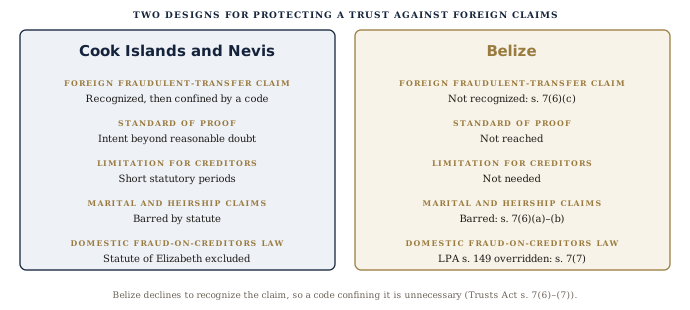
The domestic fraud-on-creditors statute. Each of the three jurisdictions inherited a version of the Statute of Elizabeth, the English statute of 1571 under which a conveyance made to delay, hinder or defraud creditors was void against them. The Cook Islands and Nevis statutes exclude the Statute of Elizabeth in favour of their own codes. Belize retains its descendant, section 149 of the Law of Property Act, for domestic purposes, and section 7(7) of the Trusts Act provides that section 7(6) has effect notwithstanding section 149, section 43 of the Bankruptcy Act and the Reciprocal Enforcement of Judgments Act. Trusts Act s. 7(7). The express override of section 149 is significant for the reading of section 7(6)(c), because section 149 is the provision on which a creditor would rely to set aside a transfer made to defeat it (see infra ¶ 160.05).
Courts and record. The three jurisdictions differ in their courts. Appeals from the Cook Islands and Nevis lie ultimately to the Judicial Committee of the Privy Council in London. Since June 1, 2010, the final court of appeal for Belize has been the Caribbean Court of Justice (see infra ¶ 140.03). The Cook Islands has the longest published record of decisions applying its trust statute, and Nevis a substantial one. Belize's record is thinner and is known in large part from American decisions describing proceedings in Belize (see infra ch. 26). No reported decision of the Caribbean Court of Justice has considered section 7 of the Trusts Act. For clients who place weight on a long local record and on the Privy Council, these differences favour the other two jurisdictions. For clients who place weight on the form of the statutory protection, Belize's categorical bar is a strong one.
International standing and banking. The three jurisdictions also differ in their international standing. Belize has been listed by the European Union as a non-cooperative jurisdiction for tax purposes more than once since 2019, and was removed from the last of those lists on October 9, 2026 (see infra ¶ 150.08). Listings affect the willingness of banks and counterparties to accept a Belize structure, and the effect may persist after a listing ends. The planner should confirm with the client's intended bank, at the outset of each engagement, that it will open accounts for a Belize trust, LLC or foundation. In practice, many Belize structures hold their assets through entities and accounts in other jurisdictions, so that a bank's view of Belize affects the trust's account opening more than the day-to-day administration of the assets.
Foundations and LLCs. The comparison is not confined to trusts. Each of the three jurisdictions has an LLC statute with an exclusive charging order, and each has a foundation statute. The Belize LLC statute, as amended in 2023, now treats an LLC as subject to Belize tax laws, with a rule under which the LLC is generally treated as a disregarded entity for income and business tax unless it elects to be taxed as a company (see infra ch. 28). The Nevis statute limits a charging order to three years and provides by statute that an LLC may pay members' income taxes directly to the taxing authority without making a distribution, features the Belize statute does not contain (see infra ch. 17). The choice of LLC jurisdiction beneath a Belize trust is examined in chapters 18 and 27.
Belize stated fairly. A fair statement of Belize's position is as follows. Its trust statute declines to recognize the foreign claims that matter most to families: those of a divorcing spouse, a disappointed heir and a creditor whose claim rests on the settlor's failure to pay, whether or not a bankruptcy has been filed. Its LLC and foundation statutes add protective provisions of their own. Its weaknesses lie in the thinness of its reported case law, an untested final court and a listing history that affects banking. None of these weaknesses lies in the text of its statutes.
¶ 140
The Courts and the Regulator in Brief
The court of first instance. Civil proceedings concerning trusts, LLCs and foundations are heard in the Supreme Court of Belize, styled the High Court in recent judgments. The Trusts Act confers on it jurisdiction over Belize trusts and broad powers to give directions to trustees, to appoint and remove trustees and to make orders concerning the administration of a trust. Trusts Act ss. 57–59. The LLC Act gives it exclusive jurisdiction over claims by a creditor against a member's interest and over applications for charging orders. Limited Liability Companies Act s. 36(1). The Foundations Act gives it jurisdiction over foundations, with powers in relation to their administration, enforcement of judgments, priority of claims and limitation of proceedings, and directs that proceedings concerning a foundation be held in camera unless the court orders otherwise. Int'l Fin. Servs. Comm'n, Briefing Note, supra, ¶¶ 14–15. Chapter 2 examines the court's organization and chapter 25 its procedure.
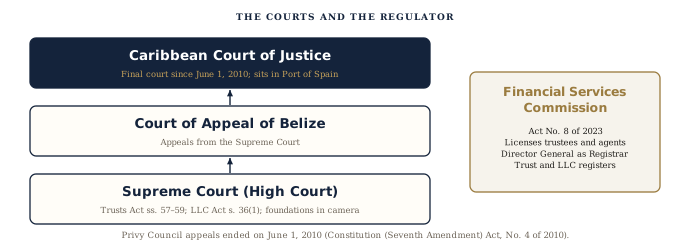
The Court of Appeal. Appeals from the Supreme Court lie to the Court of Appeal of Belize. Its judgments, like those of the Supreme Court, are published by the Belize judiciary, although publication of older decisions is incomplete. The Court of Appeal's decisions on the Trusts Act are few, and none of those identified for this book applies section 7(6) to a foreign creditor (see infra ch. 26).
The Caribbean Court of Justice. Since June 1, 2010, the final court of appeal for Belize has been the Caribbean Court of Justice, which replaced the Judicial Committee of the Privy Council. Belize Constitution (Seventh Amendment) Act, No. 4 of 2010; Caribbean Court of Justice Act, No. 5 of 2010. The Court sits in Port of Spain, Trinidad and Tobago, and exercises an appellate jurisdiction for the states that have accepted it and an original jurisdiction under the Revised Treaty of Chaguaramas. Its judges are drawn from across the Caribbean and the wider Commonwealth. It has decided several significant Belize appeals, including appeals concerning the relationship between the executive, the legislature and private parties, but it has not yet decided a case concerning a Belize international trust, LLC or foundation. Its approach to section 7(6) of the Trusts Act is therefore unknown, and planners should not assume that it will follow any particular line of English or Privy Council authority on a question the Belize statute answers in its own terms.
The Financial Services Commission. Trust companies, registered agents and other financial service providers are licensed and supervised by the Financial Services Commission. The Financial Services Commission Act, No. 8 of 2023, assented to and gazetted on April 15, 2023, repealed and replaced the International Financial Services Commission Act, Cap. 272, "to strengthen the regulatory and supervisory framework for financial services." Financial Services Commission Act, No. 8 of 2023, long title. The Act establishes the Commission as an institution, provides for its functions and duties, its committees, its funds and an appeal panel, and lists in its Schedule the financial services that require a licence, including registered-agent services, nominee director and shareholder services and "international asset protection and management." Id. ss. 3, 15, 19, 56 & sched. Its definition of a registered agent includes a person who forms or registers an LLC and a person appointed as the registered representative of a private trust company established under the Belize Companies Act. Id. s. 2. The Act was amended by Act No. 47 of 2023. Chapter 3 examines the Commission and the licensing regime.
Registrars. The Commission's Director General is the Registrar for international trusts and for LLCs, and the Belize Companies and Corporate Affairs Registry, established under section 284 of the Belize Companies Act 2022, holds the register of companies and the Online Business Registry System into which beneficial-ownership information is entered. International Foundations (Amendment) Act 2023, ss. 4, 10 (definitions of "Director General" and "Registry"; new s. 84B(2)). The registers of international trusts and foundations are not open to public inspection beyond minimal particulars, and the registrars may disclose information to regulatory and law-enforcement authorities in the circumstances the statutes define (see infra ch. 29).
Belize counsel. Belize has an independent legal profession, and the opinion of Belize counsel is essential to any structure of significance. The planner should obtain Belize counsel's written opinion on the registration and validity of the trust, LLC or foundation, on the application of the protective provisions to the claims the client is most concerned about and on the vehicle's tax position in Belize. The opinion should be kept in the client's file, so that it can be produced in any later proceeding to show the basis on which the structure was established.
¶ 150
The Reform Cycle, 2017 to 2025
The pressures. Between 2017 and 2025, Belize rebuilt the tax and transparency features of its financial-services law. The reforms responded to three sets of international standards: the European Union's criteria for its list of non-cooperative jurisdictions for tax purposes, which address tax transparency, fair taxation and the implementation of minimum standards on base erosion and profit shifting; the standards of the OECD Global Forum on Transparency and Exchange of Information for Tax Purposes; and the Recommendations of the Financial Action Task Force, assessed for Belize by the Caribbean Financial Action Task Force. Each body reviewed Belize during the period, and each review produced legislation. The reforms came in four waves: the company reforms of 2017 and 2018, the tax and substance reforms of 2019, the new company statute of 2022 and the beneficial-ownership and regulatory reforms of 2023. The Insolvency and Bankruptcy Act 2025 followed.
The company reforms of 2017 and 2018. The International Business Companies (Amendment) Act 2017, Act No. 36 of 2017, abolished bearer shares and required IBCs to keep registers of directors and beneficial owners. Further amendments followed in 2018. Act No. 24 of 2018. The reforms ended the anonymity that had made the IBC attractive to some users and had drawn the attention of international bodies.
The tax and substance reforms of 2019. In 2019, in response to the European Union's listing process, Belize enacted the Economic Substance Act 2019 and repealed the tax exemption of the IBC regime, with grandfathering until June 30, 2021, for companies incorporated by October 16, 2017. Act No. 15 of 2019; Act No. 17 of 2019. The Economic Substance Act requires a Belize company or LLC that carries on a relevant activity (banking, insurance, fund management, financing and leasing, headquarters, distribution and service centre, or shipping business, or holding-company business in relation to those activities) to have adequate substance in Belize in relation to that activity, and to report annually (see infra ch. 28). The repeal of the exemption ended the separation between the international and domestic tax regimes on which the IBC had been built.
The Belize Companies Act 2022. The Belize Companies Act 2022, Act No. 11 of 2022, repealed and replaced both the International Business Companies Act and the domestic Companies Act, creating a single statute for all Belize companies. Its first provisions came into force on July 28, 2022, under a commencement order made by the Prime Minister as Minister responsible for finance. Belize Companies Act 2022 (Commencement) Order 2022, S.I. No. 116 of 2022 (gazetted July 30, 2022). The repeal of the IBC Act and the Companies Act was deferred by that order and took effect later in 2022, and existing companies were required to re-register under the new Act within twelve months. See id. art. 2. The Act established the Belize Companies and Corporate Affairs Registry and an online registry system, provides for private trust companies and segregated portfolio companies, and requires every company to keep a register of beneficial owners and to file the information with the registry (see infra ch. 18).
The 2023 amendments. In 2023, Belize amended each of its trust, LLC and foundation statutes and replaced its regulatory statute. The amendments are listed in Table 1-2. Their common purpose, stated in the long titles of the LLC and foundation amendments of December 2023, was to facilitate compliance with Recommendation 24 of the Financial Action Task Force on the transparency and beneficial ownership of legal persons. They imposed obligations to keep accurate, adequate and up-to-date beneficial-ownership information, to file it with the registrar, to produce records within short periods on request and to keep them for at least six years after a vehicle is struck off or dissolved. They also introduced administrative fines enforceable by the Commission.
Table 1-2. The 2023 amendments
| Act | Assent | Principal effect |
|---|---|---|
| Financial Services Commission Act, No. 8 of 2023 | Apr. 15, 2023 | Repealed and replaced the IFSC Act, Cap. 272; Commission's licensing and supervisory powers restated |
| International Limited Liability Companies (Amendment) Act, No. 29 of 2023 | July 21, 2023 | Renamed the statute the Limited Liability Companies Act; residents admitted; s. 15 repealed; tax exemption replaced by taxation with disregarded-entity default; administrative fines |
| Trusts (Amendment) Act, No. 40 of 2023 | Sept. 5, 2023 | Trustee records and information duties; disclosure of trustee status (s. 30A); annual beneficial-ownership attestation (s. 30B); new definition of international trust (s. 64(1)); general offence (s. 68A) |
| Financial Services Commission (Amendment) Act, No. 47 of 2023 | Dec. 13, 2023 | Capital-maintenance currency; new s. 23A |
| Limited Liability Companies (Amendment) (No. 2) Act, No. 48 of 2023 | Dec. 13, 2023 | Beneficial-ownership and record-keeping provisions (ss. 2A, 2B, 18A, 30A–30C, 96A, 97A) |
| International Foundations (Amendment) Act, No. 49 of 2023 | Dec. 13, 2023 | "Foundation" substituted for "international foundation"; Commission administers Act; register particulars; beneficial-ownership register; fines up to $100,000 |
What the reforms did not change. The reforms did not amend section 7 of the Trusts Act, the protective provisions of the LLC Act in sections 33 to 38, or the provisions of Part III of the Foundations Act disregarding foreign law. The 2023 amendment to the Trusts Act left section 65D, which exempts a registered international trust from income and business tax, estate and gift taxes and stamp duty, unchanged. Trusts Act s. 65D(1). The protective design of the three statutes therefore survived intact. What changed was the setting in which they operate: Belize structures are now transparent to Belize regulators and, through information exchange, to the tax authorities of other countries, and the protective provisions apply to vehicles whose beneficial owners are known to the Belize authorities. That combination, protection against private claims with transparency toward public authorities, is the model toward which all the leading trust jurisdictions have moved.
The Insolvency and Bankruptcy Act 2025. The Insolvency and Bankruptcy Act 2025, Act No. 13 of 2025, repeals and replaces the Bankruptcy Act, Cap. 244, and is being brought into force in phases. Its preliminary, netting and miscellaneous Parts commenced in September 2025. Under the Commission's revised schedule, its bankruptcy Part (Part XIII) is to commence in January 2027 and its voidable-transaction Parts (Parts VII and XV) in June 2027. Fin. Servs. Comm'n, Press Release (Sept. 17, 2025); Fin. Servs. Comm'n, Public Notice FSC/CPR/001-17 (Apr. 24, 2026). The 2025 Act does not amend section 7(7) of the Trusts Act, which still refers to section 43 of the Bankruptcy Act, and its repeal and savings provision preserves existing orders, pending proceedings and accrued rights under the repealed Act without addressing references to it in other enactments. Insolvency and Bankruptcy Act, No. 13 of 2025, ss. 518–519 (Belize). The interaction between the 2025 Act and the three protective statutes is examined in chapter 24.
The listings. Belize's standing with international bodies changed several times during the reform cycle. The European Union added Belize to Annex I of its list of non-cooperative jurisdictions for tax purposes in March 2019 and moved it to Annex II, the list of jurisdictions that have made commitments to reform, in November 2019. Belize returned to Annex I in October 2023, after the Global Forum rated it partially compliant with the standard on exchange of information on request, and was removed from Annex I in February 2024. It was removed from Annex II on October 9, 2026, after a supplementary Global Forum review, published in April 2026, rated it largely compliant. The fourth-round mutual evaluation of Belize by the Caribbean Financial Action Task Force was adopted in December 2024 and published in January 2025. Belize signed the Multilateral Competent Authority Agreement for the Common Reporting Standard on October 29, 2015. The United States Treasury lists no FATCA intergovernmental agreement with Belize. Chapter 29 examines these standards and their effect on Belize structures.
¶ 160
Section 7 and the Meaning of Insolvency: A Preview
The text. The protective core of the Trusts Act is section 7(6), which provides:
Trusts Act s. 7(6). Section 7(7) provides that subsection (6) has effect notwithstanding section 149 of the Law of Property Act, section 43 of the Bankruptcy Act and the Reciprocal Enforcement of Judgments Act. Id. s. 7(7). Chapter 11 examines section 7 in full, and chapter 23 examines paragraph (c). This paragraph previews the reading of paragraph (c) on which the rest of the book proceeds.
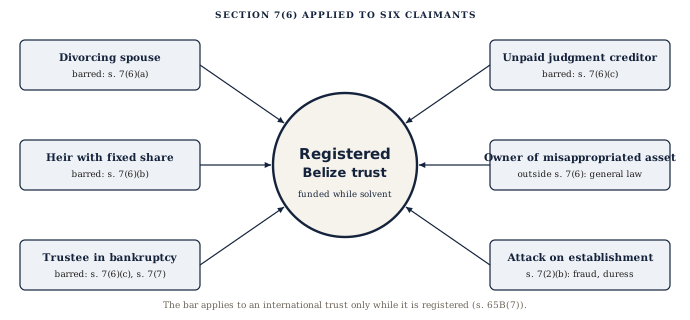
Three categories of claim. Section 7(6) operates on three categories of claim, each brought under foreign law or a foreign order. The first is the marital claim: a spouse's or former spouse's claim under the matrimonial or community-property law of another jurisdiction or under a foreign divorce decree. The second is the succession claim: an heir's claim under foreign forced-heirship rules, including the fixed shares of spouses and relatives. The third is the claim of creditors in an insolvency. For each category, the Belize court may not vary or set aside the trust, and may not recognize the validity of the claim against the trust property. The provision applies to any trust created under the law of Belize, and in the case of an international trust only while the trust is registered. Trusts Act s. 65B(7).
Insolvency and bankruptcy distinguished. Much published commentary, usually written by practitioners in competing jurisdictions, treats "insolvency" in paragraph (c) as if it meant bankruptcy, and concludes that the paragraph protects a Belize trust only against a trustee in bankruptcy or creditors acting collectively in a formal proceeding. The reading confuses two distinct concepts. Bankruptcy is a legal proceeding: a petition, a court, a trustee, a discharge. Insolvency is a financial condition. A debtor is insolvent on either of two tests used throughout the common-law world: the balance-sheet test, under which the debtor's liabilities exceed the debtor's assets, and the cash-flow test, under which the debtor is not paying debts as they fall due. The tests are alternatives. A debtor with a very high net worth who is not paying a creditor is insolvent on the cash-flow test, whatever the balance sheet shows, and whether or not anyone has filed a petition. American law uses the same two tests: the Uniform Voidable Transactions Act defines insolvency by the balance sheet and presumes it where the debtor is generally not paying debts as they become due. Unif. Voidable Transactions Act § 2(a)–(b) (2014). Belize's own Insolvency and Bankruptcy Act 2025 confirms that insolvency is a condition distinct from any proceeding. A company is insolvent if it fails to comply with a statutory demand, if execution on a judgment of the High Court in favour of a creditor is returned wholly or partly unsatisfied, or if the value of its liabilities exceeds its assets or it is unable to pay its debts as they fall due; an individual is insolvent if he fails to comply with a statutory demand or if execution on a judgment of the High Court in favour of a creditor is returned wholly or partly unsatisfied. Insolvency and Bankruptcy Act, No. 13 of 2025, s. 8(1)–(2) (Belize). On that definition, an individual against whom execution on a Belize judgment is returned unsatisfied is insolvent, whatever the individual's net worth and whether or not a bankruptcy order has been sought (see infra ch. 24).
Fraudulent-transfer claims are insolvency claims. A fraudulent-transfer claim is inherently the claim of a creditor in an insolvency. The constructive-fraud claims of the Uniform Voidable Transactions Act require that the debtor was insolvent, was left with unreasonably small assets or was unable to pay debts as they came due. Id. §§ 4(a)(2), 5(a). The actual-intent claim exists to reach property a debtor has placed beyond a creditor who is not being paid; a creditor whose debtor pays has no need to pursue the transferee. A creditor who comes to Belize seeking to reach trust property on the ground that the settlor's transfer defeated its claim is, by the nature of that claim, asserting that the settlor will not or cannot pay it. That creditor is a creditor in an insolvency within section 7(6)(c), and the Belize court will not recognize its claim under foreign law or a foreign order.
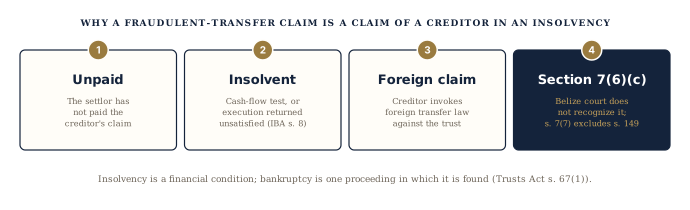
The statutory context. Two features of the Trusts Act confirm the reading. First, section 7(7) provides that section 7(6) has effect notwithstanding section 149 of the Law of Property Act, Belize's own fraud-on-creditors provision, which makes every transfer of property made with intent to defraud creditors "voidable, at the instance of any person thereby prejudiced." Law of Property Act, Cap. 190, s. 149(1). The reference would serve no purpose if paragraph (c) were confined to formal bankruptcy proceedings. The legislature named the fraudulent-conveyance statute because it understood paragraph (c) to reach fraudulent-conveyance claims. Section 7(7) names the Bankruptcy Act separately, which shows that bankruptcy is one instance of the insolvency the paragraph covers. Second, the Act's definition provides that "insolvency" "includes" the making of an administration order, the appointment of a receiver and the bankruptcy of any person. Trusts Act s. 67(1). The definition is inclusive: it names bankruptcy as one instance of insolvency without confining the term to it.
An American court's reading. An American bankruptcy court that considered section 7(6) read it the same way, describing Belize trusts as "immune from attack from creditors even when created by fraudulent transfers." Higashi v. Brown (In re Brown), 4 A.B.R. 279, 282, 1996 WL 33657614 (Bankr. D. Alaska Mar. 11, 1996). The court applied Alaska law to the trust in that case, because the settlor, the creditor and the assets were all in Alaska and the Belize trustee never held or controlled the assets, but its description of the Belize statute matches the reading set out here. The case is examined in chapter 26.
Consequences. Read correctly, section 7(6) bars, under foreign law and foreign orders, the claims of a divorcing spouse, an heir with a forced share and every creditor whose claim against the trust rests on the settlor's failure to pay, whether that creditor is a trustee in bankruptcy or an individual holding a judgment. The ordinary judgment creditor, whether a tort plaintiff, a lender on a guaranty or a former business partner, who seeks to reach the property of a registered Belize trust because the settlor has not paid, faces the same bar as a trustee in bankruptcy. Belize is therefore strong against ordinary judgment creditors, and any description of it as weak against them rests on the misreading described in ¶ 160.03.
The limits of section 7(6). Section 7(6) is broad within its terms, and its terms cover most of the claims a settlor is likely to face. It has limits. A claim against trust property that does not rest on the settlor's failure to pay, such as a claim that the trustee holds a particular asset on a constructive trust for a defrauded owner, falls outside the three categories and is decided under the general law of Belize. Section 7(2)(b) permits the court to declare a trust invalid to the extent it was established by duress, fraud, mistake, undue influence or misrepresentation, or is immoral or contrary to public policy. Id. s. 7(2)(b). And section 7 applies to an international trust only if it is registered. Id. s. 65B(7). Each limit is examined in Part II and Part V of this book.
Analogues in the LLC and Foundations Acts. The LLC Act and the Foundations Act protect their vehicles by different provisions. The LLC Act bars any action that "seeks or purports to disregard a limited liability company as a valid, separate and distinct legal entity," provides that the LLC's property "shall not be available to satisfy any claim or judgment against a member," makes the charging order the sole and exclusive remedy of a member's judgment creditor and makes only judgments of the Belize court enforceable against the LLC and its members and managers. Limited Liability Companies Act ss. 34(1), 35, 36(3), 38. The Foundations Act provides for disregarding foreign law concerning the validity of a foundation or a disposition to it, restricts alienation of the endowment and shortens the period within which actions concerning a foundation may be brought. The three statutes reach a similar result by different means, and Part V of this book examines how they operate together.

¶ 170
Who Uses Belize Structures, and Why
Four groups of clients. Belize structures are used by four broad groups of clients. The first is the American or other common-law client who seeks to protect accumulated wealth against future claims: the professional, the business owner or the investor with substantial liquid assets beyond present needs and a realistic risk of large claims in the future. The second is the family from a civil-law country, often in Latin America or Europe, whose principal concern is succession: forced-heirship rules, the claims of spouses under community-property regimes and the orderly transfer of a family business. The third is the Central American or Caribbean family that values a trustee or registered agent nearby, in the same time zone and with staff who work in English and Spanish. The fourth is the business or investment structure that uses a Belize LLC or company as a holding vehicle, whether alone or beneath a trust or foundation formed in Belize or elsewhere.
The American client. For the American client, a Belize international trust offers the categorical bar of section 7(6). The trust is suitable for the same profile as a Cook Islands or Nevis trust: a solvent client, with assets substantially in excess of present needs, who funds the trust before any claim arises and who will hold no powers over it. The client must accept that the trust is a foreign grantor trust for American tax purposes, with the reporting that entails, and that an American court may apply its own law to the trust and may order the client to repatriate assets, with contempt as the sanction for a refusal the court does not accept (see infra chs. 26 and 30). The protection of the assets abroad and the exposure of the settlor at home are separate questions, and the planner must explain both.
The civil-law family. For a family from a civil-law country, the foundation may be the more familiar vehicle, and the Foundations Act was designed for that market. Int'l Fin. Servs. Comm'n, Briefing Note, supra, ¶¶ 1–2. A foundation owns its assets as a legal person, its council answers to the foundation and the founder may hold defined rights under the charter and by-laws. For succession purposes, section 7(6)(b) of the Trusts Act and the non-recognition provisions of the Foundations Act protect the vehicle against claims under foreign forced-heirship rules. The planner must consider how the family's home country will treat the vehicle for tax and succession purposes, and whether its courts will recognize the transfer to it. Those questions are governed by the home country's law, and Belize counsel's opinion does not answer them.
The business owner. A Belize LLC offers a holding vehicle with an exclusive charging order and a statutory bar on veil piercing. Since 2023 it may be owned by residents of Belize and may carry on business in Belize. It is subject to Belize tax law with a default rule under which it is treated as a disregarded entity for income and business tax unless it elects to be taxed as a company. Limited Liability Companies Act s. 94 (as replaced by No. 29 of 2023, s. 13). For the American owner, the Belize LLC is an eligible entity for federal tax classification, and the Belize public limited company is the only Belize entity on the Treasury's list of per se corporations. Treas. Reg. § 301.7701-2(b)(8)(i). The LLC's place beneath a trust or foundation is examined in chapters 18 and 27.
The record in practice. The reported cases show how Belize structures operate under pressure. They come largely from American courts and show a consistent pattern: the American court applies its own law to the trust and acts against the settlor personally, while the Belize trustee, if it holds the assets outside the United States, declines to act on foreign orders and seeks the directions of the Belize court. The most instructive case is a Florida bankruptcy decision concerning a trust that had migrated to Belize.
Divorce. The same pattern appears in divorce litigation. In an Illinois case, a husband ordered to transfer 120,000 shares of stock to his former wife was held in indirect civil contempt after the trustees of his Belize trust refused to transfer the shares, citing the trust's terms and a 2018 order of the Belize court and treating the request as made under duress. The appellate court affirmed the contempt order and a body attachment. In re Marriage of Harnack & Fanady, 2022 IL App (1st) 210143, 216 N.E.3d 261, 269–71, 281. In 2025 it affirmed the denial of his motion to vacate his commitment. In re Marriage of Harnack & Fanady, 2025 IL App (1st) 240835, ¶¶ 1–2. The trust held, and the settlor bore the consequences at home. The case shows why a Belize trust should be established before a marriage, or in contemplation of it with full disclosure, and why it is not a substitute for a premarital agreement (see infra chs. 11 and 26).
Who should not use Belize. Belize is unsuitable for a client who is already facing claims and hopes that section 7(6) will protect a late transfer. The Belize assets may be protected, but the American court will reach the client personally, and a trust established in the face of a known claim invites an attack under section 7(2)(b) on the ground that it was established by fraud. Belize is also unsuitable for a client whose bank will not accept a Belize structure, for a client who places decisive weight on an appeal to the Privy Council or on a long record of local decisions, and for a client who will not accept the reporting and compliance obligations that now apply to every Belize vehicle. A client who wishes to keep control of the assets is unsuitable for any protective trust.
¶ 180
Sources, Citation and Method
The Revised Edition. The statutes of Belize are consolidated in the Substantive Laws of Belize, Revised Edition 2020, prepared by the Law Revision Commissioner under the Law Revision Act, Cap. 3, and showing the law as at December 31, 2020. Each chapter of the Revised Edition carries a note listing the Acts consolidated in it and, in the margin, the Acts from which each section derives. The Revised Edition is the starting point for every statute examined in this book. Statutes enacted after 2020 are cited to the Act as enacted and gazetted, and amendments to a chapter of the Revised Edition are cited to the amending Act. Where a chapter of this book relies on an amendment, it states which sections the amendment changed, so that the reader can reconstruct the current text.
Where the texts are found. The Financial Services Commission publishes the Revised Edition texts of the financial-services statutes and the amending Acts, together with its own notices, guidelines and briefing notes. The Attorney General's Ministry publishes Acts and an index of the Laws of Belize, the National Assembly publishes bills and enacted Acts, and the Belize judiciary publishes judgments of the Supreme Court and the Court of Appeal and older revised editions. The Caribbean Court of Justice publishes its judgments and media releases. The book cites the official text wherever it has been located. Where it relies on a secondary description of a provision, it says so.
A caution about commentary. Commentary on Belize published by practitioners and promoters is uneven. Some of it attributes to the Trusts Act provisions it does not contain, such as a two-year limitation period, a requirement that fraud be proved beyond reasonable doubt or a general immunity from bankruptcy. Some of it understates the Act, reading "insolvency" as "bankruptcy" (see supra ¶ 160.03). Some of it describes the IBC regime as if it still existed. The planner should rely on the current statute, on the official notices of the Commission and on the written opinion of Belize counsel, and should treat commentary as a guide to questions to ask.
Case law. Belize judgments are cited by the name of the parties, the claim or action number, the court and the date, with the paragraph number where the judgment is paragraphed: for example, McLiberty v. Corozal Free Zone Dev., Action No. 302 of 1999, ¶ 2 (Sup. Ct. Belize Mar. 17, 2000). Judgments of the Caribbean Court of Justice are cited by their neutral citation, for example [2013] CCJ 5 (AJ), with the appeal number and date. English and Commonwealth decisions are cited in the form used in their home jurisdiction. American decisions are cited in Bluebook form. Many Belize trust matters are heard in chambers or in camera and are not reported, so the record of decisions understates the volume of litigation, and what is known of some Belize proceedings comes from foreign judgments that describe them.
Citation forms used in this book. The three principal statutes are cited as "Trusts Act," "Limited Liability Companies Act" (or "LLC Act") and "Foundations Act," with the section number, without repeating the chapter number after the first citation in each chapter. Other Belize statutes are cited by short title, chapter or Act number and year. Paragraphs of this book are cited by the ¶ symbol, for example ¶ 160.05, and cross-references use see supra and see infra with the paragraph or chapter number. The companion volumes in this series are cited by title.
Currency and the date of the law. Amounts stated in Belize statutes are in Belize dollars unless the statute provides otherwise; the 2023 amendment to the LLC Act redefined "dollar" to mean the Belize dollar for that statute. Limited Liability Companies Act s. 2 (as amended by No. 29 of 2023, s. 4(c)). The Belize dollar has been fixed at two to one United States dollar for several decades, but the book states amounts as the statutes state them. The law is stated as of November 2026. Belize amends its financial-services statutes frequently, and the planner should check for amendments, commencement orders and Commission notices issued after that date.
Method. Each chapter of this book is organized in the same way: an overview at ¶ X01, then sections numbered ¶ X10, ¶ X20 and onward, divided into numbered paragraphs. Statutory provisions are quoted where their words matter. Decisions are examined in case discussions setting out the facts, the proceedings, the holding and the lessons for the planner. Examples apply the law to facts drawn from practice, and Planning Notes and Comments state practical conclusions. Where Belize law has not decided a question, the book says so, sets out the arguments and states the better view.

¶ 190
How This Book Is Organised
The seven Parts. The book has thirty chapters in six Parts, followed by a seventh Part of forms and reference material. Its structure is shared with the companion volumes on Nevis and the Cook Islands, so that a reader comparing the jurisdictions can find the corresponding treatment in each: the legal system and regulator first, then trusts, LLCs and foundations, then creditor protection and litigation, then tax, reporting and anti-money-laundering law, and finally forms.
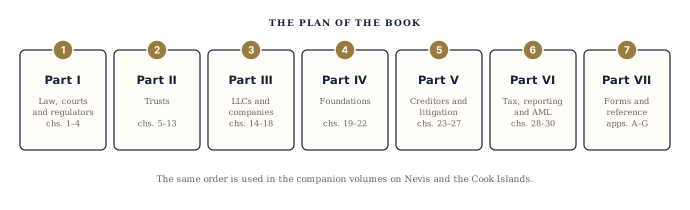
Part I: Belize Law, Courts and Regulators. Part I sets out the framework within which the three statutes operate. This chapter introduces the jurisdiction. Chapter 2 examines the legal system: the Constitution, the reception of English law, the Supreme Court, the Court of Appeal and the Caribbean Court of Justice. Chapter 3 examines the Financial Services Commission and the licensing of trust and company service providers. Chapter 4 examines the conflict of laws and the recognition of foreign judgments in Belize, including the Reciprocal Enforcement of Judgments Act and the common-law action on a foreign judgment, and their interaction with the non-recognition provisions examined in chapters 11, 17 and 21.
Part II: Trusts. Part II examines the Trusts Act in nine chapters. Chapter 5 describes its structure, history and amendments. Chapter 6 examines the creation of a Belize trust, the distinction between domestic and international trusts and registration. Chapter 7 examines trustees, chapter 8 beneficiaries, discretionary interests and protective trusts, and chapter 9 protectors, reserved powers and letters of wishes. Chapter 10 examines purpose and charitable trusts. Chapter 11 examines section 7 in full. Chapter 12 examines variation, migration, duration and termination, and chapter 13 private trust companies and trust administration.
Part III: Limited Liability Companies. Part III examines the LLC Act in four chapters and the Belize company in a fifth. Chapter 14 traces the statute's history and the 2023 reforms. Chapter 15 examines formation, the operating agreement, management and series. Chapter 16 examines the liability shield, the bar on veil piercing and the member's interest. Chapter 17 examines charging orders and the remedies of a member's creditors. Chapter 18 examines the Belize Companies Act 2022 and the use of Belize companies in holding structures.
Part IV: Foundations. Part IV examines the Foundations Act in four chapters. Chapter 19 examines the nature and formation of a foundation, chapter 20 its founders, councils, protectors and beneficiaries, and chapter 21 its endowment, the non-recognition provisions and creditor protection. Chapter 22 compares the foundation with the trust and the LLC and examines continuation into and out of Belize.
Part V: Creditor Protection and Litigation. Part V examines the protective provisions of the three statutes in operation. Chapter 23 examines fraudulent-transfer claims and the meaning of "insolvency" in section 7(6)(c). Chapter 24 examines the Insolvency and Bankruptcy Act 2025 and its interaction with Belize structures. Chapter 25 examines litigation in Belize: procedure, freezing and anti-suit injunctions, directions applications and costs. Chapter 26 examines Belize structures in foreign courts, including the American decisions on turnover, repatriation and contempt. Chapter 27 brings the analysis together in the design of structures combining Belize trusts, LLCs and foundations.
Part VI: Tax, Reporting and AML. Part VI examines the obligations that now accompany every Belize vehicle. Chapter 28 examines Belize taxation, the end of the offshore exemptions and the Economic Substance Act 2019. Chapter 29 examines beneficial ownership, anti-money-laundering and counter-terrorist-financing law and the international standards that shaped them. Chapter 30 examines the American tax and reporting rules that apply to Belize trusts, LLCs and foundations with American settlors, members, founders or beneficiaries.
Part VII: Forms and Reference. Part VII contains seven appendices: selected statutory provisions (Appendix A); a model Belize international trust deed (Appendix B); a model LLC operating agreement (Appendix C); a model foundation charter and by-laws (Appendix D); forms of registration, resolutions, protector instruments and court applications (Appendix E); checklists and a filing calendar (Appendix F); and a glossary (Appendix G). A Table of Cases, a Table of Statutes and Regulations and an Index follow.
How to use the book. A reader with a particular question should begin with the chapter that treats the vehicle concerned and then follow the cross-references to Part V for the protective provisions and to Part VI for tax and reporting. A reader comparing Belize with Nevis or the Cook Islands should use the corresponding chapters of the companion volumes, which follow the same order. A reader designing a structure should begin with chapter 27, which draws on the rest of the book, and should use the checklists in Appendix F.