

¶ 901
Overview
Scope of the chapter. A trustee who does not perform a function personally may stand in one of two relationships to the person who does. In the first, the trustee chooses the person, settles the terms on which the person acts and keeps the person under review. The person is the trustee's agent, and the law of delegation governs. In the second, the terms of the trust give the power to the person directly, and the trustee carries out what the person decides. The person is a trust director, adviser or protector, and the law of directed trusts governs. This chapter sets the two relationships side by side. It traces the old rule against delegation and its replacement by a prudence standard (¶ 910), states the modern law of delegation to agents (¶¶ 920–930), shows how direction differs (¶ 940), examines the arrangements that fall between the two and the risk that a court will treat one as the other (¶ 950), turns to the allocation of functions among cotrustees (¶ 960) and to English and offshore law (¶ 970), and closes with the choice between the two structures and the drafting that carries it out (¶¶ 980–990).
Two ways of dividing trusteeship. Both structures divide the work of a trust among specialists. A family trustee may hire an investment manager; a settlor may name the same manager as investment director. In each case the manager selects the investments and the trustee holds title, keeps the records and makes the distributions. The economic arrangement can be identical. The legal arrangement is not. A delegation is an act of the trustee, made under a power the trustee holds, and the trustee remains answerable for the way it was made and for the supervision that follows. A direction is an act of the settlor, made through the terms of the trust, and the trustee's answerability is fixed by the statute that recognizes the power. The source of the power is the dividing line. Who holds the pen when the specialist is chosen determines who carries the fiduciary responsibility for the choice.
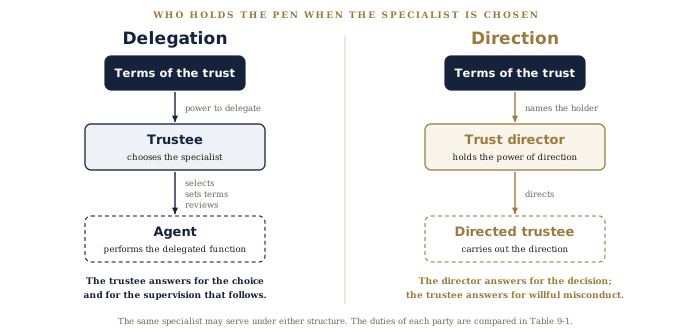
Why the line matters. Four consequences follow from the classification. (a) Standard of liability. A trustee that delegates must exercise reasonable care, skill and caution in selecting the agent, in setting the terms of the delegation and in reviewing the agent's performance. Unif. Prudent Investor Act § 9(a) (1994); Unif. Trust Code § 807(a) (2000, amended 2010). A directed trustee must take reasonable action to comply with a direction and is liable only if compliance would be willful misconduct. Unif. Directed Trust Act § 9(a)–(b) (2017). The difference between ordinary care and willful misconduct is the difference between the claims a beneficiary can bring and the claims it cannot. (b) Duty to monitor. The delegating trustee must monitor. The directed trustee, unless the terms of the trust say otherwise, has no duty to monitor the director. Unif. Directed Trust Act § 11(a)(1). (c) Duty of the specialist. An agent owes the trust a duty to exercise reasonable care to comply with the terms of the delegation. Unif. Prudent Investor Act § 9(b). A trust director has the fiduciary duty and liability of a trustee in a like position. Unif. Directed Trust Act § 8(a)(1). (d) Allocation of cost and control. A trustee that delegates decides whether to continue the arrangement and must weigh its cost against its benefit. A trustee that is directed has no say in whether the director continues; that question belongs to whoever holds the power to remove and appoint directors, a power the Directed Trust Act leaves to other law. Id. § 5(b)(2).
Terminology. The chapter uses "agent" and "delegate" for a person to whom a trustee has entrusted a function under the trustee's own power, and "trust director" for a person who holds a power of direction under the terms of the trust, whatever the instrument calls the person. See Unif. Directed Trust Act § 2(9) (a person is a trust director "whether or not the terms of the trust refer to the person as a trust director"). "Adviser" and "protector" appear where a statute attaches consequences to those labels, as the Delaware statute does. Del. Code Ann. tit. 12, § 3313(a), (f). An "excluded cotrustee" or "excluded fiduciary" is a trustee from which the terms of the trust have withdrawn a power and given it to another person. See supra ch. 7 (state statutes).
Relation to other chapters. Chapters 6 and 7 examine the directed-trust statutes in detail, chapter 8 the advisers that commonly hold powers of direction, and chapter 10 the case law on the liability of directed trustees and directors. Chapter 5 states the mandatory rules that limit both structures. This chapter assumes that material and concentrates on the boundary between the two regimes and on the choices it presents to the drafter and the trustee.